
 Afrika
 Asia
Asia Europa
 Hego Amerika
 Australia eta Ozeania
 Antartika
 Ozeano Barea
 Ozeano Atlantikoa
 Ozeano Indikoa
 Ozeano Artikoa
 Mediterraneo itsasoa
 Itsaso Gorria
 Karibe itsasoa
 Koralen itsasoa
 Hego Txinako itsasoa
 Filipinetako itsasoa
 Andaman itsasoa
 Ipar itsasoa
 Timor eta Arafura itsasoak
 Bengalako golkoa
 Kaliforniako golkoa
Golfodulcean poison frog
 Pozoia azalean
The Golfodulcean poison frog is a small, brightly marked frog that lives only in Costa Rica. Its skin contains a strong nerve poison, so it is one of the most toxic frogs in its genus, and it is a reminder that bright colours can be a warning. It lives in wet forests near streams.1

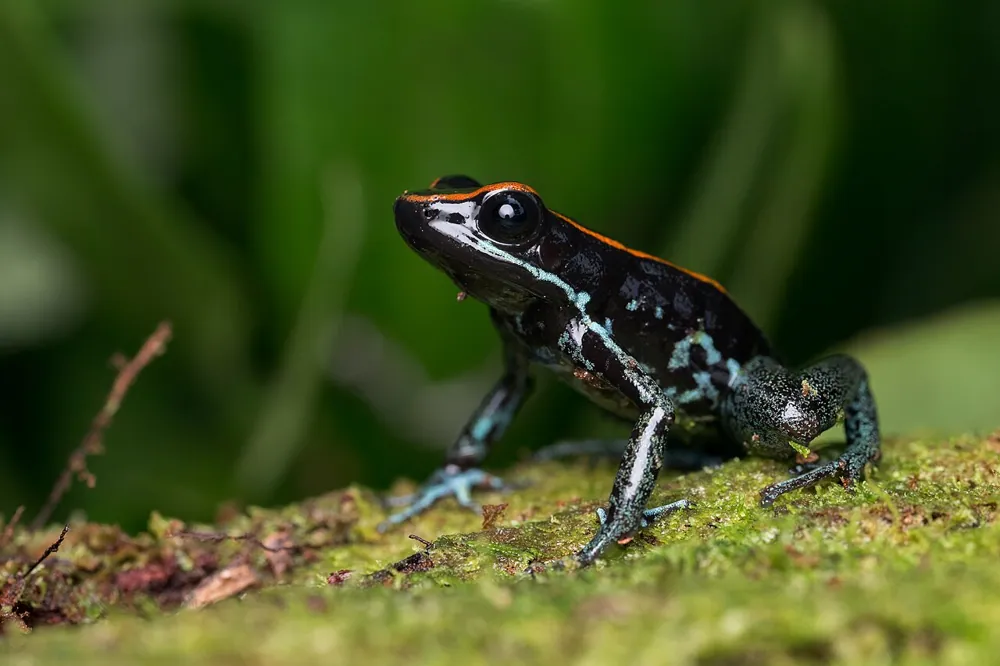
 Nola ezagutu
- The body is black, but it can look glittery because of pigments in the skin.1
- Two stripes run down the back from just above the vent to the tip of the nose. They are usually fire orange, but can be golden, yellow or green.1
- The legs are mottled blue, and the sides often have a blue or green marble pattern.1
- It is a fairly large poison frog for its genus, with a smooth, sloping back. Its shoulder blades are usually hidden under the skin, so it can look a little plump.1
- Females are typically larger than males. Adults reach about 3.5 cm long.1
Askotan honekin nahasten da: The related P. bicolor and P. terribilis have visible shoulder blades under the skin, which the Golfodulcean poison frog usually lacks, so it looks smoother and rounder.1
Pozoi-indarra
Bere azala toxikoa da. Arriskutsua da ukitzea, miazkatzea edo jatea.
Zer egiten du bere toxinak?
Its skin contains batrachotoxin, a neurotoxic alkaloid poison, which attacks the nerves. A large enough dose causes severe pain, then tonic-clonic seizures (violent convulsions) and paralysis.1
Zein arriskutsua da pertsonentzat?
Arriskua pertsonentzat: MingarriaBenetan min handia eman dezake, baina ia inoiz ez da larria.It is highly toxic, though it is only the fourth most toxic species in the genus Phyllobates. The poison is in the skin, so the risk comes from handling the frog or getting the poison from its skin into the body.1
Zer egiten du beldurtzen denean?
Its bright, multi-coloured body advertises its toxin as a warning to predators.1
 Norbaitek ukitu edo jan badu
- Norbaitek bat ukitu badu: garbitu eskuak ondo eta ez ukitu begiak edo ahoa. Haur edo maskota batek bat miazkatu edo jan badu: deitu zure intoxikazio-zentrora edo larrialdi-zenbakira.
Deitu beti lehenik zure larrialdi-zenbakira (112, 000, 911). Lehen sorospenei buruzko orientabide orokorra da hau, ez mediku-aholkua. Lehen sorospenen oinarriak
 Egon seguru
- Ez ukitu, ez harrapatu eta ez zirikatu inoiz animalia basati bat, txikia izan arren, eta lo edo hilda dagoela badirudi ere.
- Utzi tartea. Bat aurkitzen baduzu, egon lasai, egin atzera poliki eta utzi bere bidetik joaten.
- Ukitu edo jan baduzu: ez igurtzi begiak edo ahoa, garbitu eskuak eta lortu mediku-laguntza.
Ez dabil zure atzetik. Pozoia ezerk jan ez dezan baino ez du. Seguru egoteari buruz gehiago
Munduko zein tokitan?
Zein handia da?
Zein luzea da?
 klip bat bezain luzea, gutxi gorabehera
 100 metro 100 segundotan egin litzake (gizakirik azkarrenak 9,6 behar ditu)
Zein handia da Golfodulcean poison frog ZUREKIN alderatuta?
Matematika hutsa zure nabigatzailean. Ez da ezer gordetzen, ezta inora bidaltzen ere.
Zein azkarra da?


Datuak
It is one of the few frogs whose poison is named batrachotoxin, a potent nerve toxin.1
Its climbing toe pads stick to leaves in a similar way to geckos, and it can climb out of an unsealed container.1
Male frogs carry their tadpoles on their backs, often for 1 to 2 days, to puddles, pools in palm leaves, or water-filled tree holes.1
Frogs in captivity have no toxin, which shows that their poison comes from what they eat.1
Its skin holds a large amount of poison, because it is comparatively large for a poison dart frog.1
The tadpoles become frogs after about 45 days, and the young frogs become sexually mature after ten months.1
Pozoi-adituentzat
- Izen zientifikoa
- Phyllobates vittatus
- Taldea
- Igel toxikoak, apoak eta uhandreak
- Familia
- Dendrobatidae2
- Ordena
- Anura
- Kontinenteak
- Ipar Amerika
- Kumeak
- During the breeding season, the female lays 7 to 21 eggs per clutch on leaves, about every one or two weeks, and the male guards the eggs and carries the hatched tadpoles on his back to water.1
- Arriskua pertsonentzat
- 2 / 5: Mingarria3
Datuak nondik datozen
- Golfodulcean poison frog (Wikipedia (CC BY-SA 4.0))
- Phyllobates vittatus (iNaturalist): izenak eta sailkapena.
- Venom Wiki: arrisku-maila, ohiko tamaina eta abiadura-kalkulua geureak dira. Ikusi nola kalkulatzen ditugun: Nola baloratzen dugun arriskua.
Orrialde honetako datu bakoitzak zenbaki bat du, bere iturrira eramaten zaituena. Zerbait gaizki badugu, barkatu, animalien zaleak gara, ez zientzia-aldizkari bat. Esaiguzu [email protected] helbidean eta konponduko dugu.
 Eskorpioia gose da! Venom Wiki pertsona bakar baten proiektua da: doakoa, iragarkirik eta jarraitzailerik gabe. Eskupeko txiki batek sarean mantentzen laguntzen du.Elikatu eskorpioia
Talde bereko gehiago: Igel toxikoak, apoak eta uhandreak
 Cane toadIgel toxikoak, apoak eta uhandreakMedikua behar duEz ukitu
 Strawberry poison-dart frogIgel toxikoak, apoak eta uhandreakMin ematen du, besterik ezEz ukitu
 California newtIgel toxikoak, apoak eta uhandreakHil dezakeEz ukitu
 Rough-skinned newtIgel toxikoak, apoak eta uhandreakHil dezakeEz ukitu
 Colorado River toadIgel toxikoak, apoak eta uhandreakMedikua behar duEz ukitu
 Panamanian golden frogIgel toxikoak, apoak eta uhandreakMedikua behar duEz ukitu
 Terciopelo
 Eastern coral snake
 Eastern diamondback rattlesnake
 Eyelash viper
 Timber rattlesnake
 Western diamondback rattlesnake