
 Afirik
 Aazi
Aazi Orop
Orop Amerik Sud
 Ostarali e Oseyani
 Antarktik
 Geeci Pasifik
 Geeci Atlantik
 Geeci Enndo
 Geeci Arktik
 Geeci Mediteraane
 Geeci Boɗeewi
 Geeci Karayib
 Geeci Korayl
 Geeci Siin Sud
 Geeci Filipiin
 Geeci Andaman
 Geeci Nord
 Geeci Timor e Arafura
 Gulf Bengal
 Gulf Kaliforni
Banded krait
 Ŋatgol
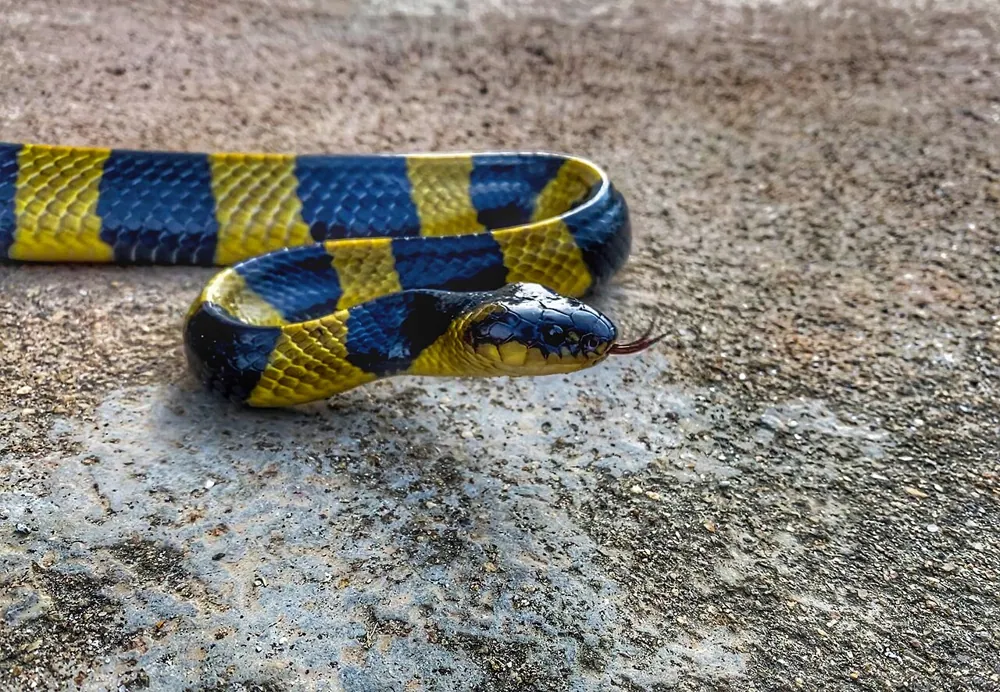
The banded krait is a venomous snake with black and yellow bands around its body. It lives across much of Asia, from India through Southeast Asia to southern China. It matters because its venom is strongly neurotoxic, which means it attacks the nerves, and it can be lethal to people.1



 Hono anndirtee ngal
Doole tooke ŋatgol
Tooke no yaltira ñiiƴe mum tuma ngal ŋatata.
Ko honɗun tooke mum waɗata (ŋatgol walla jukkugol)?
The venom mainly contains neurotoxins, which attack the nerves. The major effects include vomiting, abdominal pain, diarrhoea and dizziness. Severe envenomation can cause respiratory failure, and death may occur through suffocation. The venom can also damage the kidneys if injected.1
Hono musiiba mum heewiri e yimɓe?
Musiiba e yimɓe: Musiiba sanneNo waawi warugol neɗɗo mo safraaka.A clinical toxicology study gives an untreated mortality rate of 1 to 10 per cent. Contact with humans is rare, and defensive bites are thought to result in very low envenomation. At night the snake is more active and is widely considered more dangerous.1
 Kabaaru moƴƴo: doktoroɓe no njogii lekki (sérum antivenimeux) walla safaara ngam ɗum.1
Ko honɗun ngal waɗata si ngal hulii?
When harassed, it usually hides its head under its coils and does not generally attempt to bite.1
 Si no ŋata
- Polyvalent antivenoms are available in India and Indonesia.1
- Haɗu neɗɗo on dillagol, deeƴnu mo, ittu baagiiji e ko tiiɗi fow, yahra mo lopitaan law: sérum antivenimeux ko safaara.
Adii fow noddu nimero ballal (112, 000, 911). Ɗum ko anndinal ballal adiingal, wanaa saaraangal doktoro. Ko adii nder ballal adiingal
 Reen hoore maa
- Wota a meem, wota a nanngu, wota a jalnu kullal ladde haa abada, hay si ko tokooso, hay si no yi'ee no ɗaanii walla maayii.
- Accu ngal nokku. Si a fotti e ngal, deeƴu, ruttu ɓaawo seeɗa seeɗa, accu ngal yaha laawol mum.
- Si gooto e majji ŋatii ma: deeƴu, wota a dillu, noddu nimero ballal (112, 000, 911) walla yahu lopitaan law. Jogo e hakkille no ngal nanndi, natal no walla.
Ngal faalaaka gaañugol ma. Ngal no huutora tooke mum ngam nanngugol ñaamdu walla reenugol hoore mum, ngal ɓuri yiɗugol suuɗaade. Ko ɓeydi fii reenugol hoore maa
Hoto nder aduna?
Hono mawniri?
Hono juutiri?
 juuti no ulluuɗi suudu 4, hinere haa lawol
 juuti no banaanaaji 12 jokkondirɗi
 no waawi taccugol meeteruuji 100 nder segonde 46 (neɗɗo ɓurɗo yaawugol sokli 9,6)
Hono Banded krait mawniri, si fooɗondiraama e AN?
Ko limoore tun nder navigateur maa. Alaa ko danndetee walla ko neldetee ka nokku woo.
Hono yaawiri?


Humpito
The banded krait's venom yield is the highest of any krait because of its size, even though its toxicity is lower than that of many other kraits.1
It is the longest krait with a distinguishable gold and black pattern.1
It is generally considered timid and docile, and it is shy and rarely seen.1
Banded kraits are mainly nocturnal, and during the day they lie up in grass, pits or drains.1
It is believed to become adult in its third year, at a length of about 914 mm.1
Ngam ganduɓe tooke
Ɗo humpitooji ɗin iwri
- Banded krait (Wikipedia (CC BY-SA 4.0))
- Bungarus fasciatus (iNaturalist): inɗe e ŋoordingol (classification).
- Venom Wiki: tolno musiiba, mawnugol aadaajo e miijo yaawugol ko amen. Ndaar no min ƴeewtirta ɗum: Hono min tolnirta musiiba.
Kala humpito nder ngoo hello no jogii limoore hollirnde iwdi mum. Si min juumii, yaafo, min ko yiɗɓe kulle, wanaa jaaynde ganndal. Haalan min e [email protected], min feewnitan.
 Yaare nden no weelaa! Venom Wiki ko golle neɗɗo gooto: ko yoɓetaake, alaa piiblisite, alaa reweteeɓe. Kopporde tokooso no walla heddingol ɗum e enternet.Ñaamnu yaare nden
 Indian cobra
 King cobra
 Caspian cobra
 Common krait
 Malayan krait
 Many-banded krait
 Deathstalker
 Indian saw-scaled viper
 Puff adder
 Bowngal Russell
 Asian giant hornet
 Komodo dragon