
 Afirik
 Aazi
Aazi Orop
Orop Amerik Sud
 Ostarali e Oseyani
 Antarktik
 Geeci Pasifik
 Geeci Atlantik
 Geeci Enndo
 Geeci Arktik
 Geeci Mediteraane
 Geeci Boɗeewi
 Geeci Karayib
 Geeci Korayl
 Geeci Siin Sud
 Geeci Filipiin
 Geeci Andaman
 Geeci Nord
 Geeci Timor e Arafura
 Gulf Bengal
 Gulf Kaliforni
Many-banded krait
 Ŋatgol
The many-banded krait is an extremely venomous snake found in central and southern China and much of Southeast Asia. It is black or bluish-black with many white bands across its body. It matters because its bite can be fatal, and it is one of the most venomous land snakes in the world.1



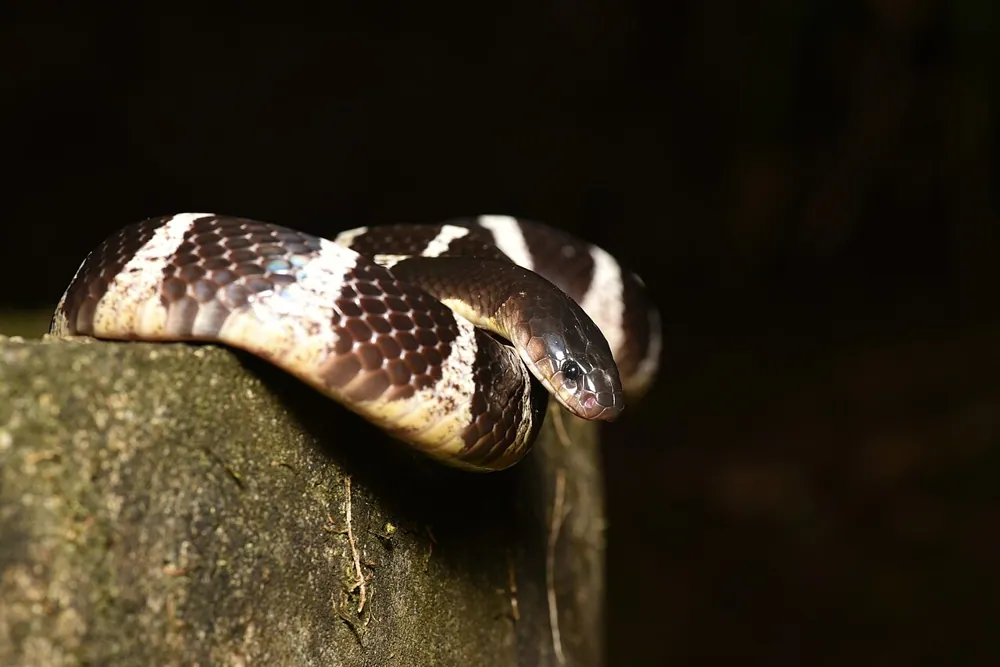
 Hono anndirtee ngal
- The body is black to dark bluish-black.1
- It has about 21 to 30 white or creamy white cross bands along its upper body.1
- The short, pointed tail is black with 7 to 11 white cross bands.1
- The head is mostly black, broad and oval, and slightly flat.1
- Young snakes often have whitish blotches on the underside of the head.1
No jiibondiree e: The Malayan krait (Bungarus candidus) is easily confused with this species. A 2017 genetic study found that many museum specimens labelled as many-banded kraits in China were actually Malayan kraits.1
Doole tooke ŋatgol
Tooke no yaltira ñiiƴe mum tuma ngal ŋatata.
Ko honɗun tooke mum waɗata (ŋatgol walla jukkugol)?
Its venom contains neurotoxins, which attack the nerves and the connections between nerves and muscles. Local effects are usually mild, with slight itching and numbness rather than serious swelling or pain. Symptoms usually start one to six hours after a bite and can include drooping eyelids, double vision, weakness, tongue paralysis, loss of voice and difficulty breathing.1
Hono musiiba mum heewiri e yimɓe?
Musiiba e yimɓe: WaroowoGooto e kulle ɓurɗe musiiba nder aduna.Estimated death rates from untreated bites vary between studies, from 25–35% to 70–100%. In a serious bite, breathing can stop and lead to death. In 2001, a juvenile bit the herpetologist Joe Slowinski in Myanmar and he died 29 hours later.1
Ko honɗun ngal waɗata si ngal hulii?
It is generally timid and placid, but it is more defensive at night and thrashes about when handled.1
 Si no ŋata
- Haɗu neɗɗo on dillagol, deeƴnu mo, ittu baagiiji e ko tiiɗi fow, yahra mo lopitaan law: sérum antivenimeux ko safaara.
Adii fow noddu nimero ballal (112, 000, 911). Ɗum ko anndinal ballal adiingal, wanaa saaraangal doktoro. Ko adii nder ballal adiingal
 Reen hoore maa
- Wota a meem, wota a nanngu, wota a jalnu kullal ladde haa abada, hay si ko tokooso, hay si no yi'ee no ɗaanii walla maayii.
- Accu ngal nokku. Si a fotti e ngal, deeƴu, ruttu ɓaawo seeɗa seeɗa, accu ngal yaha laawol mum.
- Si gooto e majji ŋatii ma: deeƴu, wota a dillu, noddu nimero ballal (112, 000, 911) walla yahu lopitaan law. Jogo e hakkille no ngal nanndi, natal no walla.
Ngal faalaaka gaañugol ma. Ngal no huutora tooke mum ngam nanngugol ñaamdu walla reenugol hoore mum, ngal ɓuri yiɗugol suuɗaade. Ko ɓeydi fii reenugol hoore maa
Hoto nder aduna?
Hono mawniri?
Hono juutiri?
 juuti no ulluuɗi suudu 4, hinere haa lawol
 juuti no banaanaaji 10 jokkondirɗi
 no waawi taccugol meeteruuji 100 nder segonde 49 (neɗɗo ɓurɗo yaawugol sokli 9,6)
Hono Many-banded krait mawniri, si fooɗondiraama e AN?
Ko limoore tun nder navigateur maa. Alaa ko danndetee walla ko neldetee ka nokku woo.
Hono yaawiri?


Humpito
Its venom is among the most potent of any land snake, based on lab tests on mice dating back to 1943.1
In 2001, a juvenile bite in Myanmar killed Joe Slowinski, which drew worldwide attention to the species.1
The snake that bit Slowinski was first thought to be this species, but it was later classified as a different species.1
It is active from April and retreats into hibernation in November.1
Bonnoowo fenaandeeji
Fenaande: American soldiers in the Vietnam War called it the "two-step snake", believing its venom could kill a person within two steps.
Goonga: Its symptoms usually start one to six hours after a bite, and death can take much longer. The two-step belief is wrong, and a bite still needs urgent medical care.1
Ngam ganduɓe tooke
- Innde ganndal
- Bungarus multicinctus
- Fedde
- Kobra, mamba e kraits
- Ɓesngu
- Elapidae2
- Ordre
- Squamata
- Leyɗe mawɗe
- Aazi
- Ɓiɓɓe tokosɓe
- It lays eggs. Females usually lay 3 to 15 eggs, and up to 20 are possible. The eggs hatch about six weeks later, and the young are about 25 cm long.1
- Duuɓi nguurndam
- wona duuɓi 13,71
- Musiiba e yimɓe
- 5 / 5: Waroowo3
Ɗo humpitooji ɗin iwri
- Many-banded krait (Wikipedia (CC BY-SA 4.0))
- Bungarus multicinctus (iNaturalist): inɗe e ŋoordingol (classification).
- Venom Wiki: tolno musiiba, mawnugol aadaajo e miijo yaawugol ko amen. Ndaar no min ƴeewtirta ɗum: Hono min tolnirta musiiba.
Kala humpito nder ngoo hello no jogii limoore hollirnde iwdi mum. Si min juumii, yaafo, min ko yiɗɓe kulle, wanaa jaaynde ganndal. Haalan min e [email protected], min feewnitan.
 Yaare nden no weelaa! Venom Wiki ko golle neɗɗo gooto: ko yoɓetaake, alaa piiblisite, alaa reweteeɓe. Kopporde tokooso no walla heddingol ɗum e enternet.Ñaamnu yaare nden
 Kobra Enndo
 Kobra laamɗo
 Caspian cobra
 Common krait
 Malayan krait
 Monocled cobra
 Yaare oolnde maayde
 Wipeeri cerkeeje siy Enndo
 Wipeeri fuufoowndi
 Bowngal Russell
 Asian giant hornet
 Komodo dragon