
 Afirik
 Aazi
Aazi Orop
Orop Amerik Sud
 Ostarali e Oseyani
 Antarktik
 Geeci Pasifik
 Geeci Atlantik
 Geeci Enndo
 Geeci Arktik
 Geeci Mediteraane
 Geeci Boɗeewi
 Geeci Karayib
 Geeci Korayl
 Geeci Siin Sud
 Geeci Filipiin
 Geeci Andaman
 Geeci Nord
 Geeci Timor e Arafura
 Gulf Bengal
 Gulf Kaliforni
Giant green anemone
 Tiimbe jukkooje
The giant green anemone is a sea animal that looks like a flower but is a relative of jellyfish. It lives on rocky and sandy shores along the Pacific coast of North America, where it is covered by water for most of the day. Its bright green colour comes partly from tiny algae that live inside its body and make food for it.1



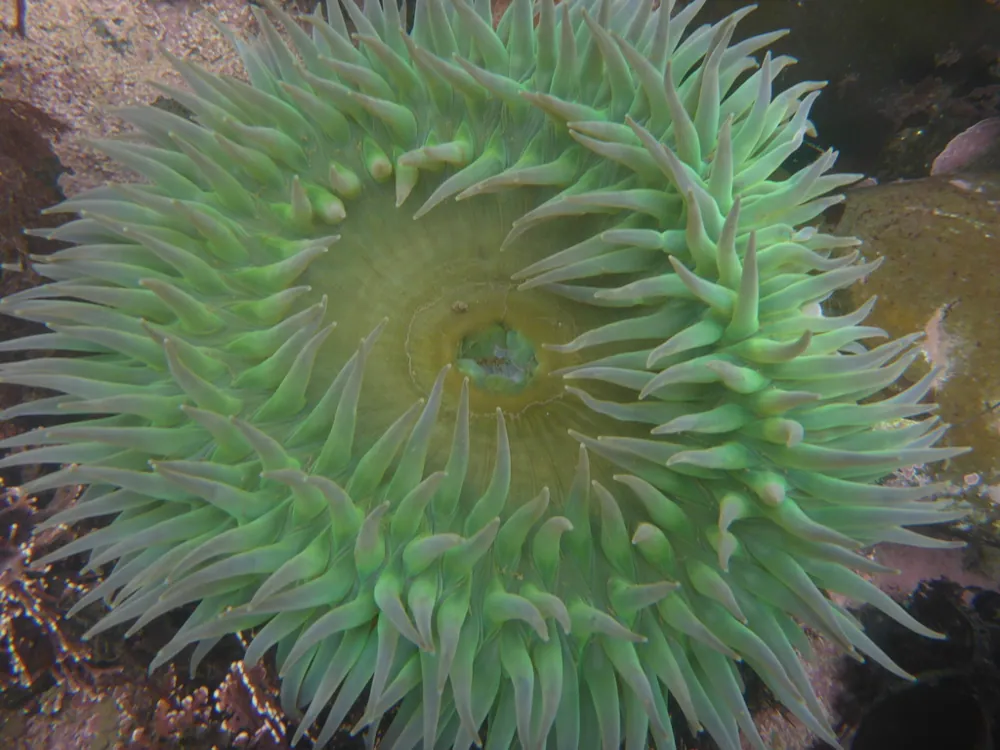
 Hono anndirtee ngal
- Bright green when underwater in good sunlight.1
- Dark green or brown when out of the water, because it closes up and droops, showing its darker outer body.1
- Broad, flat top surface (oral disk) with no stripes, bands or other markings.1
- Short, cone-shaped tentacles arranged in six or more rows around the mouth, with pointed or blunt tips.1
No jiibondiree e: Large giant green anemones can be confused with A. elegantissima or A. sola. Those two usually have pink-tipped tentacles and a striped oral disk, which the giant green anemone does not have.1
Doole tooke ŋatgol
Ceeli jukkooji tokosɗi ujunaaje no tuha tuma huunde meemi ɗi.
Ko honɗun tooke mum waɗata (ŋatgol walla jukkugol)?
Stinging cells called nematocysts in the tentacles release a paralysing venom that helps the anemone catch prey.1
Hono musiiba mum heewiri e yimɓe?
Musiiba e yimɓe: SeeɗaNo jukkugol ñaaki walla ko ɓuri famɗugol. Ko ɓadii alaa musiiba e yimɓe.Ko honɗun ngal waɗata si ngal hulii?
It uses its stinging cells in the tentacles to defend itself against predators.1
 Si no jukka
- Yaltin neɗɗo on e ndiyam, ittu kala tiimbe meduusi (e gaŋteeji walla taƴre conci).
- Ngam meduusi kaaɗe tulnde: wuju winegara e nokkuuje jukkaaɗe, ko famɗi fow segonde 30, noddu ballal, hebulo waɗugol réanimation (RCP). Ngam bluebottles e ko heewi e goɗɗe: loot e ndiyam geeci, refti ndiyam guleeɗam ngam muusu.
Adii fow noddu nimero ballal (112, 000, 911). Ɗum ko anndinal ballal adiingal, wanaa saaraangal doktoro. Ko adii nder ballal adiingal
 Reen hoore maa
- Wota a meem, wota a nanngu, wota a jalnu kullal ladde haa abada, hay si ko tokooso, hay si no yi'ee no ɗaanii walla maayii.
- Accu ngal nokku. Si a fotti e ngal, deeƴu, ruttu ɓaawo seeɗa seeɗa, accu ngal yaha laawol mum.
- Si gooto e majji jukkii ma: deeƴu, wota a dillu, noddu nimero ballal (112, 000, 911) walla yahu lopitaan law. Jogo e hakkille no ngal nanndi, natal no walla.
Ngal faalaaka gaañugol ma. Ngal no huutora tooke mum ngam nanngugol ñaamdu walla reenugol hoore mum, ngal ɓuri yiɗugol suuɗaade. Ko ɓeydi fii reenugol hoore maa
Hono mawniri?
Hono juutiri?
 juuti no kaaɗe mahirɗe 9 e diisa gooto
 ɓuri kokiyaasi ngesa leelugol
Hono Giant green anemone mawniri, si fooɗondiraama e AN?
Ko limoore tun nder navigateur maa. Alaa ko danndetee walla ko neldetee ka nokku woo.
Hono yaawiri?

Humpito
Tiny algae living inside its body help feed it through photosynthesis and add to its bright green colour.1
It can have a crown of tentacles up to 25 cm across.1
Anemones in caves and shady places have few or no algae and are usually less colourful.1
Its main predators include a leather seastar, two nudibranchs and several snails and sea spiders.1
Ngam ganduɓe tooke
- Innde ganndal
- Anthopleura xanthogrammica
- Fedde
- Meduusiiji e kulle geeci jukkooje
- Ɓesngu
- Actiniidae2
- Ordre
- Actiniaria
- Leyɗe mawɗe
- Geeci Pasifik, Oseyanuuji
- Ɓiɓɓe tokosɓe
- Sperm and eggs are released into the water in late autumn and join outside the body. The young larvae float in the water until they settle in mussel beds.1
- Musiiba e yimɓe
- 1 / 5: Seeɗa3
Ɗo humpitooji ɗin iwri
- Anthopleura xanthogrammica (Wikipedia (CC BY-SA 4.0))
- Anthopleura xanthogrammica (iNaturalist): inɗe e ŋoordingol (classification).
- Venom Wiki: tolno musiiba, mawnugol aadaajo e miijo yaawugol ko amen. Ndaar no min ƴeewtirta ɗum: Hono min tolnirta musiiba.
Kala humpito nder ngoo hello no jogii limoore hollirnde iwdi mum. Si min juumii, yaafo, min ko yiɗɓe kulle, wanaa jaaynde ganndal. Haalan min e [email protected], min feewnitan.
 Yaare nden no weelaa! Venom Wiki ko golle neɗɗo gooto: ko yoɓetaake, alaa piiblisite, alaa reweteeɓe. Kopporde tokooso no walla heddingol ɗum e enternet.Ñaamnu yaare nden
Ko ɓeydi e fedde wootere: Meduusiiji e kulle geeci jukkooje
 Meduusi kaaɗe OstaraliMeduusiiji e kulle geeci jukkoojeWaroowoWota a meem
 Irukandji jellyfishMeduusiiji e kulle geeci jukkoojeNo waawi warugolWota a meem
 Portuguese man o' warMeduusiiji e kulle geeci jukkoojeNo sokli doktoroWota a meem
 Lion's mane jellyfishMeduusiiji e kulle geeci jukkoojeNo muusi tunWota a meem
 Moon jellyfishMeduusiiji e kulle geeci jukkoojeAlaa musiiba
 Common kingslayerMeduusiiji e kulle geeci jukkoojeNo waawi warugolWota a meem
No hoɗi kadi nder: Geeci Pasifik
 Kokiyaasi kone jeografiKokiyaasi kone e pulpuujiWaroowo
 Pulpu mawɗo koode bulaajeKokiyaasi kone e pulpuujiWaroowo
 Liingu ufotoongu SapoŋKulle goɗɗe tookeeje ɓannduWaroowo
 Pulpu koode bulaaje sudKokiyaasi kone e pulpuujiWaroowo
 Hawksbill sea turtleKulle goɗɗe tookeeje ɓannduNo waawi warugol
 Reef stonefishLiƴƴi tookeNo waawi warugolWota a meem