
 Afirik
 Aazi
Aazi Orop
Orop Amerik Sud
 Ostarali e Oseyani
 Antarktik
 Geeci Pasifik
 Geeci Atlantik
 Geeci Enndo
 Geeci Arktik
 Geeci Mediteraane
 Geeci Boɗeewi
 Geeci Karayib
 Geeci Korayl
 Geeci Siin Sud
 Geeci Filipiin
 Geeci Andaman
 Geeci Nord
 Geeci Timor e Arafura
 Gulf Bengal
 Gulf Kaliforni
Long-spine porcupinefish
 Tooke si ñaamaamaNo ñaama: Seeɗa nder kala huundeTookeejo ɓanndu, wanaa naatnoowo tooke
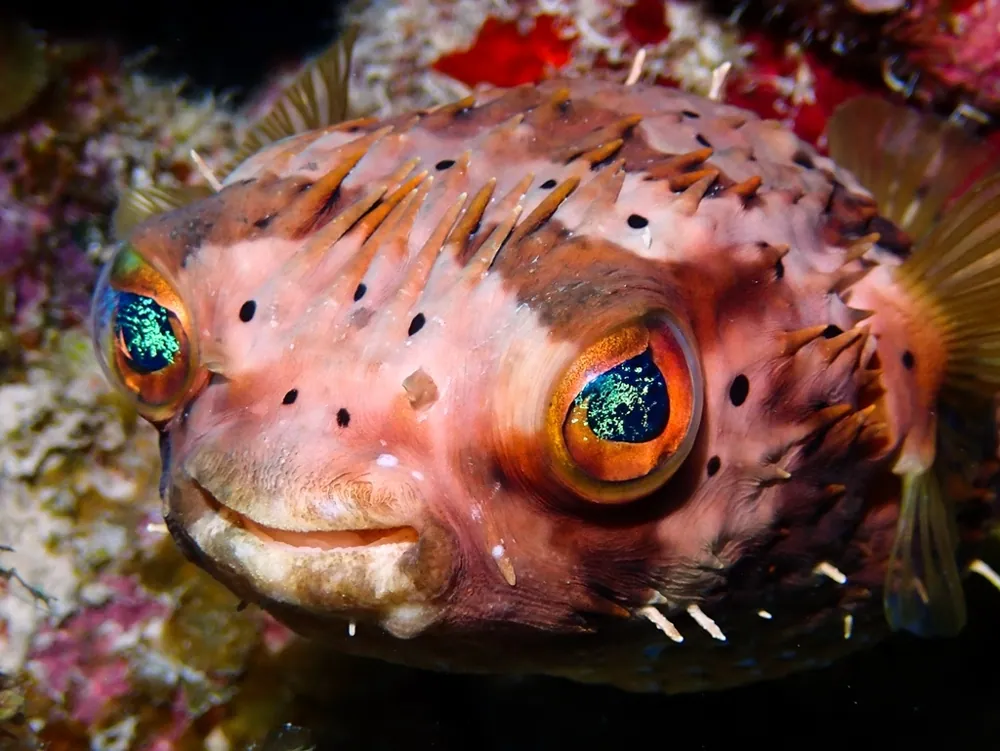
The long-spine porcupinefish is a marine fish covered in long, sharp spines. It lives in warm tropical and subtropical seas around the world, often over muddy seabeds or on reefs. Its beak-like jaws can crush hard prey such as sea urchins and shellfish.1



 Hono anndirtee ngal
- Pale in colour, with large black blotches and smaller black spots. The spots become fewer as the fish gets older.1
- Many long spines, each with two roots, which can be raised or lowered. They are especially numerous on the head.1
- The teeth of the two jaws are fused into a parrot-like beak.1
- Adults can reach 50 cm in length.1
No jiibondiree e: The black-blotched porcupinefish (Diodon liturosus) is the only other fish it might be confused with. The long-spine porcupinefish has much longer spines.1
Doole tooke
Ngal bonataa si wanaa huunde ñaamii ngal.
Hono musiiba mum heewiri e yimɓe?
Musiiba e yimɓe: Musiiba mawɗoSi neɗɗo ñaamii ngal, yahu ka doktoro. Maayde no famɗi sanne. Si neɗɗo meemii walla ñaamii ngal
- Si neɗɗo ñaamii ngal walla no jogii maandeeji caggal ñaamugol ngal: noddu nimero ballal walla centre antipoison jooni jooni.
Adii fow noddu nimero ballal (112, 000, 911). Ɗum ko anndinal ballal adiingal, wanaa saaraangal doktoro. Ko adii nder ballal adiingal
 Reen hoore maa
- Wota a meem, wota a nanngu, wota a jalnu kullal ladde haa abada, hay si ko tokooso, hay si no yi'ee no ɗaanii walla maayii.
- Accu ngal nokku. Si a fotti e ngal, deeƴu, ruttu ɓaawo seeɗa seeɗa, accu ngal yaha laawol mum.
- Si a meemii walla a ñaamii ngal: wota a moomtu gite maa walla hunuko maa, loot juuɗe maa, heɓu ballal doktoro.
Ngal faalaaka gaañugol ma. Tooke mum woodi tun ngam wota huunde ñaam ngal. Ko ɓeydi fii reenugol hoore maa
Hoto nder aduna?
Hono mawniri?
Hono juutiri?
 juuti no banaanaaji 3 jokkondirɗi
 juuti no kaaɗe mahirɗe 16 e diisa gooto
 no waawi yoowugol juutde pisin mawɗo (50 m) nder segonde 45
Hono Long-spine porcupinefish mawniri, si fooɗondiraama e AN?
Ko limoore tun nder navigateur maa. Alaa ko danndetee walla ko neldetee ka nokku woo.
Hono yaawiri?
Humpito
Its jaws are fused into a beak that looks like a parrot's, and it uses it to crack open sea urchins and molluscs.1
Its spines have two roots and can be raised or lowered.1
The black spots on its pale body become fewer as it ages.1
Young fish are found in groups, and they stay in open water until they reach about 7 cm.1
Ngam ganduɓe tooke
- Innde ganndal
- Diodon holocanthus
- Fedde
- Kulle goɗɗe tookeeje ɓanndu
- Ɓesngu
- Diodontidae2
- Ordre
- Tetraodontiformes
- Leyɗe mawɗe
- Geeci Pasifik, Geeci Atlantik, Geeci Enndo, Geeci Boɗeewi, Geeci Karayib, Geeci Korayl, Geeci Filipiin, Geeci Siin Sud, Gulf Meksik, Geeci Timor e Arafura, Gulf Bengal, Gulf Kaliforni, Oseyanuuji
- Ɓiɓɓe tokosɓe
- It spawns at the surface at dawn or dusk, in pairs or in groups of males with one female. The young stay pelagic (living in open water) until they are at least 7 cm long.1
- Musiiba e yimɓe
- 3 / 5: Musiiba mawɗo3
Ɗo humpitooji ɗin iwri
- Long-spine porcupinefish (Wikipedia (CC BY-SA 4.0))
- Diodon holocanthus (iNaturalist): inɗe e ŋoordingol (classification).
- Venom Wiki: tolno musiiba, mawnugol aadaajo e miijo yaawugol ko amen. Ndaar no min ƴeewtirta ɗum: Hono min tolnirta musiiba.
Kala humpito nder ngoo hello no jogii limoore hollirnde iwdi mum. Si min juumii, yaafo, min ko yiɗɓe kulle, wanaa jaaynde ganndal. Haalan min e [email protected], min feewnitan.
 Yaare nden no weelaa! Venom Wiki ko golle neɗɗo gooto: ko yoɓetaake, alaa piiblisite, alaa reweteeɓe. Kopporde tokooso no walla heddingol ɗum e enternet.Ñaamnu yaare nden
Ko ɓeydi e fedde wootere: Kulle goɗɗe tookeeje ɓanndu
 Liingu ufotoongu SapoŋKulle goɗɗe tookeeje ɓannduWaroowo
 Hawksbill sea turtleKulle goɗɗe tookeeje ɓannduNo waawi warugol
 Greenland sharkKulle goɗɗe tookeeje ɓannduNo muusi tun
 Silver-cheeked toadfishKulle goɗɗe tookeeje ɓannduWaroowo
 Blackspotted pufferKulle goɗɗe tookeeje ɓannduNo waawi warugol
 White-spotted pufferKulle goɗɗe tookeeje ɓannduNo waawi warugol
No hoɗi kadi nder: Geeci Pasifik
 Meduusi kaaɗe OstaraliMeduusiiji e kulle geeci jukkoojeWaroowoWota a meem
 Kokiyaasi kone jeografiKokiyaasi kone e pulpuujiWaroowo
 Pulpu mawɗo koode bulaajeKokiyaasi kone e pulpuujiWaroowo
 Pulpu koode bulaaje sudKokiyaasi kone e pulpuujiWaroowo
 Irukandji jellyfishMeduusiiji e kulle geeci jukkoojeNo waawi warugolWota a meem
 Reef stonefishLiƴƴi tookeNo waawi warugolWota a meem