
 Afirik
 Aazi
Aazi Orop
Orop Amerik Sud
 Ostarali e Oseyani
 Antarktik
 Geeci Pasifik
 Geeci Atlantik
 Geeci Enndo
 Geeci Arktik
 Geeci Mediteraane
 Geeci Boɗeewi
 Geeci Karayib
 Geeci Korayl
 Geeci Siin Sud
 Geeci Filipiin
 Geeci Andaman
 Geeci Nord
 Geeci Timor e Arafura
 Gulf Bengal
 Gulf Kaliforni
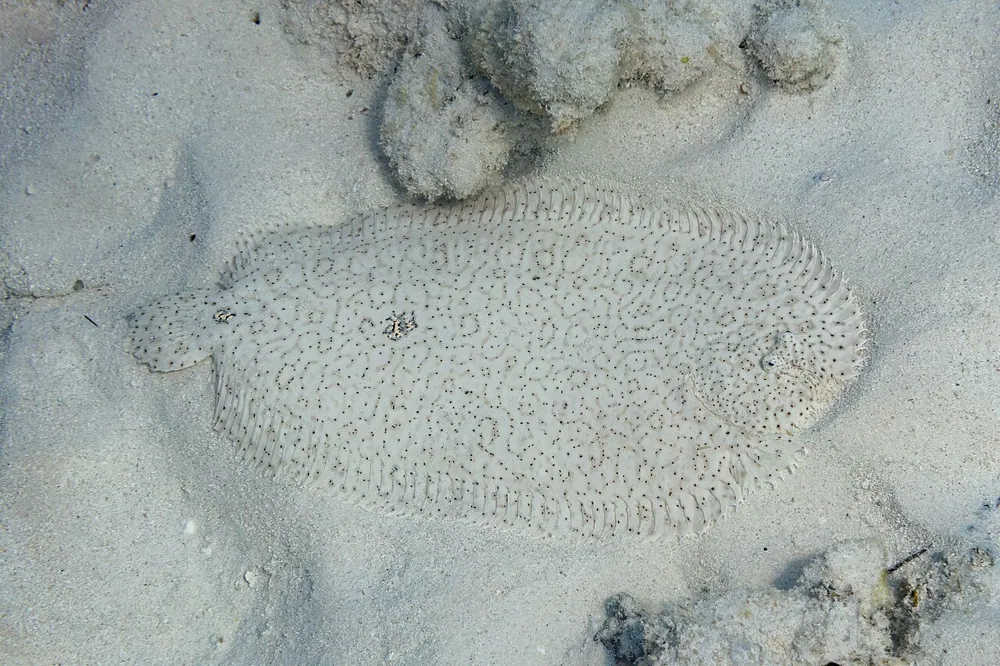
Moses sole
 Tooke nder nguru mumNo ñaama: TeewuTookeejo ɓanndu, wanaa naatnoowo tooke
The Moses sole is a flatfish that lives in shallow coastal waters of the western Indian Ocean, from the Red Sea to Sri Lanka and along the east coast of Africa. It hides on the seabed and gives off a milky toxin from its fins to deter predators, including sharks.1

 Hono anndirtee ngal
- Colour is variable, often whitish, pale brown or pale grey, with irregular dark brown ring-shaped markings1
- Many dark brown spots cover the head, body and fins1
- Normally two brown dots containing yellow flecks sit along the lateral line1
- Adults have a highly compressed, flat-sided body, with both eyes on the right side of the head1
- The rounded tail fin is not joined to the dorsal or cloacal fin1
No jiibondiree e: Mimic octopuses copy the finless sole by adapting their shape, colour and texture. They can also mimic venomous sea snakes and fish.1
Doole tooke
Nguru mum ko tooke. No musiiba meemugol ngal, meemugol ngal e ɗemngal walla ñaamugol ngal.
Ko honɗun tooke ɓanndu mum waɗata?
The finless sole releases a milky toxin called an ichthyotoxin from the base of its dorsal and cloacal fins. The main toxin, pardaxin, damages cell membranes so that cells leak their contents. It irritates the sensitive gills of predator fish.1
Hono musiiba mum heewiri e yimɓe?
Musiiba e yimɓe: SeeɗaNo jukkugol ñaaki walla ko ɓuri famɗugol. Ko ɓadii alaa musiiba e yimɓe.It is caught for food and sold fresh, even though its skin secretion is poisonous.1
Ko honɗun ngal waɗata si ngal hulii?
When threatened, it releases its toxic milky secretion from its fins, and its colour helps it blend in with sandy or pebbled seabeds.1
 Si neɗɗo meemii walla ñaamii ngal
- Si neɗɗo ñaamii ngal walla no jogii maandeeji caggal ñaamugol ngal: noddu nimero ballal walla centre antipoison jooni jooni.
Adii fow noddu nimero ballal (112, 000, 911). Ɗum ko anndinal ballal adiingal, wanaa saaraangal doktoro. Ko adii nder ballal adiingal
 Reen hoore maa
- Wota a meem, wota a nanngu, wota a jalnu kullal ladde haa abada, hay si ko tokooso, hay si no yi'ee no ɗaanii walla maayii.
- Accu ngal nokku. Si a fotti e ngal, deeƴu, ruttu ɓaawo seeɗa seeɗa, accu ngal yaha laawol mum.
- Si a meemii walla a ñaamii ngal: wota a moomtu gite maa walla hunuko maa, loot juuɗe maa, heɓu ballal doktoro.
Ngal faalaaka gaañugol ma. Tooke mum woodi tun ngam wota huunde ñaam ngal. Ko ɓeydi fii reenugol hoore maa
Hoto nder aduna?
Hono mawniri?
Hono juutiri?
 juuti no kaaɗe mahirɗe 6 e diisa gooto
Hono Moses sole mawniri, si fooɗondiraama e AN?
Ko limoore tun nder navigateur maa. Alaa ko danndetee walla ko neldetee ka nokku woo.
Hono yaawiri?


,_Zanz%C3%ADbar,_Tanzania,_2024-05-31,_DD_32.jpg)
Humpito
One of its toxins, pardaxin-1, is 5 to 10 times more toxic than pardaxin-2 and has unusual shark-repelling properties.1
Its toxin, pardaxin, is used by the fish as a defence against sharks.1
Mimic octopuses copy its shape, colour and texture, and can also copy venomous sea snakes and fish.1
Juveniles have one eye on each side of the head, but as they mature the left eye moves to the right side.1
Eugenie Clark carried out much of the early research on this species.1
Ɗo humpitooji ɗin iwri
- Pardachirus marmoratus (Wikipedia (CC BY-SA 4.0))
- Pardachirus marmoratus (iNaturalist): inɗe e ŋoordingol (classification).
- Venom Wiki: tolno musiiba, mawnugol aadaajo e miijo yaawugol ko amen. Ndaar no min ƴeewtirta ɗum: Hono min tolnirta musiiba.
Kala humpito nder ngoo hello no jogii limoore hollirnde iwdi mum. Si min juumii, yaafo, min ko yiɗɓe kulle, wanaa jaaynde ganndal. Haalan min e [email protected], min feewnitan.
 Yaare nden no weelaa! Venom Wiki ko golle neɗɗo gooto: ko yoɓetaake, alaa piiblisite, alaa reweteeɓe. Kopporde tokooso no walla heddingol ɗum e enternet.Ñaamnu yaare nden
Ko ɓeydi e fedde wootere: Kulle goɗɗe tookeeje ɓanndu
 Japanese pufferfishKulle goɗɗe tookeeje ɓannduWaroowo
 Hawksbill sea turtleKulle goɗɗe tookeeje ɓannduNo waawi warugol
 Greenland sharkKulle goɗɗe tookeeje ɓannduNo muusi tun
 Silver-cheeked toadfishKulle goɗɗe tookeeje ɓannduWaroowo
 Blackspotted pufferKulle goɗɗe tookeeje ɓannduNo waawi warugol
 White-spotted pufferKulle goɗɗe tookeeje ɓannduNo waawi warugol
No hoɗi kadi nder: Geeci Pasifik
 Australian box jellyfishMeduusiiji e kulle geeci jukkoojeWaroowoWota a meem
 Geography coneKokiyaasi kone e pulpuujiWaroowo
 Greater blue-ringed octopusKokiyaasi kone e pulpuujiWaroowo
 Southern blue-ringed octopusKokiyaasi kone e pulpuujiWaroowo
 Irukandji jellyfishMeduusiiji e kulle geeci jukkoojeNo waawi warugolWota a meem
 Reef stonefishLiƴƴi tookeNo waawi warugolWota a meem