
 Afirik
 Asiya
Asiya Turai
Turai Amerik Worgo
 Australiya e Oseaniya
 Antarktika
 Baharu Pasifik
 Baharu Atlantik
 Baharu Indiya
 Baharu Arktik
 Baharu Mediterane
 Baharu Boɗeeru
 Baharu Karibiya
 Baharu Koral
 Baharu Ciina Worgo
 Baharu Filipin
 Baharu Andaman
 Baharu Rewo
 Baharu Timor e Arafura
 Baharu Bengal
 Baharu Kaliforniya
Australian spotted jellyfish
 Tentacle fiɗooji
The Australian spotted jellyfish is a jellyfish with a bell up to 50 cm wide. It is native to the western Pacific, from Australia to Japan, but has spread to many other seas. Its sting is mild and it is not considered a threat to people, but large groups can cause problems for fishing and local sea life.1

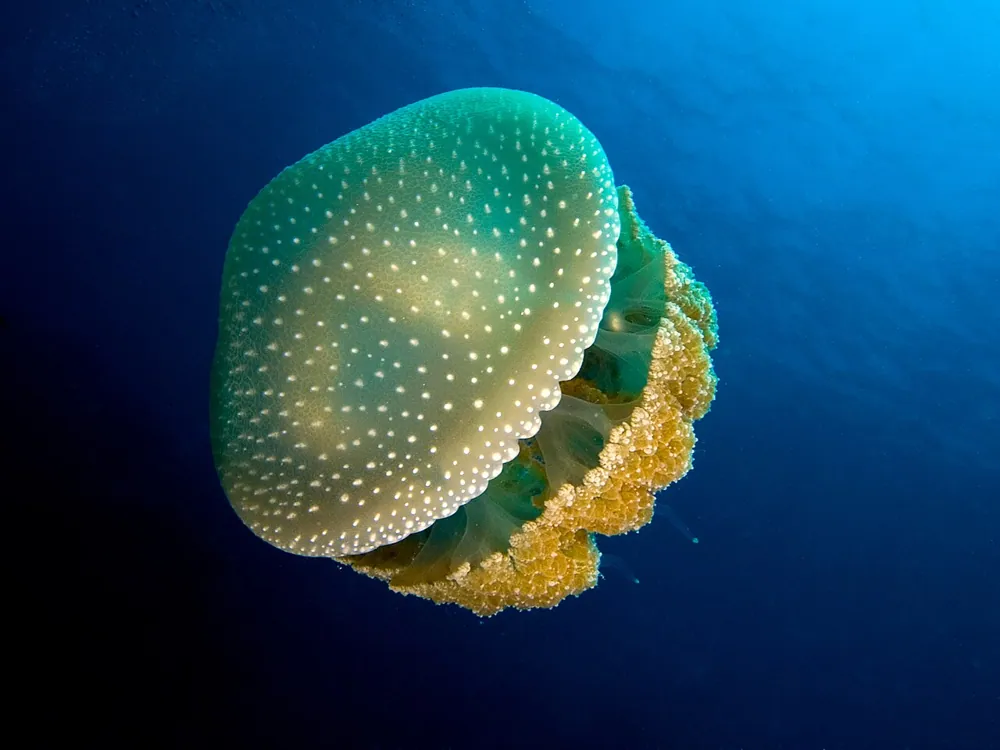
 No anndirto nde
Doole tooke
Ujunaaje selluuji pamari fiɗooji ina fiɗa si huunde memii ɗi.
Hol ko tooke mum (ŋatol walla fiɗol) waɗata?
It has only a mild venom. The venom is not strong enough to kill its prey, which is why it catches food by filtering rather than by stunning it.1
Hol no nde woni bone e yimɓe?
Bone e yimɓe: HoyɗoNo fiɗol nyaaku walla ɓuri famɗude. Ɓadii alaa bone e yimɓe.It is not considered a threat to humans, and its sting is mild or hard to notice. It does cause harm to fishing industries, where it eats fish, crab and shrimp eggs and larvae and clogs nets.1
 Si nde fiɗii
- The sting can be treated with a dilute acid, usually white or cider vinegar.1
- Yaltu e ndiyam, ittu kala tentacle (e kaddule juuɗe walla wudere).
- Ngam box jellyfish leyɗe tulɓe: loow vinegar dow fiɗe ɗe, ko famɗi fof sakan 30, noddu ballal, wonu hebbinaaɗo waɗde CPR. Ngam bluebottle e ɓurɗi ɗuuɗde: lootu e ndiyam baharu, refti ndiyam wulɗam ngam muusu.
Sahaa fof, noddu lamba ballal yaawngal (112, 000, 911) ko adii. Ɗum ko ballal arano kuuɓal, wonaa wasiyya doktaa. Aslu ballal arano
 Reen hoore maa
- Taa memu, taa nanngu, taa aaɓnu dabbaare ladde abada, hay pamaro, hay si ina wayi no ɗaanii walla maayii.
- Accu nde nokku. Si a fottii e gooto, deeƴu, ruttu caggal seeɗa seeɗa, accu nde yaha laawol mum.
- Si gooto e majji fiɗii ma: deeƴu, taa dillu, noddu lamba ballal yaawngal (112, 000, 911) walla yah asibiti law. Siftor no nde wayri, foto ina walla.
Nde ɗaɓɓaaki ma. Nde huutora tooke mum ngam nanngude ñaamdu walla reende hoore mum, nde ɓuri yiɗde suuɗaade. Ɓeydu anndude no reentorto
Hol to e aduna?
Hol no nde mawni?
Hol no nde juuti?
 juuti no ayaba 3 jokkondiraaɗi
 juuti no bulok fijo 16 jokkondiraaɗi
 ina waawi lumbaade njuuteendi pisin mawɗo (50 m) nder sakan 150
Hol no Australian spotted jellyfish mawni, fottindaade e AAN?
Hiisa tan nder browser maa. Alaa ko mooftetee walla ko neletee.
Hol no nde yaawi?

_edit.jpg)
Anndal
Each jellyfish can filter as much as 50,000 litres of seawater per day.1
One individual found on Sunset Beach, North Carolina, in October 2007 measured 74 cm wide, perhaps the largest ever recorded.1
Large swarms can clog fishing nets, damage boat intakes and sometimes force fishing areas to close.1
Its polyps can multiply by dividing into other polyps, which makes a larger group than the one the mother started with.1
Its polyp stage can last up to five years, and its adult stage up to two years.1
In the Gulf of Mexico, medusae grow unusually large, reaching more than 60 cm across.1
Feññinoowo goonga
Fenaande: It is a dangerous jellyfish that is a serious threat to people.
Goonga: It has only a mild venom and is not considered a threat to humans. Its main harm is to fishing and the local ecosystem, where it eats large amounts of zooplankton.1
Ngam ganduɓe tooke
- Innde ganndal
- Phyllorhiza punctata
- Fedde
- Jellyfish e fiɗooji baharu
- Besngu
- Mastigiidae2
- Tolno
- Rhizostomeae
- Nahiyaaji
- Baharu Pasifik, Baharu Indiya, Baharu Koral, Baharu Atlantik, Baharu Karibiya, Baharu Meksiko, Baharu Timor e Arafura, Baharuuji mawɗi
- Ɓikkoy
- Males release sperm into the water, and the female gathers it into her mouth, where she holds the fertilised eggs. The larvae settle on the seabed and grow into polyps, which reproduce by cloning themselves.1
- Bone e yimɓe
- 1 / 5: Hoyɗo3
Ɗo anndal iwi
- Phyllorhiza punctata (Wikipedia (CC BY-SA 4.0))
- Phyllorhiza punctata (iNaturalist): inɗe e tolnugol.
- Venom Wiki: darja bone, mawnude woowaaɗo e miijo yaawre ko amen. Ndaar no min hiisirta ɗum: No min betiri bone.
Kala anndal e ngoo hello ina jogii limre hollirnde iwdi mum. Si min juumii, accu min, min yiɗɓe dabbaaji, wonaa jaridaa ganndal. Wiy min e [email protected] min feewnitay.
 Yaare nden ina heege! Venom Wiki ko golle neɗɗo gooto: meere, tawa tallaaji alaa, trackers alaa. Ballal pamarngal ina walla heddinde ɗum e internet.Ñaamnu yaare nden
Goɗɗi e fedde wootere: Jellyfish e fiɗooji baharu
 Box jellyfish OstireliyaJellyfish e fiɗooji baharuWarooɗoTaa memu
 Irukandji jellyfishJellyfish e fiɗooji baharuIna waawi wardeTaa memu
 Portuguese man o' warJellyfish e fiɗooji baharuIna haani doktaaTaa memu
 Lion's mane jellyfishJellyfish e fiɗooji baharuIna muusa tanTaa memu
 Moon jellyfishJellyfish e fiɗooji baharuAlaa bone
 Common kingslayerJellyfish e fiɗooji baharuIna waawi wardeTaa memu
Ina wona kadi e: Baharu Pasifik
 Wiinde cone geographyCone snail e octopusWarooɗo
 Ɗirkuure taakeeje bulaaje mawndeCone snail e octopusWarooɗo
 Liingu ufotoongu JafanDabbaaji goɗɗi tooke memde walla ñaamdeWarooɗo
 Ɗirkuure taakeeje bulaaje worgoCone snail e octopusWarooɗo
 Hawksbill sea turtleDabbaaji goɗɗi tooke memde walla ñaamdeIna waawi warde
 Reef stonefishLiddi tookeIna waawi wardeTaa memu