
 Afirik
 Asiya
Asiya Turai
Turai Amerik Worgo
 Australiya e Oseaniya
 Antarktika
 Baharu Pasifik
 Baharu Atlantik
 Baharu Indiya
 Baharu Arktik
 Baharu Mediterane
 Baharu Boɗeeru
 Baharu Karibiya
 Baharu Koral
 Baharu Ciina Worgo
 Baharu Filipin
 Baharu Andaman
 Baharu Rewo
 Baharu Timor e Arafura
 Baharu Bengal
 Baharu Kaliforniya
Blue button
 Tentacle fiɗooji
The blue button is a small sea creature that floats on the surface of warm oceans. It looks like a jellyfish, but it is really a colony of tiny animals called polyps. Its sting is not powerful, but it can cause slight skin irritation.1
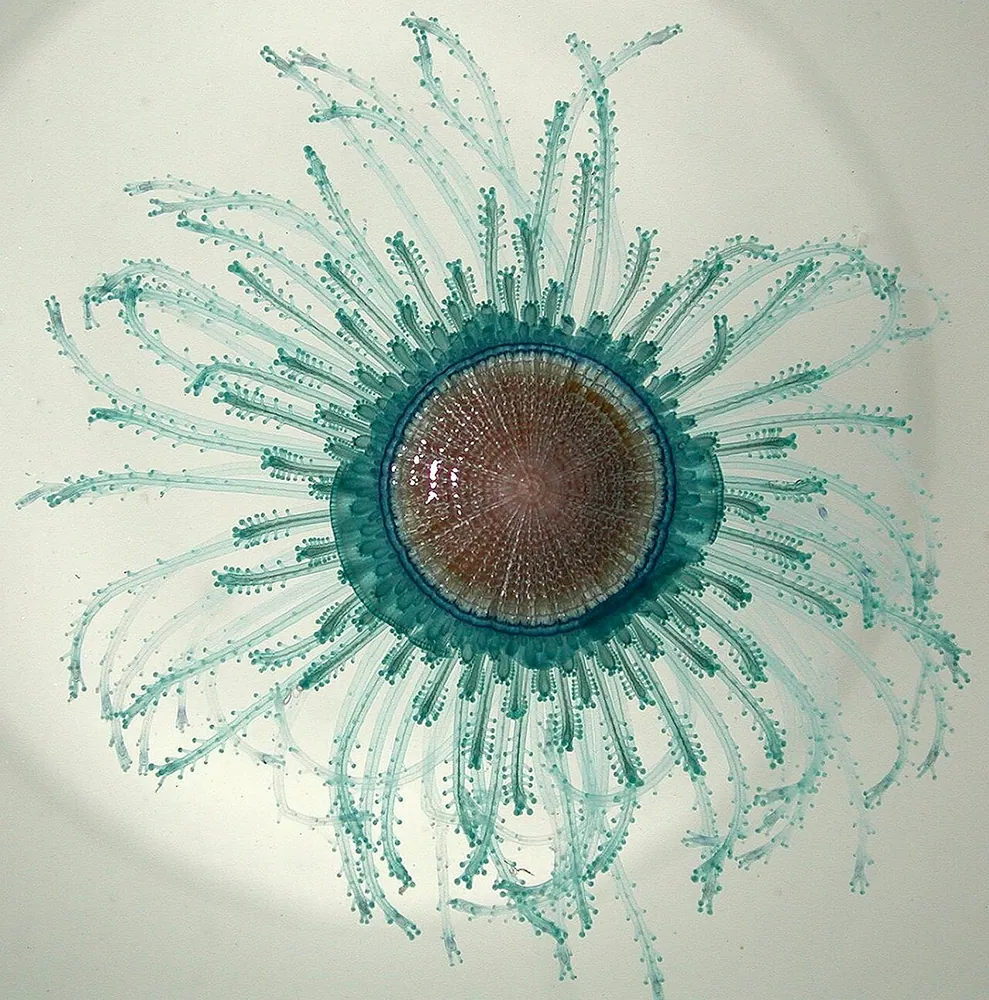
 No anndirto nde
- A round, almost flat, hard golden brown float about one inch (2.5 cm) wide1
- Bright blue turquoise to yellow polyps hanging from the float1
- Blue strands with knobs of stinging cells at the tips1
- Looks similar to a jellyfish, but each 'individual' is a colony of polyps1
Ina jiiɓindiree e: It looks superficially like a jellyfish. It is related to Velella and to the Portuguese man o' war, which are also colonial animals that float on the surface.1
Doole tooke
Ujunaaje selluuji pamari fiɗooji ina fiɗa si huunde memii ɗi.
Hol ko tooke mum (ŋatol walla fiɗol) waɗata?
It has stinging cells called nematocysts at the tips of its tentacle-like strands. The sting is not powerful and may cause slight irritation to human skin.1
Hol no nde woni bone e yimɓe?
Bone e yimɓe: HoyɗoNo fiɗol nyaaku walla ɓuri famɗude. Ɓadii alaa bone e yimɓe.The sting is not powerful and may cause slight irritation. In recent years, the first recorded case of contact dermatitis (a skin rash caused by contact) from this species was reported in Japan.1
 Si nde fiɗii
- Yaltu e ndiyam, ittu kala tentacle (e kaddule juuɗe walla wudere).
- Ngam box jellyfish leyɗe tulɓe: loow vinegar dow fiɗe ɗe, ko famɗi fof sakan 30, noddu ballal, wonu hebbinaaɗo waɗde CPR. Ngam bluebottle e ɓurɗi ɗuuɗde: lootu e ndiyam baharu, refti ndiyam wulɗam ngam muusu.
Sahaa fof, noddu lamba ballal yaawngal (112, 000, 911) ko adii. Ɗum ko ballal arano kuuɓal, wonaa wasiyya doktaa. Aslu ballal arano
 Reen hoore maa
- Taa memu, taa nanngu, taa aaɓnu dabbaare ladde abada, hay pamaro, hay si ina wayi no ɗaanii walla maayii.
- Accu nde nokku. Si a fottii e gooto, deeƴu, ruttu caggal seeɗa seeɗa, accu nde yaha laawol mum.
- Si gooto e majji fiɗii ma: deeƴu, taa dillu, noddu lamba ballal yaawngal (112, 000, 911) walla yah asibiti law. Siftor no nde wayri, foto ina walla.
Nde ɗaɓɓaaki ma. Nde huutora tooke mum ngam nanngude ñaamdu walla reende hoore mum, nde ɓuri yiɗde suuɗaade. Ɓeydu anndude no reentorto
Hol to e aduna?
Hol no nde mawni?
Hol no nde juuti?
 juuti ɓadii no kilip kaayit
Hol no Blue button mawni, fottindaade e AAN?
Hiisa tan nder browser maa. Alaa ko mooftetee walla ko neletee.
Hol no nde yaawi?


Anndal
Each apparent individual is actually a colony of hydrozoan polyps, not a single animal.1
Young Malabar trevally fish shelter under the floats and panic when removed from them.1
Young Malabar trevally fish appear to prefer a particular colony and will return to their own partner when separated and put back in the same tank.1
It is preyed on by sea slugs known as blue dragons and by violet sea-snails of the genus Janthina.1
The blue button has a single mouth under its float, which it uses for both eating and removing waste.1
Feññinoowo goonga
Fenaande: A blue button is a single jellyfish-like animal.
Goonga: Each blue button is a colony of hydrozoan polyps, which are related to anemones, corals and jellyfish.1
Ɗo anndal iwi
- Porpita porpita (Wikipedia (CC BY-SA 4.0))
- Porpita porpita (iNaturalist): inɗe e tolnugol.
- Venom Wiki: darja bone, mawnude woowaaɗo e miijo yaawre ko amen. Ndaar no min hiisirta ɗum: No min betiri bone.
Kala anndal e ngoo hello ina jogii limre hollirnde iwdi mum. Si min juumii, accu min, min yiɗɓe dabbaaji, wonaa jaridaa ganndal. Wiy min e [email protected] min feewnitay.
 Yaare nden ina heege! Venom Wiki ko golle neɗɗo gooto: meere, tawa tallaaji alaa, trackers alaa. Ballal pamarngal ina walla heddinde ɗum e internet.Ñaamnu yaare nden
Goɗɗi e fedde wootere: Jellyfish e fiɗooji baharu
 Australian box jellyfishJellyfish e fiɗooji baharuWarooɗoTaa memu
 Irukandji jellyfishJellyfish e fiɗooji baharuIna waawi wardeTaa memu
 Portuguese man o' warJellyfish e fiɗooji baharuIna haani doktaaTaa memu
 Lion's mane jellyfishJellyfish e fiɗooji baharuIna muusa tanTaa memu
 Moon jellyfishJellyfish e fiɗooji baharuAlaa bone
 Common kingslayerJellyfish e fiɗooji baharuIna waawi wardeTaa memu
Ina wona kadi e: Baharu Pasifik
 Geography coneCone snail e octopusWarooɗo
 Greater blue-ringed octopusCone snail e octopusWarooɗo
 Japanese pufferfishDabbaaji goɗɗi tooke memde walla ñaamdeWarooɗo
 Southern blue-ringed octopusCone snail e octopusWarooɗo
 Hawksbill sea turtleDabbaaji goɗɗi tooke memde walla ñaamdeIna waawi warde
 Reef stonefishLiddi tookeIna waawi wardeTaa memu