
 Afirik
 Asiya
Asiya Turai
Turai Amerik Worgo
 Australiya e Oseaniya
 Antarktika
 Baharu Pasifik
 Baharu Atlantik
 Baharu Indiya
 Baharu Arktik
 Baharu Mediterane
 Baharu Boɗeeru
 Baharu Karibiya
 Baharu Koral
 Baharu Ciina Worgo
 Baharu Filipin
 Baharu Andaman
 Baharu Rewo
 Baharu Timor e Arafura
 Baharu Bengal
 Baharu Kaliforniya
False stonefish
 Gi'e tooke
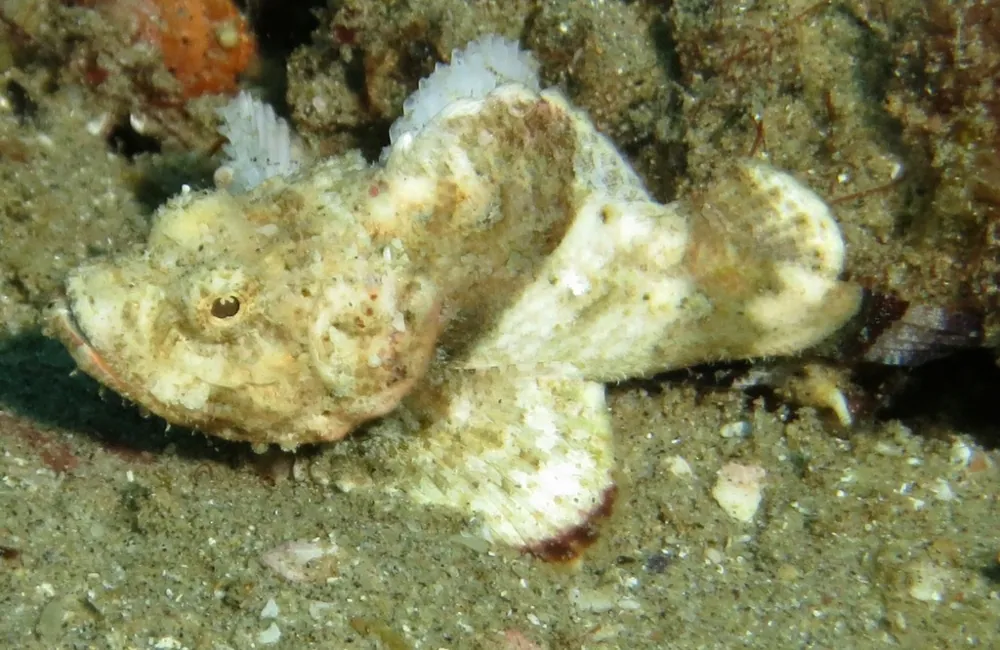
The false stonefish is a venomous fish that lives on the seabed in warm seas. It hides among rocks, coral and rubble, where it waits to ambush passing prey. It is worth knowing about because its back spines can give a painful sting.1

 No anndirto nde
- Broad head with a wide mouth, a humped back and a tapering body1
- Rough skin with low cone-shaped bumps, spines and tassels1
- Mottled grey and white colouring with reddish-brown blotches, which blends in with stones and coral1
- Twelve venomous spines in the dorsal (back) fin1
- Inner sides of the broad pectoral (side) fins show orange, black and white blotches1
Ina jiiɓindiree e: It closely resembles the reef stonefish (Synanceia verrucosa), which is why the two are easily confused.1
Doole tooke
Gi'e ceeɓɗe ina njogii tooke. Yaabude nde walla nanngude nde ina muusa.
Hol ko tooke mum (ŋatol walla fiɗol) waɗata?
Its venomous spines are in the dorsal fin on its back. They can inflict a painful wound when a person is pricked by them.1
Hol no nde woni bone e yimɓe?
Bone e yimɓe: Bone mawɗoSi gi'e mum naatii e ɓanndu maa, yah to doktaa. Maayde ina woodi seeɗa sanne.An 1829 account by the zoologists Cuvier and Valenciennes says the venom killed two local people in the Moluccas Islands of Indonesia, after what they described as frightful suffering. Local people there avoided the fish because they saw it as a bad omen.1
Hol ko nde waɗata si nde hulii?
When disturbed by a possible predator, it flares its pectoral fins as a warning.1
 Si gi'e mum naatii e ɓanndu maa
- Naatnu barme e ndiyam wulɗam, wulɗam no neɗɗo oo waawi muñde tawa sumataa (ƴeewu ɗam e junngo maa), hakkunde minti 30 e minti 90. Heɓu ballal doktaa, haa teeŋti e stonefish e stingray.
Sahaa fof, noddu lamba ballal yaawngal (112, 000, 911) ko adii. Ɗum ko ballal arano kuuɓal, wonaa wasiyya doktaa. Aslu ballal arano
 Reen hoore maa
- Taa memu, taa nanngu, taa aaɓnu dabbaare ladde abada, hay pamaro, hay si ina wayi no ɗaanii walla maayii.
- Accu nde nokku. Si a fottii e gooto, deeƴu, ruttu caggal seeɗa seeɗa, accu nde yaha laawol mum.
- Si gi'e mum naatii e ɓanndu maa: deeƴu, taa dillu, noddu lamba ballal yaawngal (112, 000, 911) walla yah asibiti law. Siftor no nde wayri, foto ina walla.
Nde ɗaɓɓaaki ma. Nde huutora tooke mum ngam nanngude ñaamdu walla reende hoore mum, nde ɓuri yiɗde suuɗaade. Ɓeydu anndude no reentorto
Hol to e aduna?
Hol no nde mawni?
Hol no nde juuti?
 juuti no bulok fijo 9 jokkondiraaɗi
 ina waawi lumbaade njuuteendi pisin mawɗo (50 m) nder sakan 90
Hol no False stonefish mawni, fottindaade e AAN?
Hiisa tan nder browser maa. Alaa ko mooftetee walla ko neletee.
Hol no nde yaawi?

Anndal
When lit by blue or ultraviolet light, it glows red. This is called biofluorescence, and it may help the fish communicate with others of its kind and aid its camouflage.1
It has twelve venomous spines in its dorsal fin, and it is these spines that make it dangerous.1
Its wide mouth and camouflage let it wait for prey to pass close by before it strikes.1
It is sometimes partly covered with sediment, which helps it stay hidden on the seabed.1
Ɗo anndal iwi
- Scorpaenopsis diabolus (Wikipedia (CC BY-SA 4.0))
- Scorpaenopsis diabolus (iNaturalist): inɗe e tolnugol.
- Venom Wiki: darja bone, mawnude woowaaɗo e miijo yaawre ko amen. Ndaar no min hiisirta ɗum: No min betiri bone.
Kala anndal e ngoo hello ina jogii limre hollirnde iwdi mum. Si min juumii, accu min, min yiɗɓe dabbaaji, wonaa jaridaa ganndal. Wiy min e [email protected] min feewnitay.
 Yaare nden ina heege! Venom Wiki ko golle neɗɗo gooto: meere, tawa tallaaji alaa, trackers alaa. Ballal pamarngal ina walla heddinde ɗum e internet.Ñaamnu yaare nden
Goɗɗi e fedde wootere: Liddi tooke
 Reef stonefish
 Red lionfish
 Estuarine stonefish
 Short-tail stingray
 Striped eel catfish
 Bluespotted ribbontail ray
Ina wona kadi e: Baharu Indiya
 Australian box jellyfishJellyfish e fiɗooji baharuWarooɗoTaa memu
 Geography coneCone snail e octopusWarooɗo
 Greater blue-ringed octopusCone snail e octopusWarooɗo
 Southern blue-ringed octopusCone snail e octopusWarooɗo
 Hawksbill sea turtleDabbaaji goɗɗi tooke memde walla ñaamdeIna waawi warde
 Irukandji jellyfishJellyfish e fiɗooji baharuIna waawi wardeTaa memu