
 Afirik
 Asiya
Asiya Turai
Turai Amerik Worgo
 Australiya e Oseaniya
 Antarktika
 Baharu Pasifik
 Baharu Atlantik
 Baharu Indiya
 Baharu Arktik
 Baharu Mediterane
 Baharu Boɗeeru
 Baharu Karibiya
 Baharu Koral
 Baharu Ciina Worgo
 Baharu Filipin
 Baharu Andaman
 Baharu Rewo
 Baharu Timor e Arafura
 Baharu Bengal
 Baharu Kaliforniya
Long-spine porcupinefish
 Tooke si ñaamaamaIna ñaama: Seeɗa e kala huundeTooke memde walla ñaamde, wonaa tooke ŋatol walla fiɗol
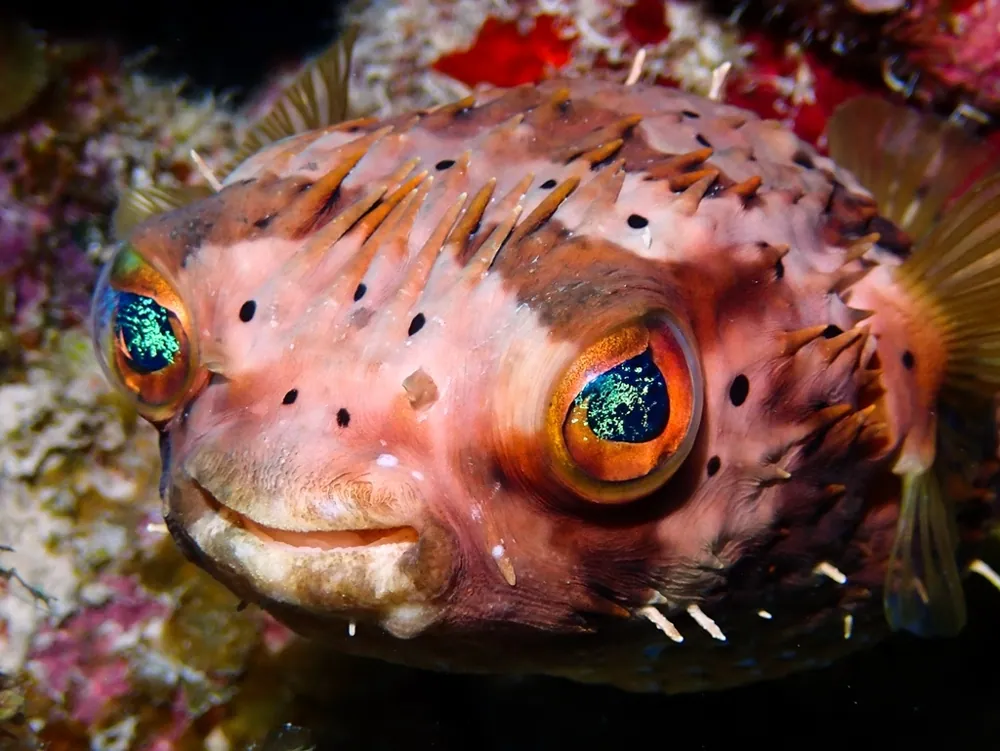
The long-spine porcupinefish is a marine fish covered in long, sharp spines. It lives in warm tropical and subtropical seas around the world, often over muddy seabeds or on reefs. Its beak-like jaws can crush hard prey such as sea urchins and shellfish.1



 No anndirto nde
- Pale in colour, with large black blotches and smaller black spots. The spots become fewer as the fish gets older.1
- Many long spines, each with two roots, which can be raised or lowered. They are especially numerous on the head.1
- The teeth of the two jaws are fused into a parrot-like beak.1
- Adults can reach 50 cm in length.1
Ina jiiɓindiree e: The black-blotched porcupinefish (Diodon liturosus) is the only other fish it might be confused with. The long-spine porcupinefish has much longer spines.1
Doole tooke
Ina bone tan si huunde ñaamii nde.
Hol no nde woni bone e yimɓe?
Bone e yimɓe: Bone mawɗoSi neɗɗo ñaamii nde, yah to doktaa. Maayde ina woodi seeɗa sanne. Si neɗɗo memii nde walla ñaamii nde
- Si neɗɗo ñaamii nde walla alaamaaji ñawu ngaɗii mo caggal ñaamde nde: noddu lamba ballal yaawngal walla nokku ballal tooke ɗoo ɗoon.
Sahaa fof, noddu lamba ballal yaawngal (112, 000, 911) ko adii. Ɗum ko ballal arano kuuɓal, wonaa wasiyya doktaa. Aslu ballal arano
 Reen hoore maa
- Taa memu, taa nanngu, taa aaɓnu dabbaare ladde abada, hay pamaro, hay si ina wayi no ɗaanii walla maayii.
- Accu nde nokku. Si a fottii e gooto, deeƴu, ruttu caggal seeɗa seeɗa, accu nde yaha laawol mum.
- Si a memii nde walla a ñaamii nde: taa momtu gite maa walla hunnduko maa, lootu juuɗe maa, heɓu ballal doktaa.
Nde ɗaɓɓaaki ma. Tooke mum ina woodi tan ngam taa huunde ñaama nde. Ɓeydu anndude no reentorto
Hol to e aduna?
Hol no nde mawni?
Hol no nde juuti?
 juuti no ayaba 3 jokkondiraaɗi
 juuti no bulok fijo 16 jokkondiraaɗi
 ina waawi lumbaade njuuteendi pisin mawɗo (50 m) nder sakan 45
Hol no Long-spine porcupinefish mawni, fottindaade e AAN?
Hiisa tan nder browser maa. Alaa ko mooftetee walla ko neletee.
Hol no nde yaawi?
Anndal
Its jaws are fused into a beak that looks like a parrot's, and it uses it to crack open sea urchins and molluscs.1
Its spines have two roots and can be raised or lowered.1
The black spots on its pale body become fewer as it ages.1
Young fish are found in groups, and they stay in open water until they reach about 7 cm.1
Ngam ganduɓe tooke
- Innde ganndal
- Diodon holocanthus
- Fedde
- Dabbaaji goɗɗi tooke memde walla ñaamde
- Besngu
- Diodontidae2
- Tolno
- Tetraodontiformes
- Nahiyaaji
- Baharu Pasifik, Baharu Atlantik, Baharu Indiya, Baharu Boɗeeru, Baharu Karibiya, Baharu Koral, Baharu Filipin, Baharu Ciina Worgo, Baharu Meksiko, Baharu Timor e Arafura, Baharu Bengal, Baharu Kaliforniya, Baharuuji mawɗi
- Ɓikkoy
- It spawns at the surface at dawn or dusk, in pairs or in groups of males with one female. The young stay pelagic (living in open water) until they are at least 7 cm long.1
- Bone e yimɓe
- 3 / 5: Bone mawɗo3
Ɗo anndal iwi
- Long-spine porcupinefish (Wikipedia (CC BY-SA 4.0))
- Diodon holocanthus (iNaturalist): inɗe e tolnugol.
- Venom Wiki: darja bone, mawnude woowaaɗo e miijo yaawre ko amen. Ndaar no min hiisirta ɗum: No min betiri bone.
Kala anndal e ngoo hello ina jogii limre hollirnde iwdi mum. Si min juumii, accu min, min yiɗɓe dabbaaji, wonaa jaridaa ganndal. Wiy min e [email protected] min feewnitay.
 Yaare nden ina heege! Venom Wiki ko golle neɗɗo gooto: meere, tawa tallaaji alaa, trackers alaa. Ballal pamarngal ina walla heddinde ɗum e internet.Ñaamnu yaare nden
Goɗɗi e fedde wootere: Dabbaaji goɗɗi tooke memde walla ñaamde
 Liingu ufotoongu JafanDabbaaji goɗɗi tooke memde walla ñaamdeWarooɗo
 Hawksbill sea turtleDabbaaji goɗɗi tooke memde walla ñaamdeIna waawi warde
 Greenland sharkDabbaaji goɗɗi tooke memde walla ñaamdeIna muusa tan
 Silver-cheeked toadfishDabbaaji goɗɗi tooke memde walla ñaamdeWarooɗo
 Blackspotted pufferDabbaaji goɗɗi tooke memde walla ñaamdeIna waawi warde
 White-spotted pufferDabbaaji goɗɗi tooke memde walla ñaamdeIna waawi warde
Ina wona kadi e: Baharu Pasifik
 Box jellyfish OstireliyaJellyfish e fiɗooji baharuWarooɗoTaa memu
 Wiinde cone geographyCone snail e octopusWarooɗo
 Ɗirkuure taakeeje bulaaje mawndeCone snail e octopusWarooɗo
 Ɗirkuure taakeeje bulaaje worgoCone snail e octopusWarooɗo
 Irukandji jellyfishJellyfish e fiɗooji baharuIna waawi wardeTaa memu
 Reef stonefishLiddi tookeIna waawi wardeTaa memu