
 Afirik
 Asiya
Asiya Turai
Turai Amerik Worgo
 Australiya e Oseaniya
 Antarktika
 Baharu Pasifik
 Baharu Atlantik
 Baharu Indiya
 Baharu Arktik
 Baharu Mediterane
 Baharu Boɗeeru
 Baharu Karibiya
 Baharu Koral
 Baharu Ciina Worgo
 Baharu Filipin
 Baharu Andaman
 Baharu Rewo
 Baharu Timor e Arafura
 Baharu Bengal
 Baharu Kaliforniya
Longhorn cowfish
 Tooke nder nguru mumIna ñaama: Seeɗa e kala huundeTooke memde walla ñaamde, wonaa tooke ŋatol walla fiɗol
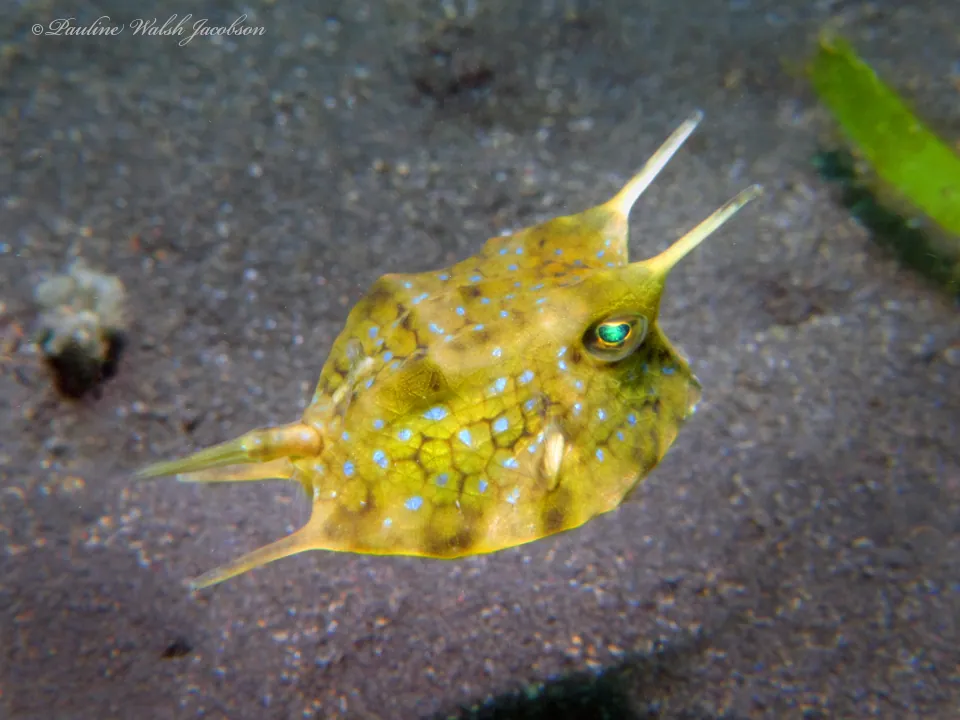
The longhorn cowfish is a small, boxy reef fish with two long horns above its eyes, like a cow's. It lives in warm waters across the Indo-Pacific, from the Red Sea to Japan and Australia. It is a slow swimmer that protects itself with a hard box-like body and a skin poison.1


 No anndirto nde
- Two long horns stick out from the front of the head, above the large eyes1
- Its body is a solid, triangular, box-like shell made of fused plate-like scales, with the fins and tail sticking out1
- The base colour is yellow to olive, decorated with white or bluish spots1
- It has no gill cover, only a small slit or hole behind the head1
- It swims slowly with its fins, so it looks as if it is hovering1
Doole tooke
Nguru mum ko tooke. Ina bone memde nde, memde nde e ɗemngal walla ñaamde nde.
Hol ko tooke mum (memde walla ñaamde) waɗata?
When it is severely stressed, it can release a toxin called pahutoxin from the mucus on its skin. This poison is toxic to other boxfish and has properties similar to sea cucumber toxins.1
Hol no nde woni bone e yimɓe?
Bone e yimɓe: HoyɗoNo fiɗol nyaaku walla ɓuri famɗude. Ɓadii alaa bone e yimɓe.Hol ko nde waɗata si nde hulii?
Its hard box-like shell, its horns, which can be used to charge at predators, and its skin poison all protect it. If severely stressed, it may release its toxin.1
 Si neɗɗo memii nde walla ñaamii nde
- Si neɗɗo ñaamii nde walla alaamaaji ñawu ngaɗii mo caggal ñaamde nde: noddu lamba ballal yaawngal walla nokku ballal tooke ɗoo ɗoon.
Sahaa fof, noddu lamba ballal yaawngal (112, 000, 911) ko adii. Ɗum ko ballal arano kuuɓal, wonaa wasiyya doktaa. Aslu ballal arano
 Reen hoore maa
- Taa memu, taa nanngu, taa aaɓnu dabbaare ladde abada, hay pamaro, hay si ina wayi no ɗaanii walla maayii.
- Accu nde nokku. Si a fottii e gooto, deeƴu, ruttu caggal seeɗa seeɗa, accu nde yaha laawol mum.
- Si a memii nde walla a ñaamii nde: taa momtu gite maa walla hunnduko maa, lootu juuɗe maa, heɓu ballal doktaa.
Nde ɗaɓɓaaki ma. Tooke mum ina woodi tan ngam taa huunde ñaama nde. Ɓeydu anndude no reentorto
Hol to e aduna?
Hol no nde mawni?
Hol no nde juuti?
Hol no nde teddi?
 juuti no ayaba 3 jokkondiraaɗi
 juuti no bulok fijo 16 jokkondiraaɗi
 ina waawi lumbaade njuuteendi pisin mawɗo (50 m) nder sakan 45
Hol no Longhorn cowfish mawni, fottindaade e AAN?
Hiisa tan nder browser maa. Alaa ko mooftetee walla ko neletee.
Hol no nde yaawi?
Anndal
Its horns may have evolved to make it harder for predators to swallow it, and if damaged, they can grow back within a few months.1
It can make humming and clicking sounds using muscles connected to its swim bladder.1
It is slow and easy to catch by hand, and it makes a grunting noise when caught.1
On Pamban Island in India, a local belief says cows on the island turned into these fish when the land separated.1
It helps protect coral reefs by eating invertebrates that damage them, and it is also important to reef growth.1
Ngam ganduɓe tooke
- Innde ganndal
- Lactoria cornuta
- Fedde
- Dabbaaji goɗɗi tooke memde walla ñaamde
- Besngu
- Ostraciidae2
- Tolno
- Tetraodontiformes
- Nahiyaaji
- Baharu Pasifik, Baharu Indiya, Baharu Boɗeeru, Baharu Koral, Baharu Filipin, Baharu Ciina Worgo, Baharu Timor e Arafura, Baharu Bengal, Baharuuji mawɗi
- Ɓikkoy
- Females spawn in small groups, with one male and 3 to 4 females in each harem. The oval eggs hatch into larvae that quickly form the box-like armour.1
- Bone e yimɓe
- 1 / 5: Hoyɗo3
Ɗo anndal iwi
- Longhorn cowfish (Wikipedia (CC BY-SA 4.0))
- Lactoria cornuta (iNaturalist): inɗe e tolnugol.
- Venom Wiki: darja bone, mawnude woowaaɗo e miijo yaawre ko amen. Ndaar no min hiisirta ɗum: No min betiri bone.
Kala anndal e ngoo hello ina jogii limre hollirnde iwdi mum. Si min juumii, accu min, min yiɗɓe dabbaaji, wonaa jaridaa ganndal. Wiy min e [email protected] min feewnitay.
 Yaare nden ina heege! Venom Wiki ko golle neɗɗo gooto: meere, tawa tallaaji alaa, trackers alaa. Ballal pamarngal ina walla heddinde ɗum e internet.Ñaamnu yaare nden
Goɗɗi e fedde wootere: Dabbaaji goɗɗi tooke memde walla ñaamde
 Liingu ufotoongu JafanDabbaaji goɗɗi tooke memde walla ñaamdeWarooɗo
 Hawksbill sea turtleDabbaaji goɗɗi tooke memde walla ñaamdeIna waawi warde
 Greenland sharkDabbaaji goɗɗi tooke memde walla ñaamdeIna muusa tan
 Silver-cheeked toadfishDabbaaji goɗɗi tooke memde walla ñaamdeWarooɗo
 Blackspotted pufferDabbaaji goɗɗi tooke memde walla ñaamdeIna waawi warde
 White-spotted pufferDabbaaji goɗɗi tooke memde walla ñaamdeIna waawi warde
Ina wona kadi e: Baharu Pasifik
 Box jellyfish OstireliyaJellyfish e fiɗooji baharuWarooɗoTaa memu
 Wiinde cone geographyCone snail e octopusWarooɗo
 Ɗirkuure taakeeje bulaaje mawndeCone snail e octopusWarooɗo
 Ɗirkuure taakeeje bulaaje worgoCone snail e octopusWarooɗo
 Irukandji jellyfishJellyfish e fiɗooji baharuIna waawi wardeTaa memu
 Reef stonefishLiddi tookeIna waawi wardeTaa memu