
 Afirik
 Asiya
Asiya Turai
Turai Amerik Worgo
 Australiya e Oseaniya
 Antarktika
 Baharu Pasifik
 Baharu Atlantik
 Baharu Indiya
 Baharu Arktik
 Baharu Mediterane
 Baharu Boɗeeru
 Baharu Karibiya
 Baharu Koral
 Baharu Ciina Worgo
 Baharu Filipin
 Baharu Andaman
 Baharu Rewo
 Baharu Timor e Arafura
 Baharu Bengal
 Baharu Kaliforniya
Pelagic stingray
 Ina fiɗa
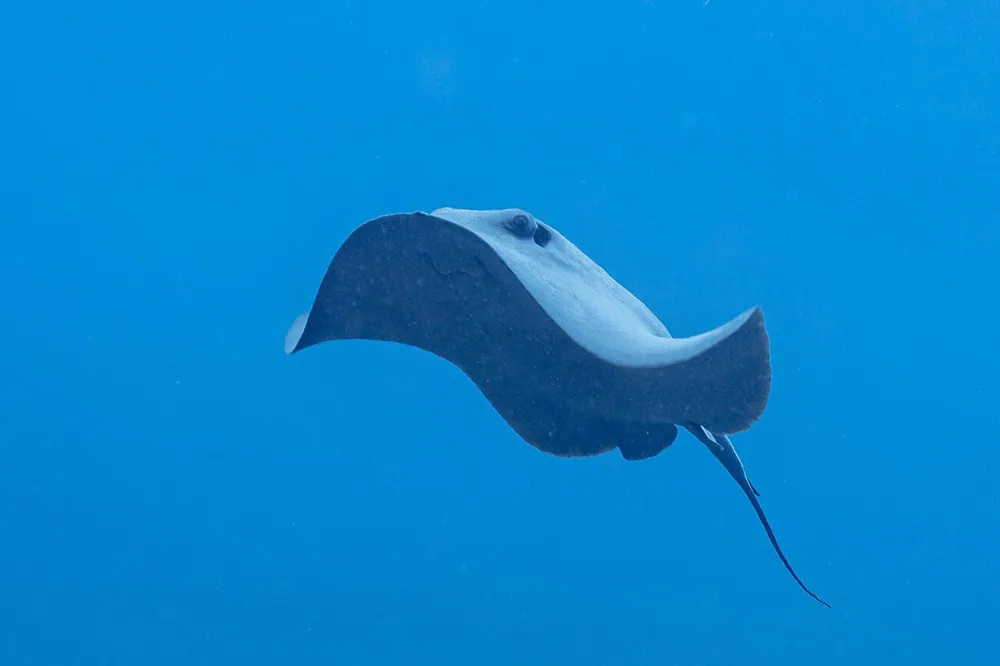
The pelagic stingray is a ray that lives in the open ocean rather than on the sea floor, which sets it apart from almost all other stingrays. It is found in warm waters around much of the world. It can give a severe sting with its tail spine, so it matters most to people who work on fishing boats.1



 No anndirto nde
- The pectoral fin disc is a thick, wedge-shaped wing that is about one-third wider than it is long.1
- It is a plain dark purple to blue-green above, with a slightly lighter shade below.1
- The tail is whip-like, up to twice as long as the disc, with an extremely long, serrated spine about a third to halfway along it.1
- Young rays are smooth-skinned, and small prickles and thorns appear with age.1
Doole tooke
Tooke ina yalta e fiɗirgal.
Hol ko tooke mum (ŋatol walla fiɗol) waɗata?
The venom is on the tail spine and is quite potent, which is why other fishes avoid it.1
Hol no nde woni bone e yimɓe?
Bone e yimɓe: Bone mawɗoFiɗol ina haani doktaa. Maayde ina woodi seeɗa sanne.It is rarely encountered except by fishery workers. Its tail spine can inflict a severe wound that can be fatal.1
Hol ko nde waɗata si nde hulii?
When captured and handled, it releases a thick black mucus that covers its body, and its tail spine delivers venom.1
 Si nde fiɗii
- Naatnu barme e ndiyam wulɗam, wulɗam no neɗɗo oo waawi muñde tawa sumataa (ƴeewu ɗam e junngo maa), hakkunde minti 30 e minti 90. Heɓu ballal doktaa, haa teeŋti e stonefish e stingray.
Sahaa fof, noddu lamba ballal yaawngal (112, 000, 911) ko adii. Ɗum ko ballal arano kuuɓal, wonaa wasiyya doktaa. Aslu ballal arano
 Reen hoore maa
- Taa memu, taa nanngu, taa aaɓnu dabbaare ladde abada, hay pamaro, hay si ina wayi no ɗaanii walla maayii.
- Accu nde nokku. Si a fottii e gooto, deeƴu, ruttu caggal seeɗa seeɗa, accu nde yaha laawol mum.
- Si gooto e majji fiɗii ma: deeƴu, taa dillu, noddu lamba ballal yaawngal (112, 000, 911) walla yah asibiti law. Siftor no nde wayri, foto ina walla.
Nde ɗaɓɓaaki ma. Nde huutora tooke mum ngam nanngude ñaamdu walla reende hoore mum, nde ɓuri yiɗde suuɗaade. Ɓeydu anndude no reentorto
Hol to e aduna?
Hol no nde mawni?
Hol no nde juuti?
Hol no nde teddi?

 juuti no ullundi galle 2,5, hinere haa laaci
 juuti no ayaba 7 jokkondiraaɗi
 ina waawi lumbaade njuuteendi pisin mawɗo (50 m) nder sakan 8,6
Hol no Pelagic stingray mawni, fottindaade e AAN?
Hiisa tan nder browser maa. Alaa ko mooftetee walla ko neletee.
Hol no nde yaawi?

Anndal
It is the only stingray that almost exclusively lives in the open ocean rather than on the sea floor.1
Instead of rippling the edges of its disc like other stingrays, it swims by flapping its pectoral fins, similar to eagle rays.1
Both sexes have pointed teeth, which is unusual among stingrays. Only the teeth of adult males are longer and sharper.1
Females can store sperm inside their bodies for more than a year, waiting for good conditions before their young develop.1
A captive female reached 94 cm across and 49 kg, the largest individual on record from a rearing experiment.1
Oceanic whitetip sharks, great white sharks and toothed whales prey on it.1
Ngam ganduɓe tooke
- Innde ganndal
- Pteroplatytrygon violacea
- Fedde
- Liddi tooke
- Besngu
- Dasyatidae2
- Tolno
- Myliobatiformes
- Nahiyaaji
- Baharu Atlantik, Baharu Pasifik, Baharu Indiya, Baharu Mediterane, Baharu Karibiya, Baharuuji mawɗi
- Ɓikkoy
- It gives birth to live young. Females may bear two litters of 4 to 13 pups per year after a gestation of 2 to 4 months.1
- Hol no nde wonata e ladde
- Least Concern1
- Bone e yimɓe
- 3 / 5: Bone mawɗo3
Ɗo anndal iwi
- Pelagic stingray (Wikipedia (CC BY-SA 4.0))
- Pteroplatytrygon violacea (iNaturalist): inɗe e tolnugol.
- Venom Wiki: darja bone, mawnude woowaaɗo e miijo yaawre ko amen. Ndaar no min hiisirta ɗum: No min betiri bone.
Kala anndal e ngoo hello ina jogii limre hollirnde iwdi mum. Si min juumii, accu min, min yiɗɓe dabbaaji, wonaa jaridaa ganndal. Wiy min e [email protected] min feewnitay.
 Yaare nden ina heege! Venom Wiki ko golle neɗɗo gooto: meere, tawa tallaaji alaa, trackers alaa. Ballal pamarngal ina walla heddinde ɗum e internet.Ñaamnu yaare nden
Goɗɗi e fedde wootere: Liddi tooke
 Reef stonefish
 Red lionfish
 Estuarine stonefish
 Short-tail stingray
 Striped eel catfish
 Bluespotted ribbontail ray
,_Cabo_de_Palos,_Espa%C3%B1a,_2022-07-16,_DD_68.jpg)
Ina wona kadi e: Baharu Atlantik
 Hawksbill sea turtleDabbaaji goɗɗi tooke memde walla ñaamdeIna waawi warde
 Portuguese man o' warJellyfish e fiɗooji baharuIna haani doktaaTaa memu
 Blue sea dragonCone snail e octopusIna muusa tan
 Greenland sharkDabbaaji goɗɗi tooke memde walla ñaamdeIna muusa tan
 Lion's mane jellyfishJellyfish e fiɗooji baharuIna muusa tanTaa memu
 Common octopusCone snail e octopusAlaa bone