
 Afrik
Afrik Aazi
Aazi Orop
Orop Amerik Worgo
 Ostaraali e Oseyaani
 Antarktik
 Geec Pasifik
 Geec Atlantik
 Geec Enndo
 Geec Arktik
 Geec Mediteraane
 Geec Boɗeejo
 Geec Karayib
 Geec Korayl
 Geec Siin Worgo
 Geec Filipiin
 Geec Andaman
 Geec Rewo
 Geec Timor e Arafura
 Gulf Bengal
 Gulf Kaliforni
Climbing mantella
 Tooke e nguru mum
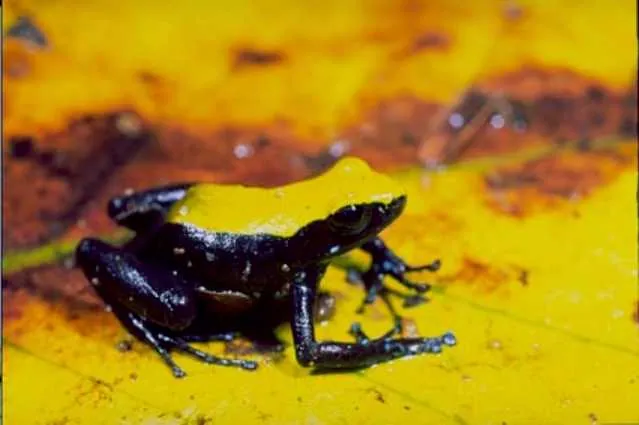
The climbing mantella is a small, brightly coloured frog that lives in the lowland rainforests of northeast Madagascar. It is a poison frog, so its skin holds chemicals that can harm predators. It is special because it is one of the few frogs whose parents care for their tadpoles by feeding them eggs.1



 No anndirte ngal
- Adults are 24–30 mm long and weigh 1.2–2.0 g1
- Front of the back is bright yellow or pale green1
- Arms, legs, belly and rear are black, with blue spots on the limbs1
- Eyes are completely black1
- Has discs at the tips of its fingers and toes, and the toes are webbed1
Ina heewi waylondireede e: M. betsileo, M. viridis and M. expectata look similar but are differently coloured. They often have blue spots on the throat rather than the limbs, and they have a faint line along the upper lip, which the climbing mantella lacks.1
Doole tooke ɓanndu
Nguru mum ina jogii tooke. Ina bonna so meemaama, lakkaama walla ñaamaama.
Hol ko tooke ɓanndu mum waɗata?
This frog is poisonous rather than venomous. Its skin glands contain lipophilic alkaloids, the chemicals that make up its poison, which it gets from the arthropods it eats. Researchers have found 41 different potent alkaloids in its skin. Captive frogs lose their toxicity over time.1
Hol no bone mum heewiri e yimɓe?
Bone e yimɓe: HoyɗoNo jukkugol ñaaki walla ko ɓuri famɗude. Ko ɓuri heewde alaa bone e yimɓe.Hol ko ngal waɗata so ina hula?
Its bright colours warn predators that its skin is toxic.1
 So neɗɗo meemii ngal walla ñaamii ngal
- So neɗɗo meemii gooto: loot juuɗe ɗee no moƴƴiri, wota a meem gite walla hunduko. So cukalel walla kullal galle lakkii walla ñaamii gooto: noddu centre antipoison walla nimero urgence.
Adii fof noddu nimero urgence (112, 000, 911). Ɗum ko anndinal ballal adiingal, wonaa saaraangal doktoor. Ko adii e ballal adiingal
 Reen hoore maa
- Wota a meem, wota a nanngu, wota a ñiŋŋu kullal ladde haa abada, hay so ngal ina famɗi, hay so ina nanndi e ɗaaniingal walla maayngal.
- Accu ngal nokku. So a fotti e ngal, deƴƴu, ruttu ɓaawo seeɗa seeɗa, accu ngal yaha laawol mum.
- So a meemii ngal walla a ñaamii ngal: wota a moomtu gite maa walla hunduko maa, loot juuɗe maa, heɓ ballal cafrol.
Ngal faalaaka gaañde ma. Tooke mum woni tan ngam wota huunde ñaam ngal. Ɓeydu anndude no reentortoo
Hol to e aduna?
Hol no mawniri?
Hol no juutiri?
Hol no teddiri?
 hedde juutde no ñippirde kaayitaaje
 hoyɗo haa a ŋaccataa ngal e jungo maa
 ina waawi taƴde 100 meeteer e segonde 100 (neɗɗo ɓurɗo yaawde ina sokli 9,6)
Hol no Climbing mantella mawniri, so fooɗondiraama e AN?
Limgal tan e navigatoor maa. Alaa ko danndetee walla ko neldetee.
Hol no yaawiri?


Humpito
Its tadpoles eat only the eggs of their own species, and the parents feed them unfertilized eggs.1
Males defend territories of about 2 square metres and fight by wrestling, chasing and leaping, sometimes for over 1.5 hours.1
Female frogs choose a mate based on the quality of the male's well, not on his call.1
The climbing mantella is the only member of the Mantella genus that breeds in water-filled wells in trees, tree holes or broken bamboo stalks.1
Its chemical defence has developed in a similar way to that of the dart frogs of Dendrobatidae, although the two families are only distantly related.1
Ngam ganduɓe tooke
- Innde ganndal
- Mantella laevigata
- Fedde
- Ñaari tooke, ñaari e newts
- Ɓesngu
- Mantellidae2
- Ordre
- Anura
- Leyɗe mawɗe
- Afrik
- Ɓiɓɓe tokooso
- Usually lays only one large egg, 3–3.5 mm across, at the side of a water-filled well or above the water line. The parents feed tadpoles unfertilized eggs.1
- Hol no ngal woniri e ladde
- Least Concern (IUCN Red List, 2016), though its population is suspected to be decreasing1
- Bone e yimɓe
- 1 / 5: Hoyɗo3
Ɗo humpito iwri
- Climbing mantella (Wikipedia (CC BY-SA 4.0))
- Mantella laevigata (iNaturalist): inɗe e ceergal.
- Venom Wiki: tolno bone, mawnude heewnde e miijo yaawde ko amen. Yiy no men keɓirta ɗum: No men tolnirta bone.
Kala humpito e ngoo hello ina jogii limoore hollirnde iwdi mum. So men juumii, yaafo, men ko yiɗɓe kulle, wonaa jaaynde ganndal. Wiy men e [email protected], men feewnita.
 Yaare nden ina weelaa! Venom Wiki ko golle neɗɗo gooto: yoɓetaake, alaa ko jeeyetee, alaa rewɓe. Ndokkal seeɗa ina walla ngam heddude e enternet.Ñaam yaare nden
Goɗɗe e nder fedde wootere: Ñaari tooke, ñaari e newts
 Golden mantellaÑaari tooke, ñaari e newtsAlaa bone
 Iberian ribbed newtÑaari tooke, ñaari e newtsAlaa bone
 Tomato frogÑaari tooke, ñaari e newtsAlaa bone
 African common toadÑaari tooke, ñaari e newtsIna muusi tanWota a meem
 Baron's mantellaÑaari tooke, ñaari e newtsAlaa bone
 Blue-legged mantellaÑaari tooke, ñaari e newtsAlaa bone
 Mamba ɓaleeri
 Yaare oolnde maayde
 Kobra Misra
 Mbaa-ndiyam (Puff adder)
 Boomslang
 Fat-tailed scorpion