
 Afrik
Afrik Aazi
Aazi Orop
Orop Amerik Worgo
 Ostaraali e Oseyaani
 Antarktik
 Geec Pasifik
 Geec Atlantik
 Geec Enndo
 Geec Arktik
 Geec Mediteraane
 Geec Boɗeejo
 Geec Karayib
 Geec Korayl
 Geec Siin Worgo
 Geec Filipiin
 Geec Andaman
 Geec Rewo
 Geec Timor e Arafura
 Gulf Bengal
 Gulf Kaliforni
Devil firefish
 Gaaɗe tooke
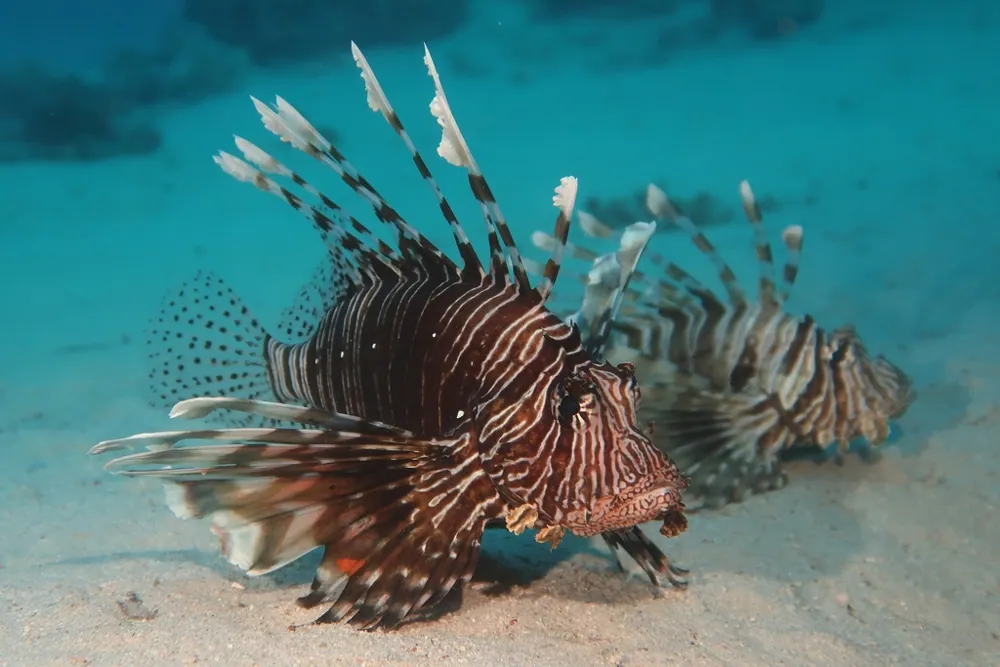
The devil firefish, also called the common lionfish, is a striped fish with long, feathery fins. It lives in the Indian Ocean, from the Red Sea to Indonesia, and has also spread into the Mediterranean, the east coast of the United States and the Caribbean. Its fin spines are venomous and can cause severe pain, so give it plenty of room.1
 No anndirte ngal
- Colour ranges from reddish to tan or grey.1
- Many thin, dark, vertical bars run across its head and body.1
- The dorsal fin looks feathery, and the pectoral fins are wing-like.1
- It grows up to 35 cm (14 in) long.1
- Its head is less angular than that of the red lionfish.1
Ina heewi waylondireede e: It is frequently confused with its close relative, the red lionfish (Pterois volitans), which is very similar in appearance. The red lionfish does not occur in the Red Sea, and its head is more angular.1
Doole tooke
Gaaɗe ceeɓɗe ina ndondii tooke. Yaabde e mum walla nanngude ɗum ina muusi.
Hol ko tooke ŋatgol mum waɗata?
The fin spines are highly venomous. A sting can cause extreme pain, vomiting, convulsions, minor paralysis and breathing difficulties.1
Hol no bone mum heewiri e yimɓe?
Bone e yimɓe: Ina tiiɗiSo gaaɗe mum tuƴii ma, yahu e doktoor. Maayde ina famɗi sanne.The fin spines have caused death in some reported cases, but a sting is rarely fatal. Some people are more sensitive to the venom than others, and symptoms vary in severity from person to person.1
Hol ko ngal waɗata so ina hula?
Its venomous spines help protect it, which is probably why it has few predators.1
 So gaaɗe mum tuƴii ma
- Immediate emergency medical attention is strongly recommended after any sting, even for healthy adults, because reactions vary and can be unpredictable.1
- Naatnu gaañande nden e ndiyam guleeɗam, guleeɗam no neɗɗo oo waawi muññude tawa sumaani (ƴeewr ɗum e jungo maa), hojomaaji 30 haa 90. Heɓ ballal cafrol, ɓuri noon ngam liƴƴi kaaƴe e liƴƴi raay.
Adii fof noddu nimero urgence (112, 000, 911). Ɗum ko anndinal ballal adiingal, wonaa saaraangal doktoor. Ko adii e ballal adiingal
 Reen hoore maa
- Wota a meem, wota a nanngu, wota a ñiŋŋu kullal ladde haa abada, hay so ngal ina famɗi, hay so ina nanndi e ɗaaniingal walla maayngal.
- Accu ngal nokku. So a fotti e ngal, deƴƴu, ruttu ɓaawo seeɗa seeɗa, accu ngal yaha laawol mum.
- So gaaɗe mum tuƴii ma: deƴƴu, wota a dillu, noddu nimero urgence (112, 000, 911) walla yahu opitaal law. Jogo e hakkille no ngal nanndi, natal ina walla.
Ngal faalaaka gaañde ma. Ina huutoroo tooke mum ngam nanngude ñaamdu walla reenaade, ina ɓuri yiɗde suuɗaade. Ɓeydu anndude no reentortoo
Hol to e aduna?
Hol no mawniri?
Hol no juutiri?
 juutde no kaaɗe mahirɗe 11 ɗaɓɓondiraaɗe
 ina waawi yoowde juuteendi pisin mawɗo (50 m) e segonde 90
Hol no Devil firefish mawniri, so fooɗondiraama e AN?
Limgal tan e navigatoor maa. Alaa ko danndetee walla ko neldetee.
Hol no yaawiri?

Humpito
Moray eels have shown resistance to its spines, and they are now known to be natural predators of this fish in the Red Sea.1
The red lionfish is thought to have arisen from hybrids between this species and a related lionfish.1
It was first recorded in the Mediterranean off Israel in 1991, after entering through the Suez Canal. It is now common in the eastern Mediterranean.1
Ɗo humpito iwri
- Pterois miles (Wikipedia (CC BY-SA 4.0))
- Pterois miles (iNaturalist): inɗe e ceergal.
- Venom Wiki: tolno bone, mawnude heewnde e miijo yaawde ko amen. Yiy no men keɓirta ɗum: No men tolnirta bone.
Kala humpito e ngoo hello ina jogii limoore hollirnde iwdi mum. So men juumii, yaafo, men ko yiɗɓe kulle, wonaa jaaynde ganndal. Wiy men e [email protected], men feewnita.
 Yaare nden ina weelaa! Venom Wiki ko golle neɗɗo gooto: yoɓetaake, alaa ko jeeyetee, alaa rewɓe. Ndokkal seeɗa ina walla ngam heddude e enternet.Ñaam yaare nden
Goɗɗe e nder fedde wootere: Liƴƴi jogiiɗi tooke
 Reef stonefishLiƴƴi jogiiɗi tookeIna waawi wardeWota a meem
 Red lionfishLiƴƴi jogiiɗi tookeIna sokli doktoorWota a meem
 Estuarine stonefishLiƴƴi jogiiɗi tookeIna waawi wardeWota a meem
 Short-tail stingrayLiƴƴi jogiiɗi tookeIna waawi warde
 Striped eel catfishLiƴƴi jogiiɗi tookeIna waawi wardeWota a meem
 Bluespotted ribbontail rayLiƴƴi jogiiɗi tookeIna sokli doktoor
Ina wuuri kadi e: Geec Enndo
 Australian box jellyfishMeduusaaji e kulle geec jukkoojeBareejoWota a meem
 Geography coneKokiyaas kone e pulpuujiBareejo
 Greater blue-ringed octopusKokiyaas kone e pulpuujiBareejo
 Southern blue-ringed octopusKokiyaas kone e pulpuujiBareejo
 Hawksbill sea turtleKulle goɗɗe jogiiɗe tooke ɓannduIna waawi warde
 Irukandji jellyfishMeduusaaji e kulle geec jukkoojeIna waawi wardeWota a meem