
 Afrik
Afrik Aazi
Aazi Orop
Orop Amerik Worgo
 Ostaraali e Oseyaani
 Antarktik
 Geec Pasifik
 Geec Atlantik
 Geec Enndo
 Geec Arktik
 Geec Mediteraane
 Geec Boɗeejo
 Geec Karayib
 Geec Korayl
 Geec Siin Worgo
 Geec Filipiin
 Geec Andaman
 Geec Rewo
 Geec Timor e Arafura
 Gulf Bengal
 Gulf Kaliforni
Short-tail stingray
 Jukkugol
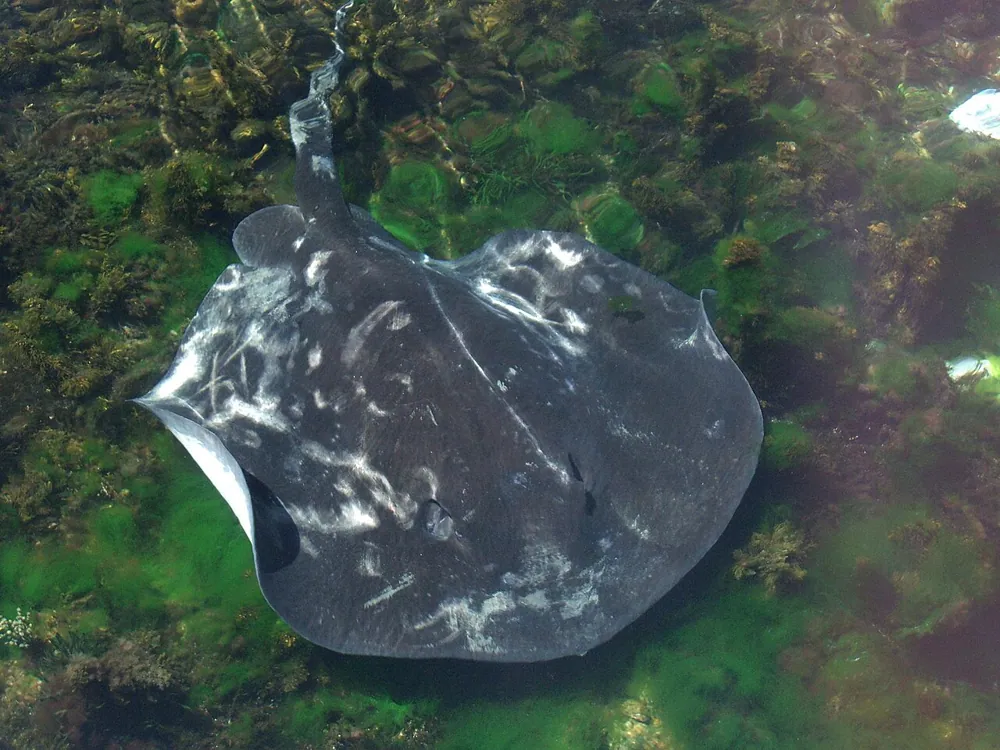
The short-tail stingray is one of the largest stingrays in the world. It lives in temperate seas off southern Africa, southern Australia and New Zealand, mostly on or near the sea floor. It is not aggressive, but its long venomous sting can cause a serious wound if the ray is startled.1



 No anndirte ngal
- Diamond-shaped, heavy disc that is smooth, with no scales (dermal denticles) on the disc even in adults1
- Plain grey-brown back, darkening towards the tail and above the eyes, with a line of white pores on either side of the head1
- Whitish underside, darkening towards the edges of the fins1
- Tail usually shorter than the disc, thick at the base, with one or two serrated stinging spines about halfway along it1
- Adults have a row of large, spear-like thorns in front of the sting1
Ina heewi waylondireede e: The pitted stingray (Dasyatis matsubarai) of the northwestern Pacific looks similar but is smaller. Records of this species from northern Australia and Thailand are thought to be other rays that were misidentified.1
Doole tooke
Tooke ngal ina yaltira jukkirgal.
Hol ko tooke ŋatgol mum waɗata?
Its sting is venomous. The mucous sheath covering the sting contains a toxin that causes necrosis, which means the death of body tissue. The most dangerous injuries involve damage to a vital organ, heavy blood loss, or secondary infection (sepsis) or tetanus.1
Hol no bone mum heewiri e yimɓe?
Bone e yimɓe: Bone sanneIna waawi warde neɗɗo mo safraaka.The short-tail stingray is not aggressive, but if startled or harassed it can inflict a serious and even fatal wound. Its sting can be over 30 cm long and can penetrate most footwear, including kevlar bootees. It is responsible for most stingray injuries off New Zealand, including the death of Australian naturalist Steve Irwin, who was pierced in the chest by its barbed tail.1
Hol ko ngal waɗata so ina hula?
When threatened, it raises its tail over its back like a scorpion, and a startled ray can leap through the water and strike with its tail.1
 So ina jukka
- Naatnu gaañande nden e ndiyam guleeɗam, guleeɗam no neɗɗo oo waawi muññude tawa sumaani (ƴeewr ɗum e jungo maa), hojomaaji 30 haa 90. Heɓ ballal cafrol, ɓuri noon ngam liƴƴi kaaƴe e liƴƴi raay.
Adii fof noddu nimero urgence (112, 000, 911). Ɗum ko anndinal ballal adiingal, wonaa saaraangal doktoor. Ko adii e ballal adiingal
 Reen hoore maa
- Wota a meem, wota a nanngu, wota a ñiŋŋu kullal ladde haa abada, hay so ngal ina famɗi, hay so ina nanndi e ɗaaniingal walla maayngal.
- Accu ngal nokku. So a fotti e ngal, deƴƴu, ruttu ɓaawo seeɗa seeɗa, accu ngal yaha laawol mum.
- So gooto jukkii ma: deƴƴu, wota a dillu, noddu nimero urgence (112, 000, 911) walla yahu opitaal law. Jogo e hakkille no ngal nanndi, natal ina walla.
Ngal faalaaka gaañde ma. Ina huutoroo tooke mum ngam nanngude ñaamdu walla reenaade, ina ɓuri yiɗde suuɗaade. Ɓeydu anndude no reentortoo
Hol to e aduna?
Hol no mawniri?
Hol no juutiri?
Hol no teddiri?
 juutde no dawaaɗi 4, hinere haa lawol
 juutde no banaanaaji 24 sammondiraaɗi
 ina waawi yoowde juuteendi pisin mawɗo (50 m) e segonde 6
Hol no Short-tail stingray mawniri, so fooɗondiraama e AN?
Limgal tan e navigatoor maa. Alaa ko danndetee walla ko neldetee.
Hol no yaawiri?


Humpito
It can flap its pectoral fins with enough force to make a loud audible 'bang' in the water, although it is usually slow-moving.1
It is one of the largest stingrays in the world, and reliable observers off New Zealand have reported individuals almost 3 m across.1
Captive experiments suggest it can detect magnetic fields, which may help it navigate.1
Every summer, large groups gather under the rocky archways of the Poor Knights Islands off New Zealand, where both mating and birthing have been seen.1
Captive females have been observed mating with up to three different males in succession.1
Ngam ganduɓe tooke
- Innde ganndal
- Bathytoshia brevicaudata
- Fedde
- Liƴƴi jogiiɗi tooke
- Ɓesngu
- Dasyatidae2
- Ordre
- Myliobatiformes
- Leyɗe mawɗe
- Geec Enndo, Geec Pasifik, Geec Korayl, Geece mawɗe
- Ɓiɓɓe tokooso
- It gives birth to live young. Females usually have litters of 6 to 10 pups in summer, and newborns measure 32 to 36 cm across.1
- Hol no ngal woniri e ladde
- Least Concern (IUCN)1
- Bone e yimɓe
- 4 / 5: Bone sanne3
Ɗo humpito iwri
- Short-tail stingray (Wikipedia (CC BY-SA 4.0))
- Bathytoshia brevicaudata (iNaturalist): inɗe e ceergal.
- Venom Wiki: tolno bone, mawnude heewnde e miijo yaawde ko amen. Yiy no men keɓirta ɗum: No men tolnirta bone.
Kala humpito e ngoo hello ina jogii limoore hollirnde iwdi mum. So men juumii, yaafo, men ko yiɗɓe kulle, wonaa jaaynde ganndal. Wiy men e [email protected], men feewnita.
 Yaare nden ina weelaa! Venom Wiki ko golle neɗɗo gooto: yoɓetaake, alaa ko jeeyetee, alaa rewɓe. Ndokkal seeɗa ina walla ngam heddude e enternet.Ñaam yaare nden
Goɗɗe e nder fedde wootere: Liƴƴi jogiiɗi tooke
 Reef stonefishLiƴƴi jogiiɗi tookeIna waawi wardeWota a meem
 Red lionfishLiƴƴi jogiiɗi tookeIna sokli doktoorWota a meem
 Estuarine stonefishLiƴƴi jogiiɗi tookeIna waawi wardeWota a meem
 Striped eel catfishLiƴƴi jogiiɗi tookeIna waawi wardeWota a meem
 Bluespotted ribbontail rayLiƴƴi jogiiɗi tookeIna sokli doktoor
 Common stingrayLiƴƴi jogiiɗi tookeIna sokli doktoor
Ina wuuri kadi e: Geec Enndo
 Meduus kaaɗe OstaraaliMeduusaaji e kulle geec jukkoojeBareejoWota a meem
 Kokiyaas kone jeografiKokiyaas kone e pulpuujiBareejo
 Pulp mawɗo koode bulaajeKokiyaas kone e pulpuujiBareejo
 Pulp koode bulaaje worgoKokiyaas kone e pulpuujiBareejo
 Hawksbill sea turtleKulle goɗɗe jogiiɗe tooke ɓannduIna waawi warde
 Irukandji jellyfishMeduusaaji e kulle geec jukkoojeIna waawi wardeWota a meem