
 Afrik
Afrik Aazi
Aazi Orop
Orop Amerik Worgo
 Ostaraali e Oseyaani
 Antarktik
 Geec Pasifik
 Geec Atlantik
 Geec Enndo
 Geec Arktik
 Geec Mediteraane
 Geec Boɗeejo
 Geec Karayib
 Geec Korayl
 Geec Siin Worgo
 Geec Filipiin
 Geec Andaman
 Geec Rewo
 Geec Timor e Arafura
 Gulf Bengal
 Gulf Kaliforni
Io moth
 Leɓɓe jukkooje
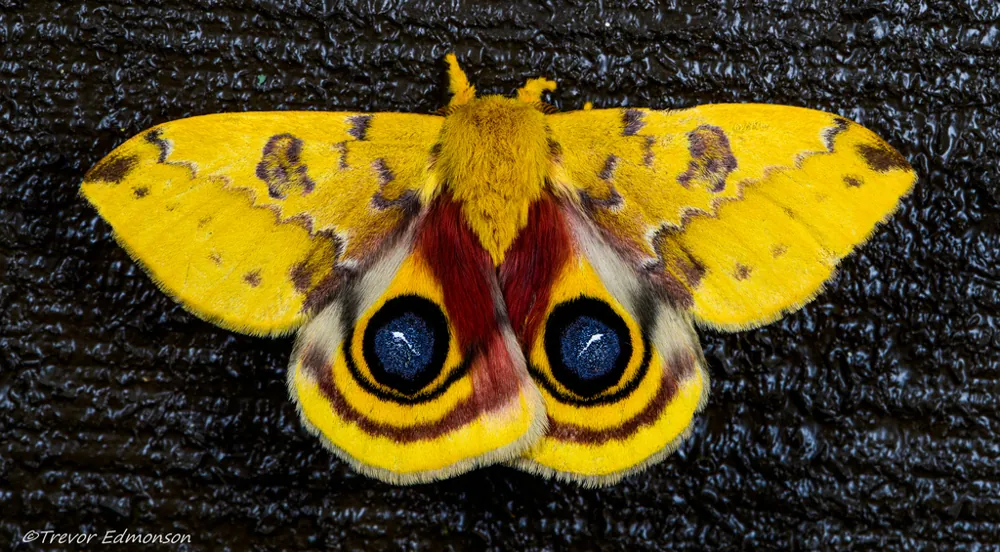
The Io moth is a colourful moth from North America. Its adults are striking, with large eyespots on their wings. Its green caterpillars carry spines that release a very painful venom, so they should be left alone.1

 No anndirte ngal
- Males have bright yellow forewings, body and legs, and much bigger feathery antennae than females.1
- Females have reddish-brown to purple forewings, body and legs.1
- Both sexes have one large black to bluish eyespot with some white in the centre on each hindwing.1
- Mature caterpillars are bright green and covered in spines, with two lateral stripes: the upper one bright red and the lower one white.1
- Adults have a wingspan of 6.3 to 8.8 cm.1
Doole tooke
Leɓɓe tokooso ina pelloo e nguru, ina njukka.
Hol ko tooke ŋatgol mum waɗata?
The spines of the green caterpillars release a very painful venom at the slightest touch. Contact is not life-threatening to humans, but it irritates the skin and causes an acute skin inflammation called erucism.1
Hol no bone mum heewiri e yimɓe?
Bone e yimɓe: MuusɗoIna waawi muusde sanne, kono hertaani wonde huunde mawnde.Contact with the spines is not life-threatening to humans, but it causes painful skin irritation.1
Hol ko ngal waɗata so ina hula?
When sitting head-down or when touched, adults shake and expose their hindwing eyespots. Caterpillars defend themselves with stinging spines.1
 So a meemii leɓɓe mum
- Ngam leɓɓe ngooɓuuli jukkooje: ittu ɗe e skots ɓataaɗo, refti loot nguru ngu. Wota a moomtu.
- Ngam ŋatgol: loot nokku oo, ɓuuɓnu. Heɓ ballal cafrol so neɗɗo oo ina wiya wonaa e jam, walla ina ƴiiɗa ko newii.
Adii fof noddu nimero urgence (112, 000, 911). Ɗum ko anndinal ballal adiingal, wonaa saaraangal doktoor. Ko adii e ballal adiingal
 Reen hoore maa
- Wota a meem, wota a nanngu, wota a ñiŋŋu kullal ladde haa abada, hay so ngal ina famɗi, hay so ina nanndi e ɗaaniingal walla maayngal.
- Accu ngal nokku. So a fotti e ngal, deƴƴu, ruttu ɓaawo seeɗa seeɗa, accu ngal yaha laawol mum.
- So a meemii leɓɓe mum: deƴƴu, wota a dillu, noddu nimero urgence (112, 000, 911) walla yahu opitaal law. Jogo e hakkille no ngal nanndi, natal ina walla.
Ngal faalaaka gaañde ma. Ina huutoroo tooke mum ngam nanngude ñaamdu walla reenaade, ina ɓuri yiɗde suuɗaade. Ɓeydu anndude no reentortoo
Hol to e aduna?
Hol no mawniri?
Hol no juutiri?
 juutde no kaaɗe mahirɗe 3 ɗaɓɓondiraaɗe
 ɓuri kokiyaas ngesa leelde
Hol no Io moth mawniri, so fooɗondiraama e AN?
Limgal tan e navigatoor maa. Alaa ko danndetee walla ko neldetee.
Hol no yaawiri?

Humpito
The caterpillars' spines are urticating, meaning they can cause a stinging reaction on contact.1
Adults live only 1 to 2 weeks and do not eat during this stage.1
After emerging from the cocoon, adults inflate their furled wings with fluid pumped from the body, which takes about twenty minutes.1
Females attract males by releasing wind-borne scent chemicals (pheromones) from a gland at the end of the abdomen.1
Many flies and wasps are parasitoids of this moth, laying their eggs in or on it.1
Ngam ganduɓe tooke
- Innde ganndal
- Automeris io
- Fedde
- Ngooɓuuli e ɓuuɓuuli
- Ɓesngu
- Saturniidae2
- Ordre
- Lepidoptera
- Leyɗe mawɗe
- Amerik Rewo
- Ɓiɓɓe tokooso
- Females lay clusters of more than twenty small white eggs on leaves. The eggs hatch within 8 to 11 days.1
- Hol no ngal woniri e ladde
- Not evaluated by the IUCN Red List and has no special status on the US Federal List. Populations in the eastern US are declining and becoming more localised.1
- Bone e yimɓe
- 2 / 5: Muusɗo3
Ɗo humpito iwri
- Automeris io (Wikipedia (CC BY-SA 4.0))
- Automeris io (iNaturalist): inɗe e ceergal.
- Venom Wiki: tolno bone, mawnude heewnde e miijo yaawde ko amen. Yiy no men keɓirta ɗum: No men tolnirta bone.
Kala humpito e ngoo hello ina jogii limoore hollirnde iwdi mum. So men juumii, yaafo, men ko yiɗɓe kulle, wonaa jaaynde ganndal. Wiy men e [email protected], men feewnita.
 Yaare nden ina weelaa! Venom Wiki ko golle neɗɗo gooto: yoɓetaake, alaa ko jeeyetee, alaa rewɓe. Ndokkal seeɗa ina walla ngam heddude e enternet.Ñaam yaare nden
Goɗɗe e nder fedde wootere: Ngooɓuuli e ɓuuɓuuli
 Giant water bugNgooɓuuli e ɓuuɓuuliIna muusi tan
 Puss caterpillarNgooɓuuli e ɓuuɓuuliIna muusi tanWota a meem
 Saddleback caterpillarNgooɓuuli e ɓuuɓuuliIna muusi tanWota a meem
 Wheel bugNgooɓuuli e ɓuuɓuuliIna muusi tan
 Giant vinegaroonNgooɓuuli e ɓuuɓuuliAlaa bone
 Rhodnius kissing bugNgooɓuuli e ɓuuɓuuliIna sokli doktoor
 Terciopelo
 Eastern coral snake
 Eastern diamondback rattlesnake
 Eyelash viper
 Timber rattlesnake
 Western diamondback rattlesnake