
 Afrik
Afrik Aazi
Aazi Orop
Orop Amerik Worgo
 Ostaraali e Oseyaani
 Antarktik
 Geec Pasifik
 Geec Atlantik
 Geec Enndo
 Geec Arktik
 Geec Mediteraane
 Geec Boɗeejo
 Geec Karayib
 Geec Korayl
 Geec Siin Worgo
 Geec Filipiin
 Geec Andaman
 Geec Rewo
 Geec Timor e Arafura
 Gulf Bengal
 Gulf Kaliforni
Rough-skinned newt
 Tooke e nguru mum
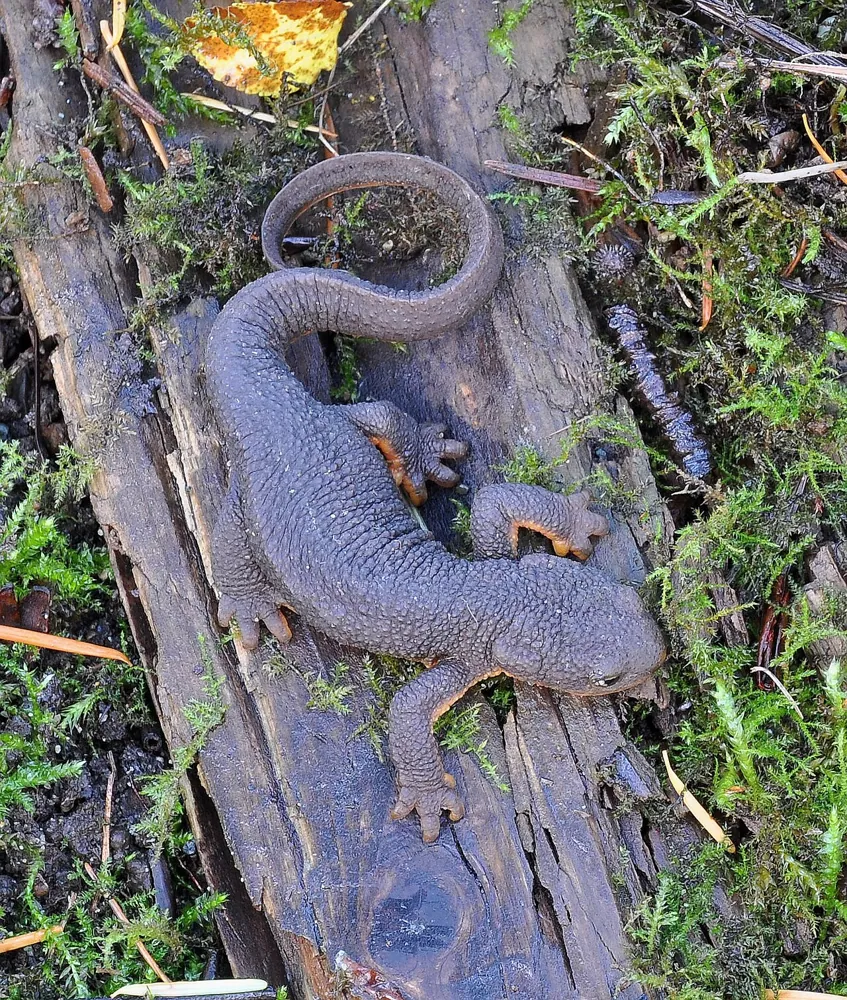
The rough-skinned newt is a small, stocky amphibian from the Pacific Northwest of North America. Its skin gives off one of the strongest toxins of any newt, so it is a creature to admire from a distance and never handle. Its toxin is also linked to a famous fight between newts and garter snakes.1
 No anndirte ngal
- Stocky body with a rounded snout.1
- Top ranges from light brown to olive or brownish-black.1
- Underside, including the head, legs and tail, is orange to yellow.1
- Skin is granular, but males are smooth-skinned during the breeding season.1
- Adults are 11 to 18 cm long overall, including the tail.1
Ina heewi waylondireede e: The California newt (Taricha torosa) looks similar. The rough-skinned newt has smaller eyes, yellow irises, V-shaped tooth patterns and uniformly dark eyelids. During breeding season, males have large swollen vent lobes and cornified toe pads, which separate them from females.1
Doole tooke ɓanndu
Nguru mum ina jogii tooke. Ina bonna so meemaama, lakkaama walla ñaamaama.
Hol ko tooke ɓanndu mum waɗata?
This animal is poisonous rather than venomous, so it does not bite or sting. Its skin produces tetrodotoxin (TTX), a neurotoxin that attacks the nerves. It blocks the sodium channels that nerves need to send signals. This can cause paralysis and death by asphyxiation, which means the person cannot breathe.1
Hol no bone mum heewiri e yimɓe?
Bone e yimɓe: Bone sanneIna waawi warde neɗɗo mo safraaka.The toxin is mainly dangerous if the newt is eaten. Some people have had skin irritation after handling the newt, especially if they touch their eyes without washing their hands first. In 1979, a 29-year-old man from Oregon died after eating one. Some newts make enough toxin to kill several adult humans.1
Hol ko ngal waɗata so ina hula?
It gives off an acrid smell that warns animals to stay away.1
 So neɗɗo meemii ngal walla ñaamii ngal
- So neɗɗo meemii gooto: loot juuɗe ɗee no moƴƴiri, wota a meem gite walla hunduko. So cukalel walla kullal galle lakkii walla ñaamii gooto: noddu centre antipoison walla nimero urgence.
Adii fof noddu nimero urgence (112, 000, 911). Ɗum ko anndinal ballal adiingal, wonaa saaraangal doktoor. Ko adii e ballal adiingal
 Reen hoore maa
- Wota a meem, wota a nanngu, wota a ñiŋŋu kullal ladde haa abada, hay so ngal ina famɗi, hay so ina nanndi e ɗaaniingal walla maayngal.
- Accu ngal nokku. So a fotti e ngal, deƴƴu, ruttu ɓaawo seeɗa seeɗa, accu ngal yaha laawol mum.
- So a meemii ngal walla a ñaamii ngal: wota a moomtu gite maa walla hunduko maa, loot juuɗe maa, heɓ ballal cafrol.
Ngal faalaaka gaañde ma. Tooke mum woni tan ngam wota huunde ñaam ngal. Ɓeydu anndude no reentortoo
Hol to e aduna?
Hol no mawniri?
Hol no juutiri?
 juutde no kaaɗe mahirɗe 6 ɗaɓɓondiraaɗe
Hol no Rough-skinned newt mawniri, so fooɗondiraama e AN?
Limgal tan e navigatoor maa. Alaa ko danndetee walla ko neldetee.
Hol no yaawiri?


Humpito
Some common garter snakes can eat rough-skinned newts and survive. They are the only known animals today able to do this.1
A garter snake tests a newt's toxin level by partly swallowing it, then either swallows it fully or lets it go.1
Newts can detect the chemical signature of a snake that has digested one of their kind, and they move away from it.1
The toxin is made by the newt's skin microbiome, meaning the bacteria living on its skin.1
The newt and the garter snake are an example of an evolutionary arms race. Each change in one species drives change in the other.1
The toxin also appears in pufferfish and other marine animals, which share the same nerve-blocking effect.1
Ɗo humpito iwri
- Rough-skinned newt (Wikipedia (CC BY-SA 4.0))
- Taricha granulosa (iNaturalist): inɗe e ceergal.
- Venom Wiki: tolno bone, mawnude heewnde e miijo yaawde ko amen. Yiy no men keɓirta ɗum: No men tolnirta bone.
Kala humpito e ngoo hello ina jogii limoore hollirnde iwdi mum. So men juumii, yaafo, men ko yiɗɓe kulle, wonaa jaaynde ganndal. Wiy men e [email protected], men feewnita.
 Yaare nden ina weelaa! Venom Wiki ko golle neɗɗo gooto: yoɓetaake, alaa ko jeeyetee, alaa rewɓe. Ndokkal seeɗa ina walla ngam heddude e enternet.Ñaam yaare nden
Goɗɗe e nder fedde wootere: Ñaari tooke, ñaari e newts
 Cane toadÑaari tooke, ñaari e newtsIna sokli doktoorWota a meem
 Strawberry poison-dart frogÑaari tooke, ñaari e newtsIna muusi tanWota a meem
 California newtÑaari tooke, ñaari e newtsIna waawi wardeWota a meem
 Colorado River toadÑaari tooke, ñaari e newtsIna sokli doktoorWota a meem
 Panamanian golden frogÑaari tooke, ñaari e newtsIna sokli doktoorWota a meem
 Eastern newtÑaari tooke, ñaari e newtsIna muusi tanWota a meem
 Terciopelo
 Eastern coral snake
 Eastern diamondback rattlesnake
 Eyelash viper
 Timber rattlesnake
 Western diamondback rattlesnake
.JPG)