
 Afrik
Afrik Aazi
Aazi Orop
Orop Amerik Worgo
 Ostaraali e Oseyaani
 Antarktik
 Geec Pasifik
 Geec Atlantik
 Geec Enndo
 Geec Arktik
 Geec Mediteraane
 Geec Boɗeejo
 Geec Karayib
 Geec Korayl
 Geec Siin Worgo
 Geec Filipiin
 Geec Andaman
 Geec Rewo
 Geec Timor e Arafura
 Gulf Bengal
 Gulf Kaliforni
Turkish deathstalker
 Jukkugol
The Turkish deathstalker is a scorpion from the family Buthidae. Its venom is highly toxic to humans, but scientists also use scorpion venom in medical research. It lives in dry, rocky places and usually keeps away from people.1


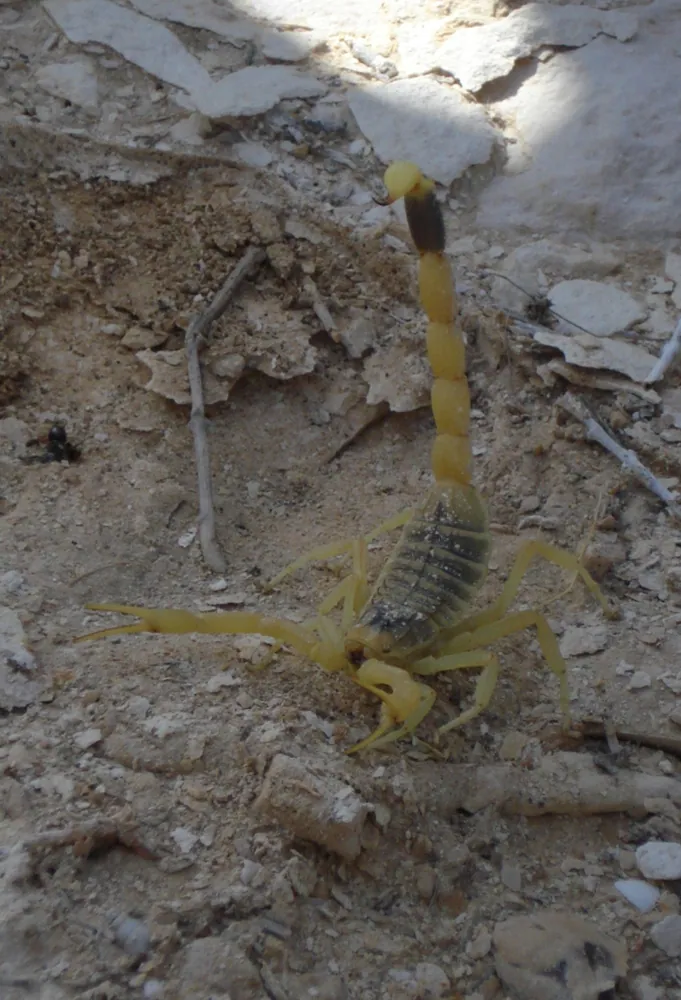
 No anndirte ngal
- Brown front body section (cephalothorax), with a yellow head, legs and tail.1
- The very last segment of the tail is brown instead of yellow.1
- Its pincers and other body parts are yellowish, against a mostly black background on the front body and tail.1
Ina heewi waylondireede e: It was once considered the same species as the deathstalker (L. quinquestriatus), but was reclassified as a separate species in 2009 based on mitochondrial DNA analysis. Its tail segments are shorter than those of the deathstalker.1
Doole tooke
Tooke ngal ina yaltira jukkirgal.
Hol ko tooke ŋatgol mum waɗata?
Its venom comes from two venom glands and is mainly made of proteins. It stimulates voltage-gated sodium and potassium channels, which control the electrical signals in nerves and muscles. Symptoms can be severe: after a sting, pain can come in waves with seizures, and blisters can form at the site of the sting.1
Hol no bone mum heewiri e yimɓe?
Bone e yimɓe: Bone sanneIna waawi warde neɗɗo mo safraaka.Only a small portion of scorpions are harmful to humans, but this species' venom is very toxic and can cause severe symptoms from a single sting. The sting is much worse in children, and it may pose a serious health threat to infants because of their small body weight.1
Hol ko ngal waɗata so ina hula?
Its venom is used for self-defence as well as for hunting.1
 So ina jukka
- Anyone who has been stung should have an early echocardiogram, which is a heart ultrasound, because the venom can affect the heart. In the case described, the patient was given sodium chloride (saline) and a local painkiller at hospital.1
- Ɓuuɓnu nokku jukkaaɗo oo e galaas, haɗ neɗɗo oo dillaade. Heɓ ballal cafrol law, ɓuri noon e sukaaɓe: yaare goɗɗe ina mbara sukaaɓe.
Adii fof noddu nimero urgence (112, 000, 911). Ɗum ko anndinal ballal adiingal, wonaa saaraangal doktoor. Ko adii e ballal adiingal
 Reen hoore maa
- Wota a meem, wota a nanngu, wota a ñiŋŋu kullal ladde haa abada, hay so ngal ina famɗi, hay so ina nanndi e ɗaaniingal walla maayngal.
- Accu ngal nokku. So a fotti e ngal, deƴƴu, ruttu ɓaawo seeɗa seeɗa, accu ngal yaha laawol mum.
- So gooto jukkii ma: deƴƴu, wota a dillu, noddu nimero urgence (112, 000, 911) walla yahu opitaal law. Jogo e hakkille no ngal nanndi, natal ina walla.
Ngal faalaaka gaañde ma. Ina huutoroo tooke mum ngam nanngude ñaamdu walla reenaade, ina ɓuri yiɗde suuɗaade. Ɓeydu anndude no reentortoo
Hol to e aduna?
Hol no mawniri?
Hol no juutiri?
 juutde no kaaɗe mahirɗe 3 ɗaɓɓondiraaɗe
 ina waawi taƴde 100 meeteer e segonde 200 (neɗɗo ɓurɗo yaawde ina sokli 9,6)
Hol no Turkish deathstalker mawniri, so fooɗondiraama e AN?
Limgal tan e navigatoor maa. Alaa ko danndetee walla ko neldetee.
Hol no yaawiri?


Humpito
In one recorded case, a sting on the thumb of a 30-year-old man caused pain, reddening, seizures and blisters, and he was unable to move his arm up for a time.1
When a male wants to mate, he injects a small dose of venom into the female to calm her before they move together in a dance-like pattern.1
In tests on rats, the venom of this species had a greater effect than the venom of the Arabian fat-tailed scorpion (Androctonus crassicauda).1
Its venom is studied for treating nervous, immune, infection, cardiovascular and cancer (neoplastic) diseases.1
Birds, bats and mice prey on scorpions, which is why they are more active on moonless nights.1
Ɗo humpito iwri
- Leiurus abdullahbayrami (Wikipedia (CC BY-SA 4.0))
- Leiurus abdullahbayrami (iNaturalist): inɗe e ceergal.
- Venom Wiki: tolno bone, mawnude heewnde e miijo yaawde ko amen. Yiy no men keɓirta ɗum: No men tolnirta bone.
Kala humpito e ngoo hello ina jogii limoore hollirnde iwdi mum. So men juumii, yaafo, men ko yiɗɓe kulle, wonaa jaaynde ganndal. Wiy men e [email protected], men feewnita.
 Yaare nden ina weelaa! Venom Wiki ko golle neɗɗo gooto: yoɓetaake, alaa ko jeeyetee, alaa rewɓe. Ndokkal seeɗa ina walla ngam heddude e enternet.Ñaam yaare nden
 Yaare oolnde maayde
 Indian red scorpion
 Arabian fat-tailed scorpion
 Chinese scorpion
 Asian forest scorpion
 Giant forest scorpion
 Kobra Enndo
 Wipeer cerkeeje siy Enndo
 Kobra laamɗo
 Mbaa-ndiyam (Puff adder)
 Ladde Russell
 Asian giant hornet