
 África
 Asia
Asia Europa
 América do Sur
 Australia e Oceanía
 Antártida
 Océano Pacífico
 Océano Atlántico
 Océano Índico
 Océano Glacial Ártico
 Mar Mediterráneo
 Mar Vermello
 Mar Caribe
 Mar do Coral
 Mar da China Meridional
 Mar de Filipinas
 Mar de Andamán
 Mar do Norte
 Mar de Timor e de Arafura
 Golfo de Bengala
 Golfo de California
Red-naped snake
 Morde
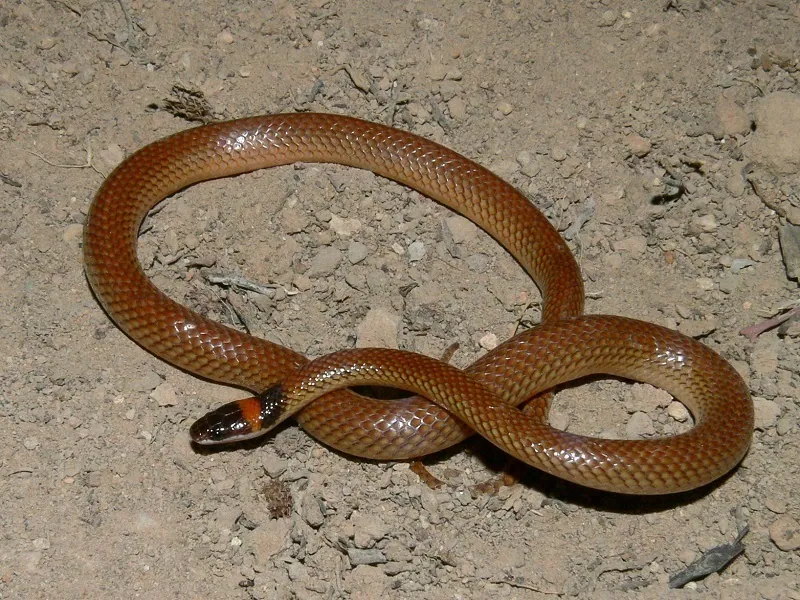
MordeThe red-naped snake is a small venomous snake with a bright red or orange patch on the back of its neck. It lives in many parts of eastern and central Australia, mostly hunting at night. It is special because it looks very like the young eastern brown snake, which is far more dangerous.1

 Como recoñecelo
- Small, slim snake, reaching a maximum length of about 45 cm1
- Shiny black head and neck, with small black eyes and a head that looks partly flattened1
- A white streak on the upper lip1
- A well-defined orange or red patch on the back of the neck, shaped like a diamond, crescent or oval1
- Red-brown body with dark edges to the scales, so the pattern looks like a net; the belly is cream or white1
Adoita confundirse con: The red-naped snake looks similar to the juvenile eastern brown snake. The eastern brown snake has a lighter band between its dark head and neck. Behaviour is the easiest difference: the eastern brown snake is active in the day, while the red-naped snake is nocturnal and is rarely seen unless its shelter is disturbed.1
Poder da pezoña
A pezoña sae polos seus cairos ou dentes cando morde.
Que perigoso é para as persoas?
Perigo para as persoas: LeveComa unha picadura de abella ou menos. Practicamente inofensivo para as persoas.The red-naped snake is venomous, but it is considered harmless to humans. It can bite, and will do so if it is provoked enough.1
Que fai cando ten medo?
When threatened, it strikes out several times with the front of its body raised off the ground, usually with its mouth closed.1
 Se morde
- Inmobilización con presión: envolve cunha venda elástica firme a mordedura e despois todo o membro cara arriba, ponlle unha férula e mantén a persoa completamente quieta ata que chegue a axuda.
- Non laves a mordedura: no hospital poden analizar a pezoña que queda na pel para escoller o antiveleno axeitado.
Chama sempre primeiro ao teu número de emerxencias (112, 000, 911). Isto son consellos xerais de primeiros auxilios, non consello médico. Primeiros auxilios básicos
 Mantente a salvo
- Nunca toques, collas nin molestes un animal salvaxe, aínda que sexa pequeno e aínda que pareza durmido ou morto.
- Déixalle espazo. Se atopas un, mantén a calma, recúa amodo e déixao ir polo seu camiño.
- Se un te morde: mantén a calma, non te movas, chama ao teu número de emerxencias (112, 000, 911) ou vai rápido a un hospital. Lembra como era, unha foto axuda.
Non vai a por ti. Usa a súa pezoña para cazar comida ou para defenderse, e prefire con moito agocharse. Máis sobre como estar a salvo
En que lugar do mundo?
Que tamaño ten?
Canto mide?
 mide coma 2,5 bananas postas en fila
 mide coma 14 pezas de construción de xoguete en fila
 podería percorrer 100 metros en 61 segundos (o humano máis rápido precisa 9,6)
Que tamaño ten Red-naped snake comparado CONTIGO?
Só son contas no teu navegador. Non se garda nin se envía nada a ningures.
Que rápido é?


Datos
It kills its prey with both venom and constriction, squeezing the prey in its coils.1
Its look is so close to the young eastern brown snake that behaviour is often the only way to tell them apart.1
Its neck patch is one of its clearest markings: an orange or red shape on an otherwise black head and neck.1
It is nocturnal, so it is rarely seen unless its hiding place is disturbed.1
Para expertos en pezoñas
- Nome científico
- Furina diadema
- Grupo
- Serpes australianas
- Familia
- Elapidae2
- Orde
- Squamata
- Continentes
- Australia e Oceanía
- Crías
- It lays eggs. Recorded clutches range from 1 to 10 eggs, with an average of 3. Young hatch in January, or February in cooler regions, and become adults within a year.1
- Como lle vai na natureza
- Threatened (listed in Victoria)1
- Perigo para as persoas
- 1 / 5: Leve3
De onde veñen os datos
- Red-naped snake (Wikipedia (CC BY-SA 4.0))
- Furina diadema (iNaturalist): nomes e clasificación.
- Venom Wiki: o nivel de perigo, o tamaño típico e a velocidade estimada son nosos. Mira como os calculamos: Como valoramos o perigo.
Cada dato desta páxina ten un número que leva á súa fonte. Se nos equivocamos nalgo, sentímolo, somos fans dos animais, non unha revista científica. Dínolo en [email protected] e arranxarémolo.
 O escorpión ten fame! Venom Wiki é un proxecto dunha soa persoa: gratis, sen anuncios e sen rastrexadores. Unha pequena propina axuda a mantelo en liña.Dálle de comer ao escorpión
Máis do mesmo grupo: Serpes australianas
 Coastal taipan
 Common death adder
 Eastern brown snake
 Inland taipan
 Tiger snake
 Collett's snake
Tamén vive en: Australia e Oceanía
 Sydney funnel-web spiderTarántulas e arañas de tea en funilMortal
 Redback spiderArañasPrecisa un médico
 Brown tree snakeSerpes con cairos traseirosSó doe
 Hooded pitohuiOutros animais velenososSó doeNon tocar
 PlatypusMamíferos pezoñentosSó doe
 Northern tree-dwelling funnel-web spiderTarántulas e arañas de tea en funilMortal