
 Afirika
 Asiya
Asiya Bulaaya
 Amerika ey'Obukiikaddyo
 Awusitureeliya ne Oseyaniya
 Antakitika
 Oseyani ya Pasifiki
 Oseyani ya Atlantiki
 Oseyani y'e Buyindi
 Oseyani ya Arakitiki
 Ennyanja ya Mediterenia
 Ennyanja Emmyufu
 Ennyanja ya Karibiyani
 Ennyanja ya Korali
 Ennyanja ya China ey'Obukiikaddyo
 Ennyanja ya Bufilipino
 Ennyanja ya Andaman
 Ennyanja ey'Obukiikakkono (North Sea)
 Ennyanja ya Timor ne Arafura
 Ekikono kya Bengal
 Ekikono kya Kalifoniya
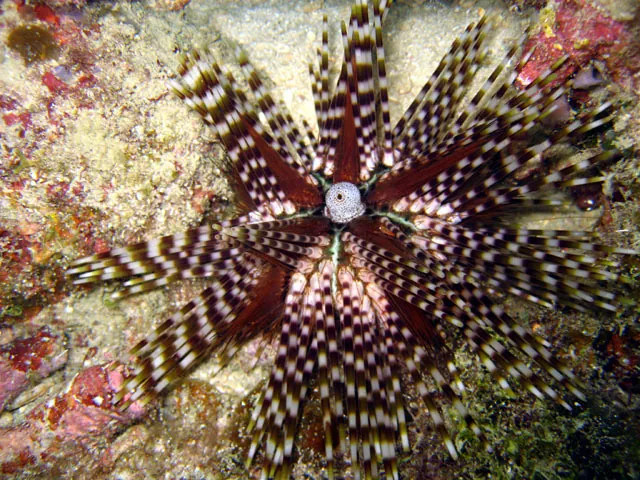
Banded sea urchin
 Amaggwa ag'obusagwa
The banded sea urchin is a spiny sea animal that lives on tropical reefs and in lagoons across the Indo-Pacific. It is active at night and hides in cracks or under rocks during the day. Its thin spines can deliver a sting, although the sting is not dangerous.1
 Engeri y'okukitegeera
- It has a slightly oval shell (test) about 5 cm across.1
- It has two kinds of spines: short, slender spines that run from yellow to dark, and longer, thicker spines that are often banded with light and dark colour.1
- The longer spines reach 10 to 15 cm and can be blunt and hollow.1
- Five bare zones in a star pattern show on the middle of the shell, and these can look blue.1
Kitera okutabulwa ne: Dark forms can look like Diadema setosum or Diadema savignyi. Diadema savignyi is bigger, more uniformly black, and has five white spots on top of its shell and an orange ring around its anus. The most common mix-up is Echinothrix diadema, which can have banded spines when young. Echinothrix diadema has a very small, all-black anal papilla and blue-sheened spines, and its spines do not crush easily, unlike the spines of the banded sea urchin.1
Amaanyi g'obusagwa
Amaggwa amasongovu ge galimu obusagwa. Okukirinnyako oba okukikwata kiruma.
Obusagwa bwakyo bukola ki?
The thinner, short spines are venomous, meaning they deliver venom through a sting. The sting is nasty, but the venom is not dangerous.1
Kirina akabi kenkana wa eri abantu?
Akabi eri abantu: Kya bulumiKisobola okuluma ddala, naye kumpi tekiba kya kabi kinene.The thinner spines are venomous but not dangerous.1
 Amaggwa gaakyo bwe gakufumita
- Teeka ekiwundu mu mazzi agookya, agookya nga omuntu bw'asobola okugumiikiriza nga tegamwokya, era funa obuyambi bw'abasawo okuggyamu amaggwa. Togasimamu ggwe kennyini.
Bulijjo sooka kuba ennamba y'ebigwa bitalaze (112, 000, 911). Buno bulagirizi bwa bujjanjabi obusooka obwa bulijjo, si kuwabula kwa musawo. Obujjanjabi obusooka obw'omusingi
 Weekuume
- Tokwatako, tokwata wadde okusoomooza ensolo ey'omu nsiko, ne bw'eba ntono, era ne bw'eba erabika nga yeebase oba nga efudde.
- Gireke n'ebbanga. Bw'osisinkana emu, beera mukkakkamu, dda emabega mpola era gireke egende mu kkubo lyayo.
- Amaggwa gaayo bwe gakufumita: beera mukkakkamu, totambula, kuba ennamba y'ebigwa bitalaze (112, 000, 911) oba tuuka mu ddwaliro mangu. Jjukira bwe yali efaanana, ekifaananyi kiyamba.
Tekikunoonya. Kikozesa obusagwa bwakyo okukwata emmere oba okwekuuma, era kyandisinze kwekweka. Ebirala ku kwekuuma
Wa mu nsi?
Kinene kyenkana wa?
Kiwanvu kyenkana wa?
 kiwanvu nga bbulooka 5 ez'okuzannyisa mu lunyiriri
 kirwawo okusinga ekkovu ly'omu nnimiro
Banded sea urchin kinene kyenkana wa bw'ogeraageranya ne GGWE?
Kubala bwokka mu browser yo. Tewali kitterekebwa wadde okusindikibwa wonna.
Kidduka kyenkana wa?

Ebituufu
Its anal papilla is large and whitish with black and white dots, and a ring of visual receptors around it gives it basic vision.1
Young cardinal fish from the family Apogonidae often hide among the spines for protection.1
In Hawaii, this sea urchin often carries a symbiotic crab, Echinoecus pentagonus, that lives with it.1
It is active at night and spends the day hidden in crevices or under rocks.1
Ku bakugu mu busagwa
- Erinnya erya ssaayansi
- Echinothrix calamaris
- Ekibinja
- Sea urchin, sea star ne fireworm
- Amaka
- Diadematidae2
- Ensengeka
- Diadematoida
- Ssemazinga
- Oseyani y'e Buyindi, Oseyani ya Pasifiki, Ennyanja Emmyufu, Ennyanja ya Korali, Ennyanja ya Bufilipino, Ennyanja ya Timor ne Arafura, Ekikono kya Bengal, Oseyani
- Akabi eri abantu
- 2 / 5: Kya bulumi3
Ebituufu we biva
- Echinothrix calamaris (Wikipedia (CC BY-SA 4.0))
- Echinothrix calamaris (iNaturalist): amannya n'ensengeka y'ebika.
- Venom Wiki: omutendera gw'akabi, obunene obwa bulijjo n'okuteebereza kw'embiro bibyaffe. Laba engeri gye tubibalamu: Engeri gye tupimamu akabi.
Buli kituufu ku lupapula luno kirina ennamba eraga we kyava. Bwe tuba tukoze ensobi, tusonyiwe, tuli bayagazi ba nsolo, so si magazini ya ssaayansi. Tubuulire ku [email protected] tujja kugitereeza.
 Enjaba erumwa enjala! Venom Wiki pulojekiti ya muntu omu: ya bwereere, tewali birango era tewali bikulondoola. Akasiimo akatono kayamba okugikuuma ku yintaneti.Liisa enjaba
Ebirala okuva mu kibinja kye kimu: Sea urchin, sea star ne fireworm
 Crown-of-thorns starfishSea urchin, sea star ne firewormKyetaaga omusawoTokwatako
 Flower urchinSea urchin, sea star ne firewormKisobola okutta
 Fire urchinSea urchin, sea star ne firewormKyetaaga omusawoTokwatako
 Bearded firewormSea urchin, sea star ne firewormKiruma bwokkaTokwatako
 Black long-spined urchinSea urchin, sea star ne firewormKiruma bwokkaTokwatako
 BloodwormSea urchin, sea star ne firewormKiruma bwokka
Era kibeera mu: Oseyani y'e Buyindi
 Australian box jellyfishJellyfish n'ebibojja eby'ennyanjaKittaTokwatako
 Geography coneCone snail ne octopusKitta
 Greater blue-ringed octopusCone snail ne octopusKitta
 Southern blue-ringed octopusCone snail ne octopusKitta
 Hawksbill sea turtleEnsolo endala ez'obutwaKisobola okutta
 Irukandji jellyfishJellyfish n'ebibojja eby'ennyanjaKisobola okuttaTokwatako