
 Afirika
 Asiya
Asiya Bulaaya
 Amerika ey'Obukiikaddyo
 Awusitureeliya ne Oseyaniya
 Antakitika
 Oseyani ya Pasifiki
 Oseyani ya Atlantiki
 Oseyani y'e Buyindi
 Oseyani ya Arakitiki
 Ennyanja ya Mediterenia
 Ennyanja Emmyufu
 Ennyanja ya Karibiyani
 Ennyanja ya Korali
 Ennyanja ya China ey'Obukiikaddyo
 Ennyanja ya Bufilipino
 Ennyanja ya Andaman
 Ennyanja ey'Obukiikakkono (North Sea)
 Ennyanja ya Timor ne Arafura
 Ekikono kya Bengal
 Ekikono kya Kalifoniya
Emerald cockroach wasp
 Kibojja
The emerald cockroach wasp is a solitary wasp with a shiny metallic blue-green body. It lives in tropical parts of Africa, South Asia, Southeast Asia and the Pacific islands, and it has an unusual way of raising its young. It uses a cockroach as food and a home for its larvae.1


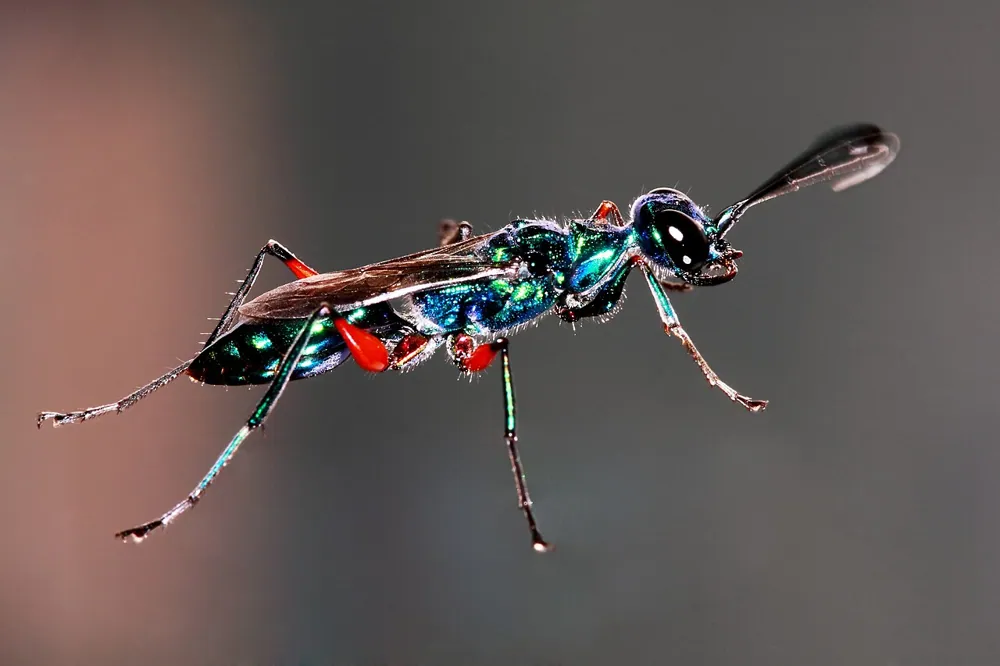
 Engeri y'okukitegeera
Amaanyi g'obusagwa
Obusagwa buyita mu ggwa lyakyo eribojja.
Obusagwa bwakyo bukola ki?
The venom works on the cockroach's nervous system. The first sting causes short paralysis of the front legs, and the second sting, into the brain, stops the cockroach from escaping and makes it groom and move sluggishly. The effect lasts for about 72 hours.1
Kirina akabi kenkana wa eri abantu?
Akabi eri abantu: KitonoNga okubojja kw'enjuki oba okutono okusingawo. Kumpi tekirina kabi eri abantu. Bwe kibojja
- Kalakata oggyemu eriggwa ly'enjuki era onyogoze ekifo.
- Omuntu bw'aba nga tassa bulungi, ng'azimbye mu maaso oba mu mumiro, oba ng'awulira ng'agenda kuzirika, buno bubenje bwa alergy obw'amangu: kuba ennamba y'ebigwa bitalaze era kozesa empiso ye eya adrenaline (adrenaline pen) bw'aba nga agirina.
Bulijjo sooka kuba ennamba y'ebigwa bitalaze (112, 000, 911). Buno bulagirizi bwa bujjanjabi obusooka obwa bulijjo, si kuwabula kwa musawo. Obujjanjabi obusooka obw'omusingi
 Weekuume
- Tokwatako, tokwata wadde okusoomooza ensolo ey'omu nsiko, ne bw'eba ntono, era ne bw'eba erabika nga yeebase oba nga efudde.
- Gireke n'ebbanga. Bw'osisinkana emu, beera mukkakkamu, dda emabega mpola era gireke egende mu kkubo lyayo.
- Bw'emu ekubojja: beera mukkakkamu, totambula, kuba ennamba y'ebigwa bitalaze (112, 000, 911) oba tuuka mu ddwaliro mangu. Jjukira bwe yali efaanana, ekifaananyi kiyamba.
Tekikunoonya. Kikozesa obusagwa bwakyo okukwata emmere oba okwekuuma, era kyandisinze kwekweka. Ebirala ku kwekuuma
Wa mu nsi?
Kinene kyenkana wa?
Kiwanvu kyenkana wa?
 kiwanvu nga pepa kiripu
 kyandisobodde okubuuka okusala ekisaawe ky'omupiira kyonna mu sikonda 14
Emerald cockroach wasp kinene kyenkana wa bw'ogeraageranya ne GGWE?
Kubala bwokka mu browser yo. Tewali kitterekebwa wadde okusindikibwa wonna.
Kidduka kyenkana wa?


Ebituufu
The wasp stings a cockroach twice, aiming for specific nerve clusters in its body and head, rather than just injecting venom at random.1
After stinging, the wasp leads the cockroach to its burrow by pulling on one of its antennae, like a leash, even though the wasp is too small to carry it.1
The stung cockroach can still walk, swim and flip over, but it loses its normal urge to escape.1
The larva eats the cockroach's internal organs over about 8 days, and the adult wasp later emerges from the dead cockroach's body.1
A single mating is enough for a female to parasitise several dozen cockroaches.1
The wasp was brought to Hawaii in 1941 as a biological control, but this did not work well because of the wasp's territorial behaviour and the small scale on which it hunts.1
Ku bakugu mu busagwa
- Erinnya erya ssaayansi
- Ampulex compressa
- Ekibinja
- Enjuki, ennumba n'ennumba ennene
- Amaka
- Ampulicidae2
- Ensengeka
- Hymenoptera
- Ssemazinga
- Asiya, Afirika
- Abaana abawere
- The female lays one or two white eggs, about 2 mm long, between the legs of a stung cockroach. Each egg hatches after about 3 days.1
- Akabi eri abantu
- 1 / 5: Kitono3
Ebituufu we biva
- Emerald cockroach wasp (Wikipedia (CC BY-SA 4.0))
- Ampulex compressa (iNaturalist): amannya n'ensengeka y'ebika.
- Venom Wiki: omutendera gw'akabi, obunene obwa bulijjo n'okuteebereza kw'embiro bibyaffe. Laba engeri gye tubibalamu: Engeri gye tupimamu akabi.
Buli kituufu ku lupapula luno kirina ennamba eraga we kyava. Bwe tuba tukoze ensobi, tusonyiwe, tuli bayagazi ba nsolo, so si magazini ya ssaayansi. Tubuulire ku [email protected] tujja kugitereeza.
 Enjaba erumwa enjala! Venom Wiki pulojekiti ya muntu omu: ya bwereere, tewali birango era tewali bikulondoola. Akasiimo akatono kayamba okugikuuma ku yintaneti.Liisa enjaba
Ebirala okuva mu kibinja kye kimu: Enjuki, ennumba n'ennumba ennene
 Asian giant hornetEnjuki, ennumba n'ennumba enneneKisobola okutta
 Common waspEnjuki, ennumba n'ennumba enneneKiruma bwokka
 European hornetEnjuki, ennumba n'ennumba enneneKiruma bwokka
 Western honey beeEnjuki, ennumba n'ennumba enneneKiruma bwokka
 Giant honey beeEnjuki, ennumba n'ennumba enneneKyetaaga omusawo
 Asian hornetEnjuki, ennumba n'ennumba enneneKiruma bwokka
 Deathstalker
 Indian cobra
 Indian saw-scaled viper
 King cobra
 Puff adder
 Essalambwa lya Russell