
 Africa
 Asia
Asia Ulaya
Ulaya Amereka ya Kumwera
 Australia ndi Oceania
 Antarctica
 Nyanja ya Pacific
 Nyanja ya Atlantic
 Nyanja ya Indian
 Nyanja ya Arctic
 Nyanja ya Mediterranean
 Nyanja Yofiira
 Nyanja ya Caribbean
 Nyanja ya Coral
 Nyanja ya South China
 Nyanja ya Philippine
 Nyanja ya Andaman
 Nyanja ya Kumpoto (North Sea)
 Nyanja ya Timor ndi Arafura
 Nyanja ya Bengal
 Gulf ya California
Anchieta's cobra
 Imaluma
Anchieta's cobra is a venomous snake that lives in parts of southwestern Africa. It is a ground-dwelling cobra that spreads a broad hood when threatened. It is active at night and often comes close to human homes and farmyards.1



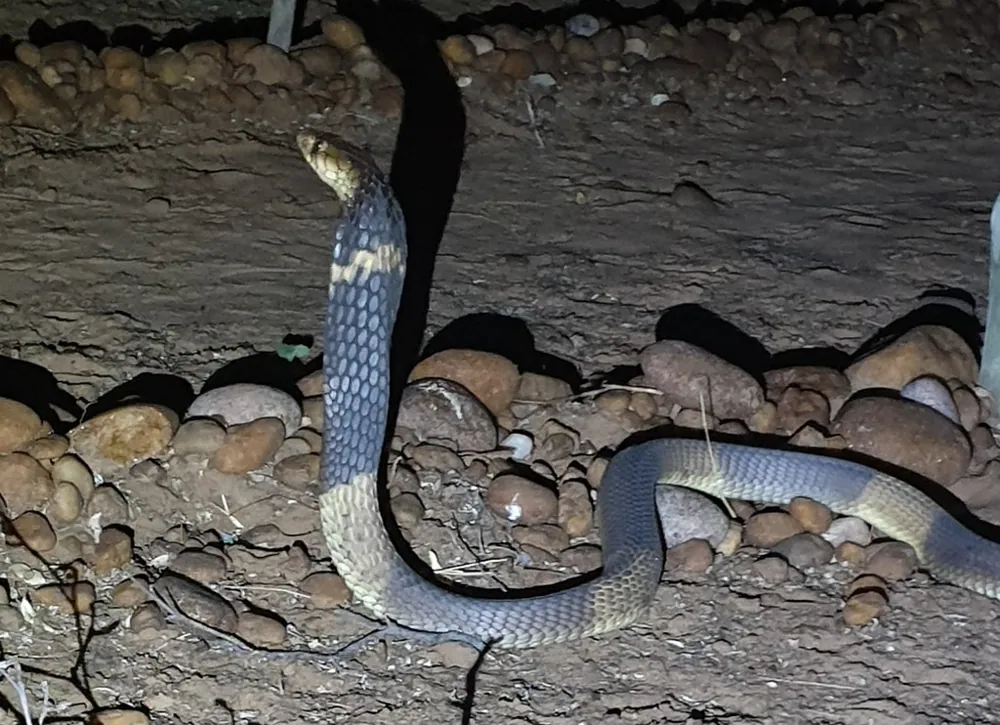
 Mmene ungaizindikirire
- Young snakes are yellowish to light brown, with a black band circling the neck.1
- As it grows, it becomes a darker brown and the neck band fades away.1
- The throat band, which covers the front belly scales, is blue-black.1
- When threatened, it spreads a large, impressive hood about 10 to 12 cm wide.1
- In the southernmost parts of its range, some snakes are black with yellow bands across the body and tail.1
Nthawi zambiri imasokonezedwa ndi: The snouted cobra is very similar in shape, size and habits. The Anchieta's cobra is more inclined to stand its ground when confronted by a threat.1
Mphamvu ya ululu
Ululu umatuluka kudzera m'mano ake ikaluma.
Ululu wake umachita chiyani?
Its venom is mainly a potent neurotoxin, which attacks the nerves. It may also contain cardiotoxic components, which harm the heart. Because it has moderately large size and relatively large fangs, it can inject a large volume of venom in a single bite.1
Ndi yoopsa bwanji kwa anthu?
Ngozi kwa anthu: Yoopsa kwambiriIngathe kupha munthu amene sanalandire chithandizo.Bites are rare, but they have been known to cause human deaths.1
Imachita chiyani ikachita mantha?
When provoked it lifts its front body off the ground, spreads its hood and takes a defensive posture, but it will flee if it gets the chance, and it sometimes feigns death.1
 Ikaluma
- Munthuyo akhale chete ndi wodekha, chotsa mphete ndi zinthu zothina, ndipo mufikitse kuchipatala mwachangu: antivenom ndiye mankhwala ake.
Nthawi zonse yamba wayimbira nambala yadzidzidzi (112, 000, 911). Awa ndi malangizo wamba a chithandizo choyamba, osati malangizo a dokotala. Zoyambira za chithandizo choyamba
 Khala wotetezeka
- Usakhudze, kugwira kapena kuseweretsa nyama yakuthengo, ngakhale yaing'ono, ndipo ngakhale ikuoneka ngati yagona kapena yafa.
- Ipatse malo. Ukakumana nayo, khala chete, bwerera m'mbuyo pang'onopang'ono ndipo uilole ipite njira yake.
- Ikakuluma: khala chete, usasunthe, imbira nambala yadzidzidzi (112, 000, 911) kapena pita kuchipatala mwachangu. Kumbukira m'mene inkaonekera, chithunzi chimathandiza.
Sikufuna kukuvulaza. Imagwiritsa ntchito ululu wake kugwira chakudya kapena kudziteteza, ndipo imakonda kwambiri kubisala. Zambiri za kukhala wotetezeka
Kuti padziko lapansi?
Ndi yaikulu bwanji?
Ndi yaitali bwanji?
 yaitali ngati amphaka apakhomo 5 mphuno ndi mchira motsatizana
 yaitali ngati nthochi 13 zoyalidwa motsatizana
 ingathamange mamita 100 m'masekondi 46 (munthu wothamanga kwambiri amafunika 9.6)
Anchieta's cobra ndi yaikulu bwanji poyerekeza ndi IWE?
Ndi masamu chabe mu msakatuli wako. Palibe chomwe chimasungidwa kapena kutumizidwa kwina.
Imathamanga bwanji?


Mfundo
The longest recorded male was 2.31 metres long and was caught in Windhoek, Namibia.1
It is hunted by birds of prey such as secretary birds and snake eagles, and by honey badgers and white-throated monitors.1
Males and females grow to similar sizes, although males usually have larger heads and longer tails.1
A banded form has been noted in roughly 13% of males and up to 22% of females.1
Za akatswiri a ululu
Kumene mfundo zimachokera
- Anchieta's cobra (Wikipedia (CC BY-SA 4.0))
- Naja anchietae (iNaturalist): mayina ndi magulu a sayansi.
- Venom Wiki: mlingo wa ngozi, kukula wamba ndi kuyerekeza kwa liwiro ndi zathu. Ona mmene timazipezera: Mmene timayezera ngozi.
Mfundo iliyonse patsamba lino ili ndi nambala yosonyeza kochokera. Ngati talakwitsa, pepani, ndife okonda nyama, osati magazini a sayansi. Tiuze pa [email protected] ndipo tikonza.
 Chinkhanira chili ndi njala! Venom Wiki ndi ntchito ya munthu mmodzi: yaulere, yopanda zotsatsa ndi zokutsatira. Mphatso yaing'ono imathandiza kuti ikhalebe pa intaneti.Dyetsa chinkhanira
 Black mamba
 Egyptian cobra
 Cape cobra
 Eastern green mamba
 Jameson's mamba
 Western green mamba
 Deathstalker
 Puff adder
 Boomslang
 Fat-tailed scorpion
 Gaboon viper
 Western honey bee