
 Africa
 Asia
Asia Ulaya
Ulaya Amereka ya Kumwera
 Australia ndi Oceania
 Antarctica
 Nyanja ya Pacific
 Nyanja ya Atlantic
 Nyanja ya Indian
 Nyanja ya Arctic
 Nyanja ya Mediterranean
 Nyanja Yofiira
 Nyanja ya Caribbean
 Nyanja ya Coral
 Nyanja ya South China
 Nyanja ya Philippine
 Nyanja ya Andaman
 Nyanja ya Kumpoto (North Sea)
 Nyanja ya Timor ndi Arafura
 Nyanja ya Bengal
 Gulf ya California
Cupboard spider
 Imaluma
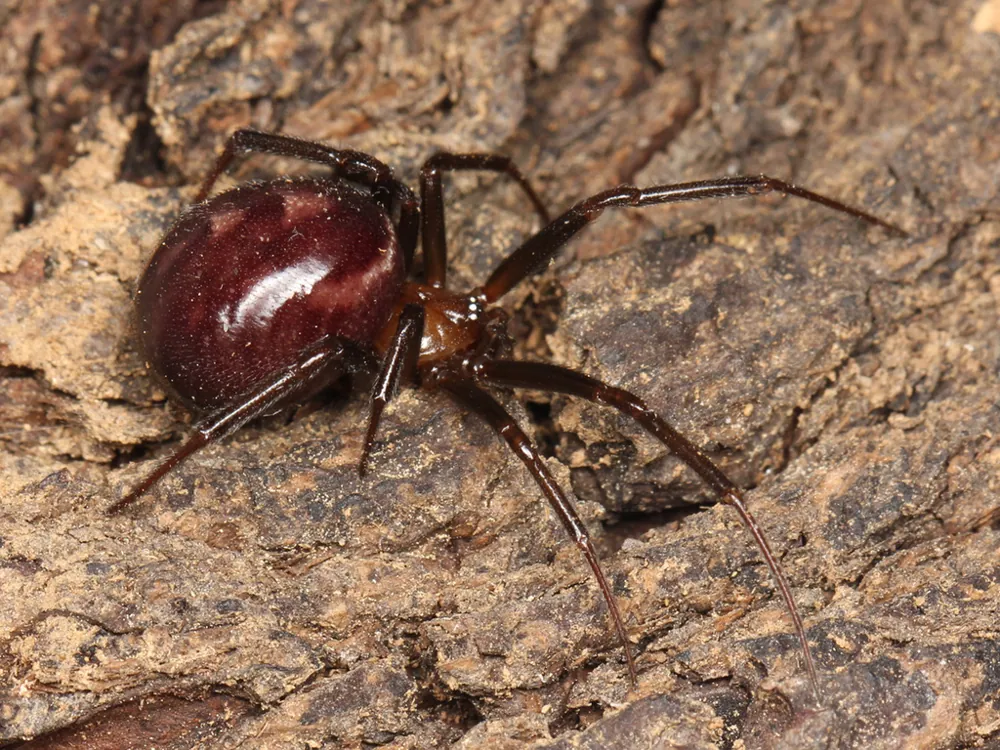
The cupboard spider is a common house spider that lives in dark corners and builds messy, three-dimensional webs. It is often mistaken for the dangerous black widow, but its bite is usually minor. Its name shows that it is found in many parts of the world, including Europe, temperate Asia and areas where it has been introduced.1

 Mmene ungaizindikirire
- Adult females are 6 to 10.5 mm long, dark coloured and round-bodied, with a bulbous abdomen.1
- Typical colour ranges from purplish brown to black, with light-coloured markings.1
- It has no bright red hourglass pattern or other bright, distinctive markings.1
- Males are thinner and can be nearly as long as females, at 4.1 to 10 mm.1
- Sexually mature males have lighter, more reddish legs than females.1
Nthawi zambiri imasokonezedwa ndi: It is often confused with black widows and redbacks (Latrodectus species), which have a bright red hourglass pattern that this spider lacks. Steatoda borealis is similar in shape but slightly smaller and found in colder climates. It has coloured markings on the top of the abdomen rather than the underside.1
Mphamvu ya ululu
Ululu umatuluka kudzera m'mano ake ikaluma.
Ululu wake umachita chiyani?
The bite is minor in humans and has no long-lasting effects. Symptoms can include blistering at the bite site and pain. A few cases have included fever, nausea, sweating and a general feeling of being unwell that lasted several days.1
Ndi yoopsa bwanji kwa anthu?
Ngozi kwa anthu: YofatsaNgati kulasidwa ndi njuchi kapena pang'ono kuposa pamenepo. Pafupifupi yosavulaza anthu.The spider is not aggressive. Most injuries to people happen when a spider is accidentally squeezed or pinched and bites in defence. It is possible that a spider may bite a finger pushed into its web by mistake.1
 Nkhani yabwino: madokotala ali ndi mankhwala (antivenom) kapena chithandizo cha ichi.1
Imachita chiyani ikachita mantha?
It usually flees when a large creature comes near, and it bites when it is squeezed or pinched.1
 Ikaluma
- Sambitsa polumidwapo ndipo ikapo paketi ya ayezi kuti uchepetse kupweteka. Peza thandizo la dokotala ngati kupweteka kuli kwakukulu, kukufalikira kapena munthuyo sakumva bwino.
Nthawi zonse yamba wayimbira nambala yadzidzidzi (112, 000, 911). Awa ndi malangizo wamba a chithandizo choyamba, osati malangizo a dokotala. Zoyambira za chithandizo choyamba
 Khala wotetezeka
- Usakhudze, kugwira kapena kuseweretsa nyama yakuthengo, ngakhale yaing'ono, ndipo ngakhale ikuoneka ngati yagona kapena yafa.
- Ipatse malo. Ukakumana nayo, khala chete, bwerera m'mbuyo pang'onopang'ono ndipo uilole ipite njira yake.
- Ikakuluma: khala chete, usasunthe, imbira nambala yadzidzidzi (112, 000, 911) kapena pita kuchipatala mwachangu. Kumbukira m'mene inkaonekera, chithunzi chimathandiza.
Sikufuna kukuvulaza. Imagwiritsa ntchito ululu wake kugwira chakudya kapena kudziteteza, ndipo imakonda kwambiri kubisala. Zambiri za kukhala wotetezeka
Kuti padziko lapansi?
Ndi yaikulu bwanji?
Ndi yaitali bwanji?
 yaing'ono moti ingakhale pa chikhadabo chako
Cupboard spider ndi yaikulu bwanji poyerekeza ndi IWE?
Ndi masamu chabe mu msakatuli wako. Palibe chomwe chimasungidwa kapena kutumizidwa kwina.
Imathamanga bwanji?


Mfundo
Director Sam Raimi chose this spider to play the radioactive spider that bites Peter Parker in the 2002 film Spider-Man. The filming spider was painted with red and blue makeup.1
The spider reportedly preys on black widows, which can make it useful to have around.1
It can go several months without feeding, as long as it has access to water.1
Females can live up to six years, while males typically live 1 to 1.5 years and often die shortly after mating.1
Kuthetsa nthano zabodza
Nthano yabodza: It is a dangerous widow spider, just like the black widow.
Zoona: Its bite is minor in humans and has no long-lasting effects, although it can cause pain, blistering and, in a few cases, several days of feeling unwell.1
Za akatswiri a ululu
- Dzina la sayansi
- Steatoda grossa
- Gulu
- Akangaude
- Banja
- Theridiidae2
- Dongosolo
- Araneae
- Makontinenti
- Ulaya
- Ana akhanda
- A well-fed female can lay three or more egg sacs each year, with 40 to 100 eggs in each sac. The eggs usually hatch within a month at normal household temperature and humidity, and the spiderlings are independent from the moment they hatch.1
- Kutalika kwa moyo
- pafupifupi zaka 61
- Ngozi kwa anthu
- 1 / 5: Yofatsa3
Kumene mfundo zimachokera
- Steatoda grossa (Wikipedia (CC BY-SA 4.0))
- Steatoda grossa (iNaturalist): mayina ndi magulu a sayansi.
- Venom Wiki: mlingo wa ngozi, kukula wamba ndi kuyerekeza kwa liwiro ndi zathu. Ona mmene timazipezera: Mmene timayezera ngozi.
Mfundo iliyonse patsamba lino ili ndi nambala yosonyeza kochokera. Ngati talakwitsa, pepani, ndife okonda nyama, osati magazini a sayansi. Tiuze pa [email protected] ndipo tikonza.
 Chinkhanira chili ndi njala! Venom Wiki ndi ntchito ya munthu mmodzi: yaulere, yopanda zotsatsa ndi zokutsatira. Mphatso yaing'ono imathandiza kuti ikhalebe pa intaneti.Dyetsa chinkhanira
Zina za gulu lomwelo: Akangaude
 Mediterranean black widow
 Diving bell spider
 European yellow sac spider
 Noble false widow
 Tarantula wolf spider
 Daddy long-legs spider
Imakhalanso ku: Ulaya
 Common European adderMa viper ndi adderIkufuna dokotala
 Spanish flyNyama zina za poizoniIkufuna dokotalaUsakhudze
 Common waspNjuchi, mavu ndi mavu akuluakulu (hornets)Imangopweteka
 European hornetNjuchi, mavu ndi mavu akuluakulu (hornets)Imangopweteka
 Fire salamanderAchule a poizoni, achule a mphini (toads) ndi ma newtImangopwetekaUsakhudze
 Western honey beeNjuchi, mavu ndi mavu akuluakulu (hornets)Imangopweteka