
 Africa
 Asia
Asia Ulaya
Ulaya Amereka ya Kumwera
 Australia ndi Oceania
 Antarctica
 Nyanja ya Pacific
 Nyanja ya Atlantic
 Nyanja ya Indian
 Nyanja ya Arctic
 Nyanja ya Mediterranean
 Nyanja Yofiira
 Nyanja ya Caribbean
 Nyanja ya Coral
 Nyanja ya South China
 Nyanja ya Philippine
 Nyanja ya Andaman
 Nyanja ya Kumpoto (North Sea)
 Nyanja ya Timor ndi Arafura
 Nyanja ya Bengal
 Gulf ya California
Egg-yolk jellyfish
 Minyewa yolasa (tentacles)
The egg-yolk jellyfish is a very large jellyfish with a bright yellow centre that looks like a fried egg. It lives in cool seas across most of the world's oceans and is most common in the Northern Pacific. It is special because it can grow very large, and it is one of the few jellyfish that can survive in low-oxygen water.1



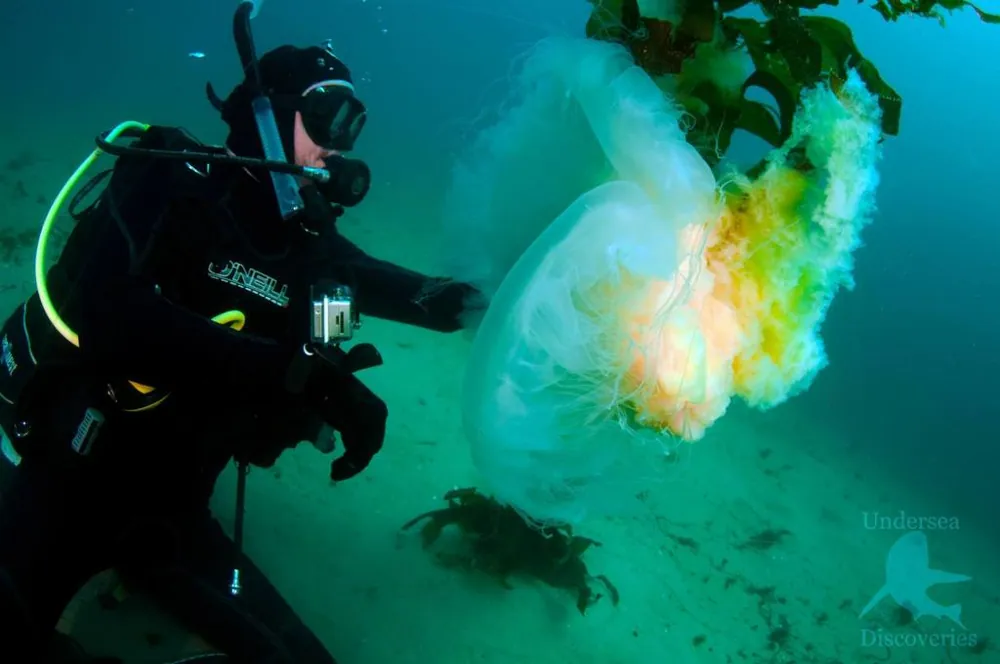
 Mmene ungaizindikirire
- A yellow centre that looks like a broken egg yolk, surrounded by opaque white tissue1
- A large bell, sometimes close to 60 cm across1
- 16 clusters of tentacles, each with up to a few dozen tentacles, and each tentacle up to 6 m long1
- Broad, curtain-like oral arms1
- Mostly drifts with the current, with only limited movement1
Nthawi zambiri imasokonezedwa ndi: The lion's mane jellyfish (Cyanea capillata) is sometimes confused with this species. The smaller Cotylorhiza tuberculata, which is found mainly in warmer water, especially in the Mediterranean Sea, is also called a fried egg jellyfish.1
Mphamvu ya ululu
Maselo ang'onoang'ono olasa masauzande amawombera chinachake chikawakhudza.
Ululu wake umachita chiyani?
Its tentacles contain nematocysts, stinging cells that help it catch prey. Its sting is weak, which allows some small animals to ride on its bell and steal food from its arms and tentacles.1
Ndi yoopsa bwanji kwa anthu?
Ngozi kwa anthu: YofatsaNgati kulasidwa ndi njuchi kapena pang'ono kuposa pamenepo. Pafupifupi yosavulaza anthu.Its sting is weak.1
Imachita chiyani ikachita mantha?
Its tentacles contain nematocysts, which also help protect it from predators.1
 Ikalasa
- Tuluka m'madzi ndipo chotsa minyewa yolasa (tentacles) iliyonse (ndi magolovesi kapena nsalu).
- Pa jellyfish ya bokosi (box jellyfish) ya kumadera otentha: thira viniga pamene walasidwa kwa masekondi 30 osachepera, itana thandizo ndipo ukhale wokonzeka kuchita CPR. Pa bluebottle ndi zina zambiri: tsuka ndi madzi a m'nyanja, kenako madzi otentha kuti uchepetse kupweteka.
Nthawi zonse yamba wayimbira nambala yadzidzidzi (112, 000, 911). Awa ndi malangizo wamba a chithandizo choyamba, osati malangizo a dokotala. Zoyambira za chithandizo choyamba
 Khala wotetezeka
- Usakhudze, kugwira kapena kuseweretsa nyama yakuthengo, ngakhale yaing'ono, ndipo ngakhale ikuoneka ngati yagona kapena yafa.
- Ipatse malo. Ukakumana nayo, khala chete, bwerera m'mbuyo pang'onopang'ono ndipo uilole ipite njira yake.
- Ikakulasa: khala chete, usasunthe, imbira nambala yadzidzidzi (112, 000, 911) kapena pita kuchipatala mwachangu. Kumbukira m'mene inkaonekera, chithunzi chimathandiza.
Sikufuna kukuvulaza. Imagwiritsa ntchito ululu wake kugwira chakudya kapena kudziteteza, ndipo imakonda kwambiri kubisala. Zambiri za kukhala wotetezeka
Kuti padziko lapansi?
Ndi yaikulu bwanji?
Ndi yaitali bwanji?
 yaitali ngati nthochi 3 zoyalidwa motsatizana
 yaitali ngati zidutswa zomangira zoseweretsa 18 pamzere
 ingasambire kutalika kwa dziwe lalikulu losambira (50 m) m'masekondi 140
Egg-yolk jellyfish ndi yaikulu bwanji poyerekeza ndi IWE?
Ndi masamu chabe mu msakatuli wako. Palibe chomwe chimasungidwa kapena kutumizidwa kwina.
Imathamanga bwanji?

Mfundo
Its tentacles can reach up to 6 m long, which is far longer than its bell.1
It has no gills, lungs or circulatory system. It takes in oxygen through its thin body surface instead.1
The giant deep-sea octopus Haliphron atlanticus clings to this jellyfish and eats its oral arms and stomach.1
It can survive in low-oxygen water for several hours at a time, and it sometimes dives into these zones during the day to avoid competition.1
Small crabs and an amphipod called Hyperia medusarum can live on its bell, and some feed on the parasites that infest the jellyfish.1
Za akatswiri a ululu
- Dzina la sayansi
- Phacellophora camtschatica
- Gulu
- Jellyfish ndi zolasa za m'nyanja
- Banja
- Phacellophoridae2
- Dongosolo
- Semaeostomeae
- Makontinenti
- Nyanja ya Pacific, Nyanja zikuluzikulu
- Ana akhanda
- Eggs are fertilised and develop into swimming larvae called planulae. These settle on the seabed and grow into polyps, which later release young jellyfish called ephyrae.1
- Ngozi kwa anthu
- 1 / 5: Yofatsa3
Kumene mfundo zimachokera
- Phacellophora (Wikipedia (CC BY-SA 4.0))
- Phacellophora camtschatica (iNaturalist): mayina ndi magulu a sayansi.
- Venom Wiki: mlingo wa ngozi, kukula wamba ndi kuyerekeza kwa liwiro ndi zathu. Ona mmene timazipezera: Mmene timayezera ngozi.
Mfundo iliyonse patsamba lino ili ndi nambala yosonyeza kochokera. Ngati talakwitsa, pepani, ndife okonda nyama, osati magazini a sayansi. Tiuze pa [email protected] ndipo tikonza.
 Chinkhanira chili ndi njala! Venom Wiki ndi ntchito ya munthu mmodzi: yaulere, yopanda zotsatsa ndi zokutsatira. Mphatso yaing'ono imathandiza kuti ikhalebe pa intaneti.Dyetsa chinkhanira
Zina za gulu lomwelo: Jellyfish ndi zolasa za m'nyanja
 Australian box jellyfishJellyfish ndi zolasa za m'nyanjaYakuphaUsakhudze
 Irukandji jellyfishJellyfish ndi zolasa za m'nyanjaIngathe kuphaUsakhudze
 Portuguese man o' warJellyfish ndi zolasa za m'nyanjaIkufuna dokotalaUsakhudze
 Lion's mane jellyfishJellyfish ndi zolasa za m'nyanjaImangopwetekaUsakhudze
 Moon jellyfishJellyfish ndi zolasa za m'nyanjaYosavulaza
 Common kingslayerJellyfish ndi zolasa za m'nyanjaIngathe kuphaUsakhudze
Imakhalanso ku: Nyanja ya Pacific
 Geography coneNkhono za cone ndi ma octopusYakupha
 Greater blue-ringed octopusNkhono za cone ndi ma octopusYakupha
 Japanese pufferfishNyama zina za poizoniYakupha
 Southern blue-ringed octopusNkhono za cone ndi ma octopusYakupha
 Hawksbill sea turtleNyama zina za poizoniIngathe kupha
 Reef stonefishNsomba zaululuIngathe kuphaUsakhudze