
 Africa
 Asia
Asia Ulaya
Ulaya Amereka ya Kumwera
 Australia ndi Oceania
 Antarctica
 Nyanja ya Pacific
 Nyanja ya Atlantic
 Nyanja ya Indian
 Nyanja ya Arctic
 Nyanja ya Mediterranean
 Nyanja Yofiira
 Nyanja ya Caribbean
 Nyanja ya Coral
 Nyanja ya South China
 Nyanja ya Philippine
 Nyanja ya Andaman
 Nyanja ya Kumpoto (North Sea)
 Nyanja ya Timor ndi Arafura
 Nyanja ya Bengal
 Gulf ya California
Gila monster
 Imaluma
The Gila monster is a heavy, slow-moving lizard with a venomous bite. It lives in the south-western United States and the Mexican state of Sonora. It is the only venomous lizard native to the United States, but it rarely poses a real threat to people.1



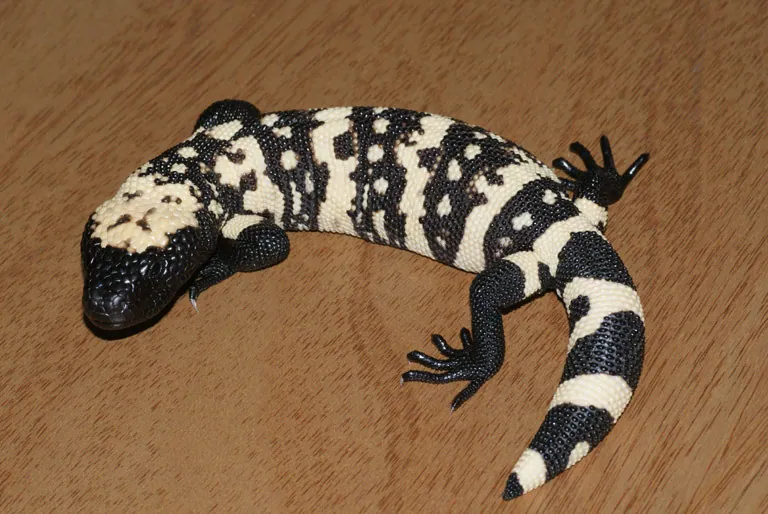
 Mmene ungaizindikirire
- Adults are yellow to pink on a black background.1
- Hatchlings have a simple, uniform pattern that is less colourful, and it changes over their first 6 months.1
- It has a heavy body, a stout snout and a massive head.1
- Adults can reach 56 cm in total length.1
- Males often have larger, more triangular heads than females.1
Nthawi zambiri imasokonezedwa ndi: Its closest relatives are beaded lizards, which live in Mexico and Guatemala. In the United States, the Gila monster is the only venomous lizard.1
Mphamvu ya ululu
Ululu umatuluka kudzera m'mano ake ikaluma.
Ululu wake umachita chiyani?
The venom is made in glands in the lower jaw and flows along grooves in the lower teeth into the bite. It contains more than a dozen peptides and other substances, which cause pain and swelling. Four potentially lethal toxins have been found, which can cause bleeding inside the organs.1
Ndi yoopsa bwanji kwa anthu?
Ngozi kwa anthu: YoopsaKulumidwa kumafuna dokotala. Imfa ndi zosowa kwambiri.The venom is usually not fatal to healthy adults. One death has been confirmed since 1930, on 16 February 2024. Earlier deaths involved adults who were drunk or whose bite was treated badly. Bites are painful and can cause shock, but the lizard is sluggish and rarely a real threat.1
Imachita chiyani ikachita mantha?
Its bright colours may warn predators to keep away, because it can inflict pain.1
 Ikaluma
- Bites are painful and need emergency medical care, because the venom may cause shock. Get medical help as quickly as possible.1
- Sambitsa bala, munthuyo akhale wodekha ndipo peza thandizo la dokotala.
Nthawi zonse yamba wayimbira nambala yadzidzidzi (112, 000, 911). Awa ndi malangizo wamba a chithandizo choyamba, osati malangizo a dokotala. Zoyambira za chithandizo choyamba
 Khala wotetezeka
- Usakhudze, kugwira kapena kuseweretsa nyama yakuthengo, ngakhale yaing'ono, ndipo ngakhale ikuoneka ngati yagona kapena yafa.
- Ipatse malo. Ukakumana nayo, khala chete, bwerera m'mbuyo pang'onopang'ono ndipo uilole ipite njira yake.
- Ikakuluma: khala chete, usasunthe, imbira nambala yadzidzidzi (112, 000, 911) kapena pita kuchipatala mwachangu. Kumbukira m'mene inkaonekera, chithunzi chimathandiza.
Sikufuna kukuvulaza. Imagwiritsa ntchito ululu wake kugwira chakudya kapena kudziteteza, ndipo imakonda kwambiri kubisala. Zambiri za kukhala wotetezeka
Kuti padziko lapansi?
Ndi yaikulu bwanji?
Ndi yaitali bwanji?
Ndi yolemera bwanji?
 yaitali ngati nthochi 3 zoyalidwa motsatizana
 yaitali ngati zidutswa zomangira zoseweretsa 18 pamzere
 ingathamange mamita 100 m'masekondi 150 (munthu wothamanga kwambiri amafunika 9.6)
Gila monster ndi yaikulu bwanji poyerekeza ndi IWE?
Ndi masamu chabe mu msakatuli wako. Palibe chomwe chimasungidwa kapena kutumizidwa kwina.
Imathamanga bwanji?


Mfundo
Exendin-4, one of the venom's peptides, led to the development of GLP-1 receptor agonists, which treat type 2 diabetes and obesity.1
Young Gila monsters can swallow up to half of their body weight in a single meal.1
It can store fat in its tail and survive a whole season on three to four large meals in spring.1
Its venom is thought to have evolved mainly for defence, because its prey is mostly eggs, small animals and other helpless prey.1
It can climb trees, cacti and fairly straight, rough-surfaced walls.1
Its teeth are replaced throughout its life, and broken teeth are replaced by the teeth behind them.1
Kuthetsa nthano zabodza
Nthano yabodza: Its bite is always fatal, and its breath is poisonous.
Zoona: The venom is usually not fatal to healthy adult humans. One death has been confirmed since 1930.1
Kumene mfundo zimachokera
- Gila monster (Wikipedia (CC BY-SA 4.0))
- Heloderma suspectum (iNaturalist): mayina ndi magulu a sayansi.
- Venom Wiki: mlingo wa ngozi, kukula wamba ndi kuyerekeza kwa liwiro ndi zathu. Ona mmene timazipezera: Mmene timayezera ngozi.
Mfundo iliyonse patsamba lino ili ndi nambala yosonyeza kochokera. Ngati talakwitsa, pepani, ndife okonda nyama, osati magazini a sayansi. Tiuze pa [email protected] ndipo tikonza.
 Chinkhanira chili ndi njala! Venom Wiki ndi ntchito ya munthu mmodzi: yaulere, yopanda zotsatsa ndi zokutsatira. Mphatso yaing'ono imathandiza kuti ikhalebe pa intaneti.Dyetsa chinkhanira
Zina za gulu lomwelo: Abuluzi aululu
 Mexican beaded lizard
 Chiapan beaded lizard
 Guatemalan beaded lizard
 Rio Fuerte beaded lizard
 Komodo dragon
 Desert monitor
Imakhalanso ku: Amereka ya Kumpoto
 TerciopeloNjoka za pit viperYakupha
 Eastern coral snakeNjoka za coralIngathe kupha
 Eastern diamondback rattlesnakeNjoka za rattlesnakeIngathe kupha
 Eyelash viperNjoka za pit viperIngathe kupha
 Timber rattlesnakeNjoka za rattlesnakeIngathe kupha
 Western diamondback rattlesnakeNjoka za rattlesnakeIngathe kupha