
 Africa
 Asia
Asia Ulaya
Ulaya Amereka ya Kumwera
 Australia ndi Oceania
 Antarctica
 Nyanja ya Pacific
 Nyanja ya Atlantic
 Nyanja ya Indian
 Nyanja ya Arctic
 Nyanja ya Mediterranean
 Nyanja Yofiira
 Nyanja ya Caribbean
 Nyanja ya Coral
 Nyanja ya South China
 Nyanja ya Philippine
 Nyanja ya Andaman
 Nyanja ya Kumpoto (North Sea)
 Nyanja ya Timor ndi Arafura
 Nyanja ya Bengal
 Gulf ya California
Mexican beaded lizard
 Imaluma
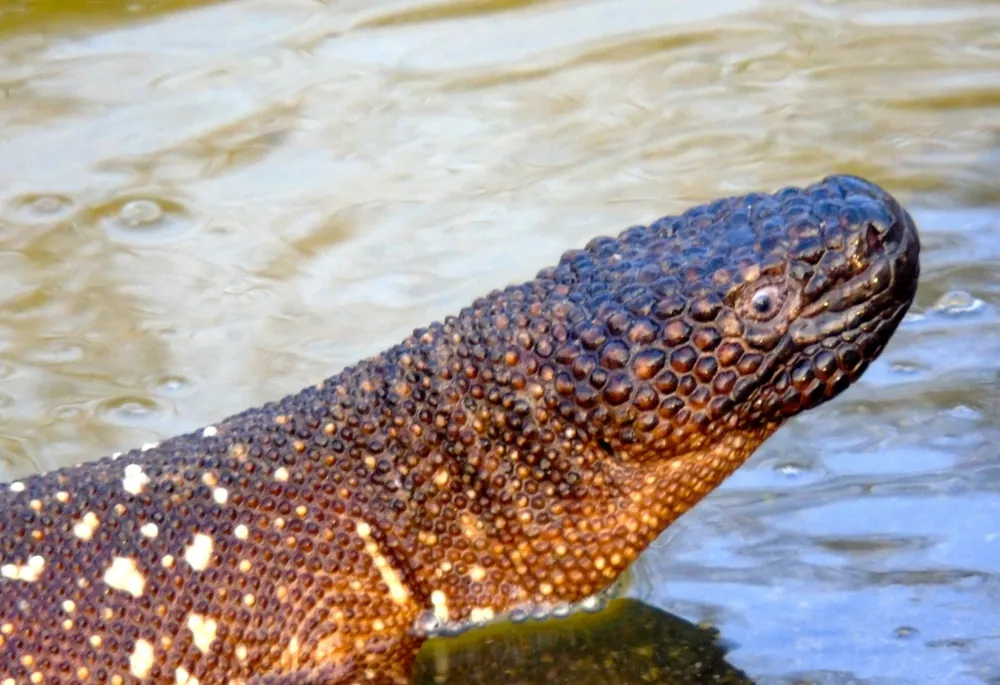
The Mexican beaded lizard is a venomous lizard found mainly in Mexico and southern Guatemala. It is one of only a few lizards known to have evolved a true venom delivery system. Its venom is also being studied for possible medicines.1



 Mmene ungaizindikirire
- Black with yellowish spots or bands.1
- Small, beadlike scales that do not overlap, which give it its name.1
- Stocky body with a broad head.1
- Short tail that stores fat, and does not regrow if broken.1
- Adults are 57 to 91 cm long.1
Nthawi zambiri imasokonezedwa ndi: The Gila monster is its closest relative and looks similar. The Mexican beaded lizard is larger, and its colours are duller, black with yellowish bands.1
Mphamvu ya ululu
Ululu umatuluka kudzera m'mano ake ikaluma.
Ululu wake umachita chiyani?
Its venom is a weak hemotoxin, meaning it attacks blood and tissue. It can cause respiratory failure, which is when breathing fails. In humans, bites cause severe pain that can spread well beyond the bite and last up to 24 hours, along with swelling, weakness, sweating and a rapid drop in blood pressure.1
Ndi yoopsa bwanji kwa anthu?
Ngozi kwa anthu: YoopsaKulumidwa kumafuna dokotala. Imfa ndi zosowa kwambiri.Human deaths from its bites are rare. Eight human bites were documented in the past century, and almost all happened when people prodded captive lizards with a finger or bare foot.1
 Ikaluma
- Sambitsa bala, munthuyo akhale wodekha ndipo peza thandizo la dokotala.
Nthawi zonse yamba wayimbira nambala yadzidzidzi (112, 000, 911). Awa ndi malangizo wamba a chithandizo choyamba, osati malangizo a dokotala. Zoyambira za chithandizo choyamba
 Khala wotetezeka
- Usakhudze, kugwira kapena kuseweretsa nyama yakuthengo, ngakhale yaing'ono, ndipo ngakhale ikuoneka ngati yagona kapena yafa.
- Ipatse malo. Ukakumana nayo, khala chete, bwerera m'mbuyo pang'onopang'ono ndipo uilole ipite njira yake.
- Ikakuluma: khala chete, usasunthe, imbira nambala yadzidzidzi (112, 000, 911) kapena pita kuchipatala mwachangu. Kumbukira m'mene inkaonekera, chithunzi chimathandiza.
Sikufuna kukuvulaza. Imagwiritsa ntchito ululu wake kugwira chakudya kapena kudziteteza, ndipo imakonda kwambiri kubisala. Zambiri za kukhala wotetezeka
Kuti padziko lapansi?
Ndi yaikulu bwanji?
Ndi yaitali bwanji?
Ndi yolemera bwanji?
 yaitali ngati amphaka apakhomo 2 mphuno ndi mchira motsatizana
 yaitali ngati nthochi 5 zoyalidwa motsatizanayolemera pafupifupi ngati mphaka wapakhomo
 ingathamange mamita 100 m'masekondi 140 (munthu wothamanga kwambiri amafunika 9.6)
Mexican beaded lizard ndi yaikulu bwanji poyerekeza ndi IWE?
Ndi masamu chabe mu msakatuli wako. Palibe chomwe chimasungidwa kapena kutumizidwa kwina.
Imathamanga bwanji?


Mfundo
It is one of only two venomous beaded lizard species, and the only lizards known to have evolved an overt venom delivery system, along with the rest of its genus.1
Some compounds in its venom are being studied for possible treatments of diabetes, Alzheimer's disease and HIV. One of them, exendin-3, is the basis of the drug exenatide.1
The beaded lizard is immune to the effects of its own venom.1
It is larger than the Gila monster, with an average adult weight of 800 g, and large specimens exceed 2,000 g.1
Beaded lizards have forked pink tongues that they use to smell, with the help of a Jacobson's organ.1
Young beaded lizards are rarely seen, as they are believed to spend much of their early lives underground.1
Kuthetsa nthano zabodza
Nthano yabodza: The beaded lizard is more venomous than a rattlesnake, can cause lightning strikes with its tail, or can make a pregnant woman miscarry by looking at her.
Zoona: These beliefs are incorrect. Its venom is weak, and human deaths are rare.1
Za akatswiri a ululu
- Dzina la sayansi
- Heloderma horridum
- Gulu
- Abuluzi aululu
- Banja
- Helodermatidae2
- Dongosolo
- Squamata
- Makontinenti
- Amereka ya Kumpoto
- Ana akhanda
- It lays clutches of 2 to 30 eggs in late summer or early fall, and the eggs hatch the following spring or summer.1
- Mmene ilili kuthengo
- Threatened (Mexican law, category A). Listed on Appendix II of CITES.1
- Ngozi kwa anthu
- 3 / 5: Yoopsa3
Kumene mfundo zimachokera
- Mexican beaded lizard (Wikipedia (CC BY-SA 4.0))
- Heloderma horridum (iNaturalist): mayina ndi magulu a sayansi.
- Venom Wiki: mlingo wa ngozi, kukula wamba ndi kuyerekeza kwa liwiro ndi zathu. Ona mmene timazipezera: Mmene timayezera ngozi.
Mfundo iliyonse patsamba lino ili ndi nambala yosonyeza kochokera. Ngati talakwitsa, pepani, ndife okonda nyama, osati magazini a sayansi. Tiuze pa [email protected] ndipo tikonza.
 Chinkhanira chili ndi njala! Venom Wiki ndi ntchito ya munthu mmodzi: yaulere, yopanda zotsatsa ndi zokutsatira. Mphatso yaing'ono imathandiza kuti ikhalebe pa intaneti.Dyetsa chinkhanira
Zina za gulu lomwelo: Abuluzi aululu
 Gila monster
 Chiapan beaded lizard
 Guatemalan beaded lizard
 Rio Fuerte beaded lizard
 Komodo dragon
 Desert monitor
Imakhalanso ku: Amereka ya Kumpoto
 TerciopeloNjoka za pit viperYakupha
 Eastern coral snakeNjoka za coralIngathe kupha
 Eastern diamondback rattlesnakeNjoka za rattlesnakeIngathe kupha
 Eyelash viperNjoka za pit viperIngathe kupha
 Timber rattlesnakeNjoka za rattlesnakeIngathe kupha
 Western diamondback rattlesnakeNjoka za rattlesnakeIngathe kupha