
 Africa
 Asia
Asia Ulaya
Ulaya Amereka ya Kumwera
 Australia ndi Oceania
 Antarctica
 Nyanja ya Pacific
 Nyanja ya Atlantic
 Nyanja ya Indian
 Nyanja ya Arctic
 Nyanja ya Mediterranean
 Nyanja Yofiira
 Nyanja ya Caribbean
 Nyanja ya Coral
 Nyanja ya South China
 Nyanja ya Philippine
 Nyanja ya Andaman
 Nyanja ya Kumpoto (North Sea)
 Nyanja ya Timor ndi Arafura
 Nyanja ya Bengal
 Gulf ya California
Greater black krait
 Imaluma
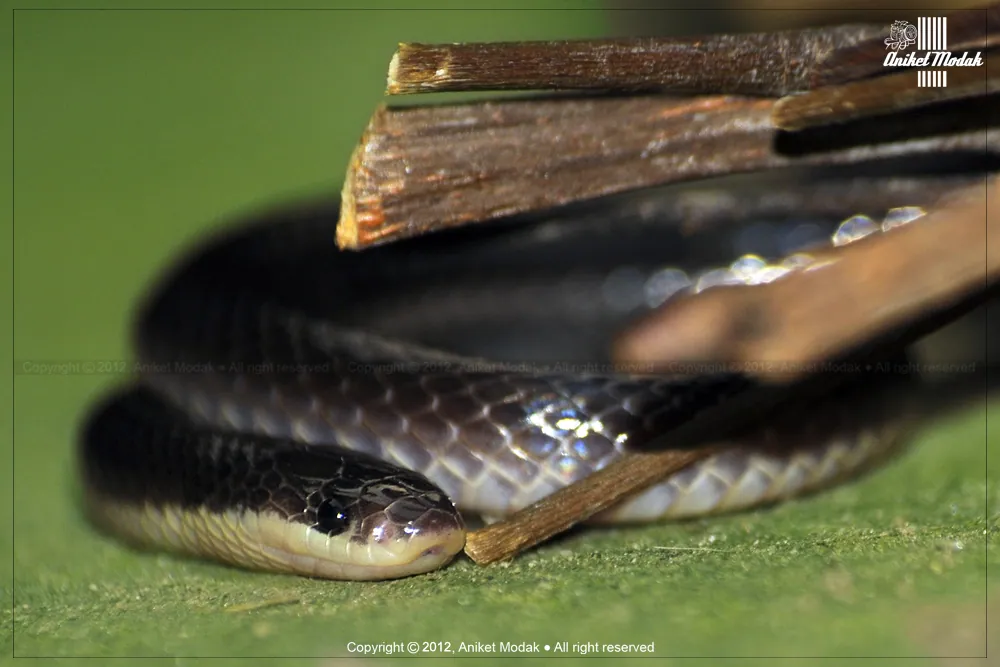
The greater black krait is a shiny black snake that is venomous, meaning it injects venom when it bites. It lives in South Asia, including northeast and north India, Nepal, Bhutan and Bangladesh. It matters because it is often overlooked but has caused many bites.1



 Mmene ungaizindikirire
- Shiny black on the upper body, with whitish colour between the scales1
- Creamy white underside with black edges, which get wider towards the tail1
- Medium length and slender, with a triangular cross-section and a short, pointed tail1
- Smooth, glossy scales, with the scales along the middle of the back enlarged and hexagonal1
- Black eyes with round pupils, and a pinkish tongue with a lighter tip1
Nthawi zambiri imasokonezedwa ndi: The lesser black krait (Bungarus lividus) lives in the same areas. The greater black krait can be told apart by its enlarged hexagonal scales along the middle of the back.1
Mphamvu ya ululu
Ululu umatuluka kudzera m'mano ake ikaluma.
Ululu wake umachita chiyani?
Its venom contains presynaptic and postsynaptic neurotoxins, which attack the nerves, and may also contain myotoxins, which damage muscle.1
Ndi yoopsa bwanji kwa anthu?
Ngozi kwa anthu: Yoopsa kwambiriIngathe kupha munthu amene sanalandire chithandizo.It is a medically important species because it has caused many bites. The mortality rate is not known, but it is said to be quite high. It is an active, nocturnal snake, so people may be bitten at night.1
Imachita chiyani ikachita mantha?
When disturbed, it coils loosely and hides its head beneath its body, and it is reluctant to bite unless it is persistently provoked.1
 Ikaluma
- Munthuyo akhale chete ndi wodekha, chotsa mphete ndi zinthu zothina, ndipo mufikitse kuchipatala mwachangu: antivenom ndiye mankhwala ake.
Nthawi zonse yamba wayimbira nambala yadzidzidzi (112, 000, 911). Awa ndi malangizo wamba a chithandizo choyamba, osati malangizo a dokotala. Zoyambira za chithandizo choyamba
 Khala wotetezeka
- Usakhudze, kugwira kapena kuseweretsa nyama yakuthengo, ngakhale yaing'ono, ndipo ngakhale ikuoneka ngati yagona kapena yafa.
- Ipatse malo. Ukakumana nayo, khala chete, bwerera m'mbuyo pang'onopang'ono ndipo uilole ipite njira yake.
- Ikakuluma: khala chete, usasunthe, imbira nambala yadzidzidzi (112, 000, 911) kapena pita kuchipatala mwachangu. Kumbukira m'mene inkaonekera, chithunzi chimathandiza.
Sikufuna kukuvulaza. Imagwiritsa ntchito ululu wake kugwira chakudya kapena kudziteteza, ndipo imakonda kwambiri kubisala. Zambiri za kukhala wotetezeka
Kuti padziko lapansi?
Ndi yaikulu bwanji?
Ndi yaitali bwanji?
 yaitali ngati amphaka apakhomo 2,5 mphuno ndi mchira motsatizana
 yaitali ngati nthochi 7 zoyalidwa motsatizana
 ingathamange mamita 100 m'masekondi 51 (munthu wothamanga kwambiri amafunika 9.6)
Greater black krait ndi yaikulu bwanji poyerekeza ndi IWE?
Ndi masamu chabe mu msakatuli wako. Palibe chomwe chimasungidwa kapena kutumizidwa kwina.
Imathamanga bwanji?


Mfundo
Kumene mfundo zimachokera
- Greater black krait (Wikipedia (CC BY-SA 4.0))
- Bungarus niger (iNaturalist): mayina ndi magulu a sayansi.
- Venom Wiki: mlingo wa ngozi, kukula wamba ndi kuyerekeza kwa liwiro ndi zathu. Ona mmene timazipezera: Mmene timayezera ngozi.
Mfundo iliyonse patsamba lino ili ndi nambala yosonyeza kochokera. Ngati talakwitsa, pepani, ndife okonda nyama, osati magazini a sayansi. Tiuze pa [email protected] ndipo tikonza.
 Chinkhanira chili ndi njala! Venom Wiki ndi ntchito ya munthu mmodzi: yaulere, yopanda zotsatsa ndi zokutsatira. Mphatso yaing'ono imathandiza kuti ikhalebe pa intaneti.Dyetsa chinkhanira
 Indian cobra
 King cobra
 Caspian cobra
 Common krait
 Malayan krait
 Many-banded krait
 Deathstalker
 Indian saw-scaled viper
 Puff adder
 Njoka ya Russell (Russell's viper)
 Asian giant hornet
 Komodo dragon
.jpg)