
 Africa
 Asia
Asia Ulaya
Ulaya Amereka ya Kumwera
 Australia ndi Oceania
 Antarctica
 Nyanja ya Pacific
 Nyanja ya Atlantic
 Nyanja ya Indian
 Nyanja ya Arctic
 Nyanja ya Mediterranean
 Nyanja Yofiira
 Nyanja ya Caribbean
 Nyanja ya Coral
 Nyanja ya South China
 Nyanja ya Philippine
 Nyanja ya Andaman
 Nyanja ya Kumpoto (North Sea)
 Nyanja ya Timor ndi Arafura
 Nyanja ya Bengal
 Gulf ya California
False water cobra
 Imaluma
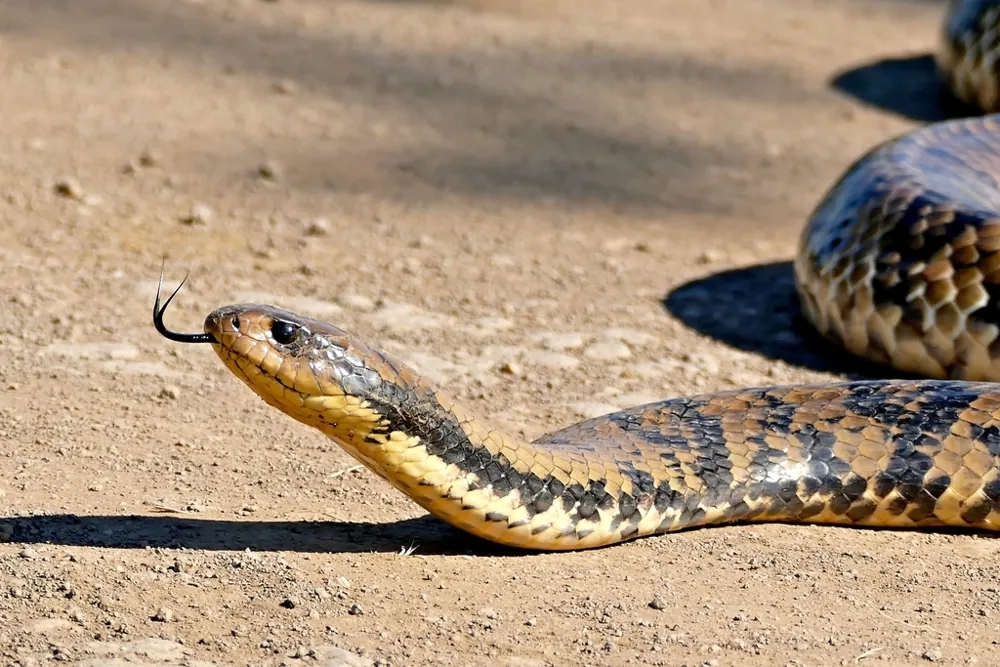
The false water cobra is a large snake that lives in South America. It is named after true cobras because it flattens its neck to look bigger when threatened, but it is not a true cobra. It is mildly venomous, and its bites rarely cause serious harm to people.1



 Mmene ungaizindikirire
- Background colour is olive green or brown, with dark spots and bands over much of the body.1
- Bands and colour grow darker towards the tail.1
- Large eyes with round pupils. The tongue is black.1
- Belly is yellow or brown with dark flecks, which form three dotted lines. Males tend to be yellow underneath and females brown.1
- Hatchlings and juveniles are much darker and lack the dark eyes of adults.1
Nthawi zambiri imasokonezedwa ndi: Its pattern and colouring look somewhat like those of true water cobras (Boulengerina). The easiest difference to see is the hood: when threatened, the false water cobra stays horizontal, while a true cobra rears up.1
Mphamvu ya ululu
Ululu umatuluka kudzera m'mano ake ikaluma.
Ululu wake umachita chiyani?
This snake has enlarged rear teeth that are not grooved, and they are linked to a gland that produces oral secretions with proteolytic activity, meaning they break down proteins. In the few serious cases, symptoms included severe swelling, bruising, numbness, itching and dizziness. Most bites cause only mild pain and minor swelling.1
Ndi yoopsa bwanji kwa anthu?
Ngozi kwa anthu: YopwetekaIngathe kupweteka kwambiri, koma pafupifupi nthawi zonse si vuto lalikulu.Many bites have been recorded, but only four cases of significant reaction in humans are reported for this species. It is considered mildly venomous.1
Imachita chiyani ikachita mantha?
When threatened, it flattens its neck like a cobra, and can flatten lower parts of its body too, to look larger and more intimidating.1
 Ikaluma
- Sambitsa polumidwapo, munthuyo akhale wodekha ndipo peza thandizo la dokotala. Mitundu ina (monga boomslang) ingathe kupha patapita maola.
Nthawi zonse yamba wayimbira nambala yadzidzidzi (112, 000, 911). Awa ndi malangizo wamba a chithandizo choyamba, osati malangizo a dokotala. Zoyambira za chithandizo choyamba
 Khala wotetezeka
- Usakhudze, kugwira kapena kuseweretsa nyama yakuthengo, ngakhale yaing'ono, ndipo ngakhale ikuoneka ngati yagona kapena yafa.
- Ipatse malo. Ukakumana nayo, khala chete, bwerera m'mbuyo pang'onopang'ono ndipo uilole ipite njira yake.
- Ikakuluma: khala chete, usasunthe, imbira nambala yadzidzidzi (112, 000, 911) kapena pita kuchipatala mwachangu. Kumbukira m'mene inkaonekera, chithunzi chimathandiza.
Sikufuna kukuvulaza. Imagwiritsa ntchito ululu wake kugwira chakudya kapena kudziteteza, ndipo imakonda kwambiri kubisala. Zambiri za kukhala wotetezeka
Kuti padziko lapansi?
Ndi yaikulu bwanji?
Ndi yaitali bwanji?
Ndi yolemera bwanji?
 yaitali ngati agalu 3 mphuno ndi mchira motsatizana
 yaitali ngati nthochi 17 zoyalidwa motsatizana
 yolemera pafupifupi ngati mphaka wapakhomo
 ingathamange mamita 100 m'masekondi 54 (munthu wothamanga kwambiri amafunika 9.6)
False water cobra ndi yaikulu bwanji poyerekeza ndi IWE?
Ndi masamu chabe mu msakatuli wako. Palibe chomwe chimasungidwa kapena kutumizidwa kwina.
Imathamanga bwanji?


Mfundo
Captive-bred individuals can become quite tame and trusting, and many show a high level of intelligence.1
Temperaments vary a lot: some individuals are docile, while others are defensive or even aggressive.1
Males are much smaller than females, a difference called sexual dimorphism.1
It is mainly active during the day, which gives it good daytime vision thanks to its large eyes.1
Kuthetsa nthano zabodza
Nthano yabodza: It is a true cobra.
Zoona: It is not a true cobra. It hoods in a similar way, but stays horizontal instead of rearing up.1
Kumene mfundo zimachokera
- Hydrodynastes gigas (Wikipedia (CC BY-SA 4.0))
- Hydrodynastes gigas (iNaturalist): mayina ndi magulu a sayansi.
- Venom Wiki: mlingo wa ngozi, kukula wamba ndi kuyerekeza kwa liwiro ndi zathu. Ona mmene timazipezera: Mmene timayezera ngozi.
Mfundo iliyonse patsamba lino ili ndi nambala yosonyeza kochokera. Ngati talakwitsa, pepani, ndife okonda nyama, osati magazini a sayansi. Tiuze pa [email protected] ndipo tikonza.
 Chinkhanira chili ndi njala! Venom Wiki ndi ntchito ya munthu mmodzi: yaulere, yopanda zotsatsa ndi zokutsatira. Mphatso yaing'ono imathandiza kuti ikhalebe pa intaneti.Dyetsa chinkhanira
Zina za gulu lomwelo: Njoka za mano akumbuyo
 Baron's green racerNjoka za mano akumbuyoImangopweteka
 Brown vine snakeNjoka za mano akumbuyoYosavulaza
 Green vine snakeNjoka za mano akumbuyoYosavulaza
 Lichtenstein's green racerNjoka za mano akumbuyoIkufuna dokotala
 Peruvian slender snakeNjoka za mano akumbuyoIkufuna dokotala
 Chilean green racerNjoka za mano akumbuyoImangopweteka
Imakhalanso ku: Amereka ya Kumwera
 Golden poison frogAchule a poizoni, achule a mphini (toads) ndi ma newtYakuphaUsakhudze
 TerciopeloNjoka za pit viperYakupha
 Brazilian wandering spiderAkangaudeIngathe kupha
 Eyelash viperNjoka za pit viperIngathe kupha
 Golden lanceheadNjoka za pit viperIngathe kupha
 South American bushmasterNjoka za pit viperIngathe kupha