
 Africa
 Asia
Asia Ulaya
Ulaya Amereka ya Kumwera
 Australia ndi Oceania
 Antarctica
 Nyanja ya Pacific
 Nyanja ya Atlantic
 Nyanja ya Indian
 Nyanja ya Arctic
 Nyanja ya Mediterranean
 Nyanja Yofiira
 Nyanja ya Caribbean
 Nyanja ya Coral
 Nyanja ya South China
 Nyanja ya Philippine
 Nyanja ya Andaman
 Nyanja ya Kumpoto (North Sea)
 Nyanja ya Timor ndi Arafura
 Nyanja ya Bengal
 Gulf ya California
Red spitting cobra
 Imapopera kapena kulavulira
The red spitting cobra is a medium-sized cobra found in East Africa. When threatened, it can spray venom into an attacker's face, which can cause burning pain and blindness. It is often considered an attractive snake, usually bright salmon-red with a black throat band.1



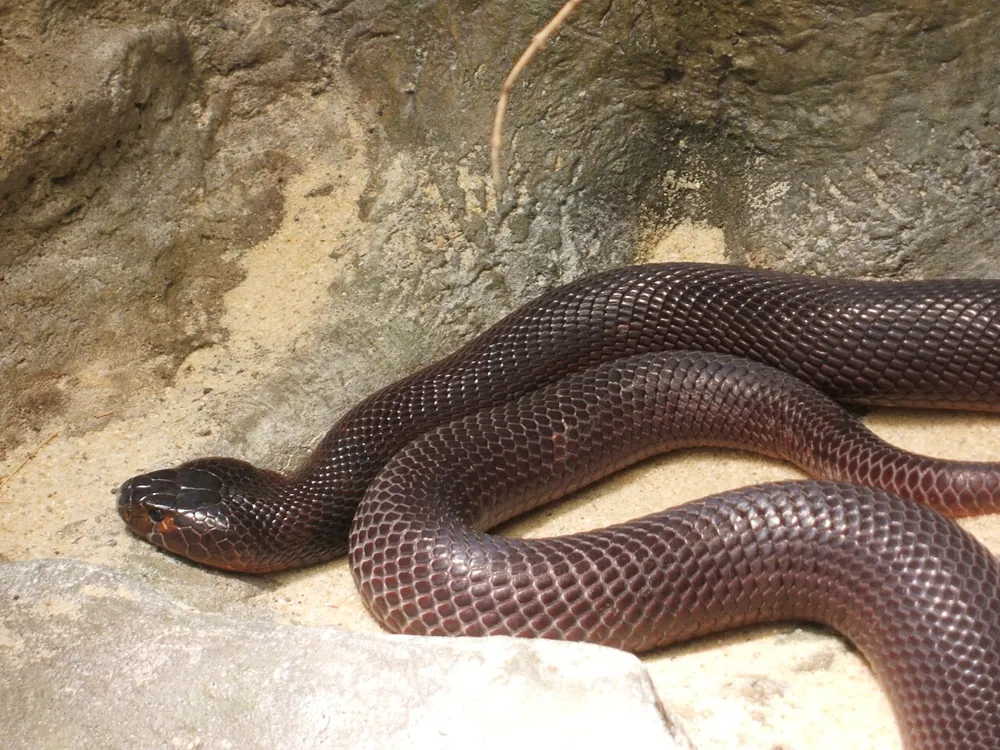
 Mmene ungaizindikirire
- Usually bright salmon-red, with a broad black throat band and teardrop markings below the eyes1
- Colour varies by region: specimens from southern Kenya and northern Tanzania are orange-red with a dark blue or black throat band1
- The throat band often fades or disappears in larger adults, and true red specimens turn reddish-brown with age1
- Adults typically measure 0.7 to 1.2 metres1
- When threatened, it rears up, shows a cobra hood and hisses loudly1
Mphamvu ya ululu
Imapopera kapena kulavulira madzi olasa kwa omwe akuiukira.
Ululu wake umachita chiyani?
Its venom contains a mixture of neurotoxins, which attack the nerves, and cytotoxins, which damage cells. A bite causes slight pain around the wound and numbness of the lips, fingers and tongue. Venom sprayed into the eyes causes burning pain and can cause blindness.1
Ndi yoopsa bwanji kwa anthu?
Ngozi kwa anthu: Yoopsa kwambiriIngathe kupha munthu amene sanalandire chithandizo.It seldom causes human deaths, but survivors of its bites are usually left disfigured. In September 2011, a snake keeper from South Africa died shortly after venom was sprayed into his face while he was photographing the snake. The venom is thought to have entered his nasal passages and caused anaphylactic shock, a severe allergic reaction, and his asthma may have contributed.1
Imachita chiyani ikachita mantha?
When threatened, it rears up, displays its hood and hisses loudly, and if the intruder does not retreat, it may spray venom at the face. In very rare cases it sprays without first rearing up.1
 Ikaluma kapena kulavulira
- Munthuyo akhale chete ndi wodekha, chotsa mphete ndi zinthu zothina, ndipo mufikitse kuchipatala mwachangu: antivenom ndiye mankhwala ake.
- Ngati ululu walavuliridwa m'maso, tsuka maso ndi madzi ambiri aukhondo nthawi yomweyo.
Nthawi zonse yamba wayimbira nambala yadzidzidzi (112, 000, 911). Awa ndi malangizo wamba a chithandizo choyamba, osati malangizo a dokotala. Zoyambira za chithandizo choyamba
 Khala wotetezeka
- Usakhudze, kugwira kapena kuseweretsa nyama yakuthengo, ngakhale yaing'ono, ndipo ngakhale ikuoneka ngati yagona kapena yafa.
- Ipatse malo. Ukakumana nayo, khala chete, bwerera m'mbuyo pang'onopang'ono ndipo uilole ipite njira yake.
- Ikakuluma kapena kukulavulira ululu m'maso: khala chete, usasunthe, imbira nambala yadzidzidzi (112, 000, 911) kapena pita kuchipatala mwachangu. Kumbukira m'mene inkaonekera, chithunzi chimathandiza.
Sikufuna kukuvulaza. Imagwiritsa ntchito ululu wake kugwira chakudya kapena kudziteteza, ndipo imakonda kwambiri kubisala. Zambiri za kukhala wotetezeka
Kuti padziko lapansi?
Ndi yaikulu bwanji?
Ndi yaitali bwanji?
 yaitali ngati amphaka apakhomo 2,5 mphuno ndi mchira motsatizana
 yaitali ngati nthochi 7 zoyalidwa motsatizana
 ingathamange mamita 100 m'masekondi 53 (munthu wothamanga kwambiri amafunika 9.6)
Red spitting cobra ndi yaikulu bwanji poyerekeza ndi IWE?
Ndi masamu chabe mu msakatuli wako. Palibe chomwe chimasungidwa kapena kutumizidwa kwina.
Imathamanga bwanji?


Mfundo
Kumene mfundo zimachokera
- Red spitting cobra (Wikipedia (CC BY-SA 4.0))
- Naja pallida (iNaturalist): mayina ndi magulu a sayansi.
- Venom Wiki: mlingo wa ngozi, kukula wamba ndi kuyerekeza kwa liwiro ndi zathu. Ona mmene timazipezera: Mmene timayezera ngozi.
Mfundo iliyonse patsamba lino ili ndi nambala yosonyeza kochokera. Ngati talakwitsa, pepani, ndife okonda nyama, osati magazini a sayansi. Tiuze pa [email protected] ndipo tikonza.
 Chinkhanira chili ndi njala! Venom Wiki ndi ntchito ya munthu mmodzi: yaulere, yopanda zotsatsa ndi zokutsatira. Mphatso yaing'ono imathandiza kuti ikhalebe pa intaneti.Dyetsa chinkhanira
 Black mamba
 Egyptian cobra
 Cape cobra
 Eastern green mamba
 Jameson's mamba
 Western green mamba
 Deathstalker
 Puff adder
 Boomslang
 Fat-tailed scorpion
 Gaboon viper
 Western honey bee