
 Africa
 Asia
Asia Ulaya
Ulaya Amereka ya Kumwera
 Australia ndi Oceania
 Antarctica
 Nyanja ya Pacific
 Nyanja ya Atlantic
 Nyanja ya Indian
 Nyanja ya Arctic
 Nyanja ya Mediterranean
 Nyanja Yofiira
 Nyanja ya Caribbean
 Nyanja ya Coral
 Nyanja ya South China
 Nyanja ya Philippine
 Nyanja ya Andaman
 Nyanja ya Kumpoto (North Sea)
 Nyanja ya Timor ndi Arafura
 Nyanja ya Bengal
 Gulf ya California
Santa Catalina rattlesnake
 Imaluma
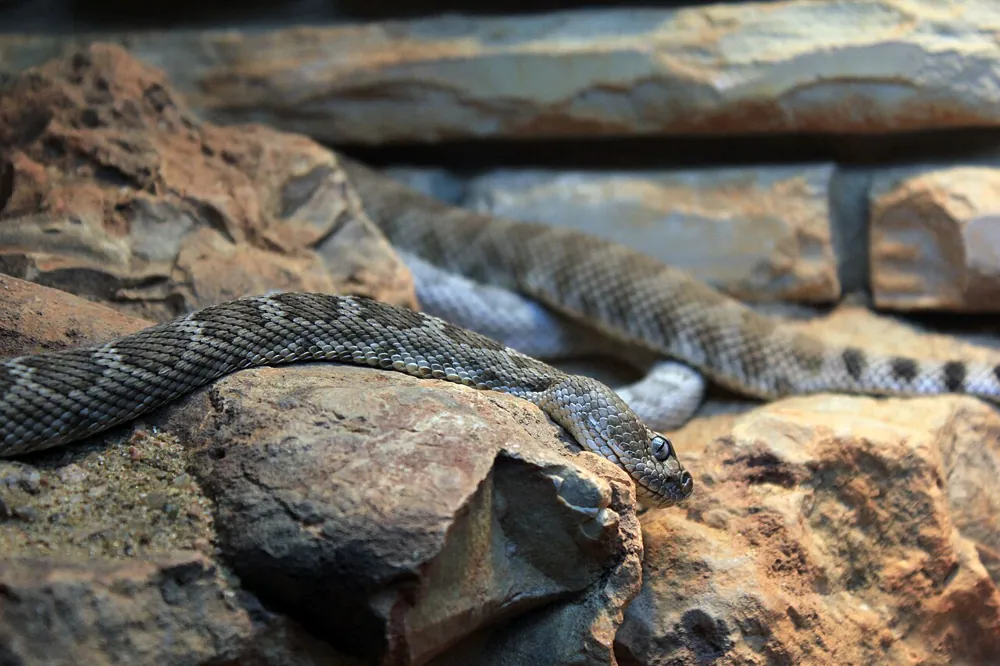
The Santa Catalina rattlesnake is a small, slender pit viper with a very unusual feature: it has no rattle. It lives only on Isla Santa Catalina, a small island in the Gulf of California off the coast of Baja California Sur, Mexico. It is critically endangered.1


 Mmene ungaizindikirire
- It has no rattle. The tail tip falls off with each shed instead of forming new segments.1
- It is relatively slender and small, growing to a maximum of 73.1 cm.1
- The most common colour form has a light cream base with reddish-brown blotches down the back and black and white banding around the tail.1
- The other colour form is ash grey with darker grey blotches, and it still has tail banding.1
- It is mostly active at night and is often seen out in the open rather than hiding.1
Mphamvu ya ululu
Ululu umatuluka kudzera m'mano ake ikaluma.
Ululu wake umachita chiyani?
It is venomous, like all pit vipers. It holds its prey in its jaws until the venom takes effect, so the prey cannot escape before it succumbs.1
Ndi yoopsa bwanji kwa anthu?
Ngozi kwa anthu: YoopsaKulumidwa kumafuna dokotala. Imfa ndi zosowa kwambiri.Imachita chiyani ikachita mantha?
Unlike most rattlesnakes, it does not tend to hide, and because it has no rattle it gives no audible warning.1
 Ikaluma
- Munthuyo akhale chete ndi wodekha, chiwalo cholumidwacho chikhale pamlingo wa mtima, chotsa mphete ndi zinthu zothina, ndipo mufikitse kuchipatala mwachangu.
Nthawi zonse yamba wayimbira nambala yadzidzidzi (112, 000, 911). Awa ndi malangizo wamba a chithandizo choyamba, osati malangizo a dokotala. Zoyambira za chithandizo choyamba
 Khala wotetezeka
- Usakhudze, kugwira kapena kuseweretsa nyama yakuthengo, ngakhale yaing'ono, ndipo ngakhale ikuoneka ngati yagona kapena yafa.
- Ipatse malo. Ukakumana nayo, khala chete, bwerera m'mbuyo pang'onopang'ono ndipo uilole ipite njira yake.
- Ikakuluma: khala chete, usasunthe, imbira nambala yadzidzidzi (112, 000, 911) kapena pita kuchipatala mwachangu. Kumbukira m'mene inkaonekera, chithunzi chimathandiza.
Sikufuna kukuvulaza. Imagwiritsa ntchito ululu wake kugwira chakudya kapena kudziteteza, ndipo imakonda kwambiri kubisala. Zambiri za kukhala wotetezeka
Kuti padziko lapansi?
Ndi yaikulu bwanji?
Ndi yaitali bwanji?
 yaitali ngati nthochi 4 zoyalidwa motsatizana
 ingathamange mamita 100 m'masekondi 100 (munthu wothamanga kwambiri amafunika 9.6)
Santa Catalina rattlesnake ndi yaikulu bwanji poyerekeza ndi IWE?
Ndi masamu chabe mu msakatuli wako. Palibe chomwe chimasungidwa kapena kutumizidwa kwina.
Imathamanga bwanji?


Mfundo
It is one of the few rattlesnakes that has lost its rattle. The tail tip falls off with each shed instead of forming a new segment.1
Although it is a rattlesnake, it is a swift and skilful climber, and individuals were most often found in low bush branches during the hottest month, July.1
Its main prey, the Santa Catalina deer mouse, lives only on this island, so the snake's food supply is also very limited.1
It does not hibernate, and the evidence suggests it is nocturnal even in winter.1
Its closest relative on the mainland is the red diamond rattlesnake, which eats a much wider range of prey, including frogs, birds and other snakes.1
Kumene mfundo zimachokera
- Crotalus catalinensis (Wikipedia (CC BY-SA 4.0))
- Crotalus catalinensis (iNaturalist): mayina ndi magulu a sayansi.
- Venom Wiki: mlingo wa ngozi, kukula wamba ndi kuyerekeza kwa liwiro ndi zathu. Ona mmene timazipezera: Mmene timayezera ngozi.
Mfundo iliyonse patsamba lino ili ndi nambala yosonyeza kochokera. Ngati talakwitsa, pepani, ndife okonda nyama, osati magazini a sayansi. Tiuze pa [email protected] ndipo tikonza.
 Chinkhanira chili ndi njala! Venom Wiki ndi ntchito ya munthu mmodzi: yaulere, yopanda zotsatsa ndi zokutsatira. Mphatso yaing'ono imathandiza kuti ikhalebe pa intaneti.Dyetsa chinkhanira
Zina za gulu lomwelo: Njoka za rattlesnake
 Eastern diamondback rattlesnakeNjoka za rattlesnakeIngathe kupha
 Timber rattlesnakeNjoka za rattlesnakeIngathe kupha
 Western diamondback rattlesnakeNjoka za rattlesnakeIngathe kupha
 SidewinderNjoka za rattlesnakeIkufuna dokotala
 Mojave rattlesnakeNjoka za rattlesnakeIngathe kupha
 Aruba rattlesnakeNjoka za rattlesnakeIkufuna dokotala
 Terciopelo
 Eastern coral snake
 Eyelash viper
 Arizona bark scorpion
 Brown recluse
 Cane toad