
 Africa
 Asia
Asia Ulaya
Ulaya Amereka ya Kumwera
 Australia ndi Oceania
 Antarctica
 Nyanja ya Pacific
 Nyanja ya Atlantic
 Nyanja ya Indian
 Nyanja ya Arctic
 Nyanja ya Mediterranean
 Nyanja Yofiira
 Nyanja ya Caribbean
 Nyanja ya Coral
 Nyanja ya South China
 Nyanja ya Philippine
 Nyanja ya Andaman
 Nyanja ya Kumpoto (North Sea)
 Nyanja ya Timor ndi Arafura
 Nyanja ya Bengal
 Gulf ya California
Golden lancehead
 Imaluma
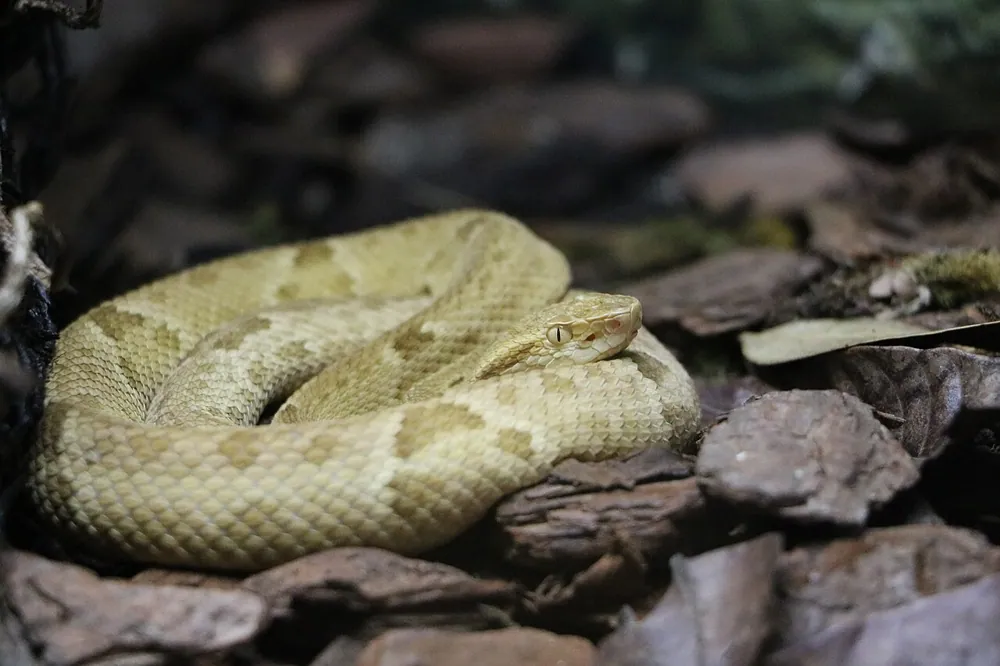
The golden lancehead is an extremely venomous pit viper that lives only on one small Brazilian island, Ilha da Queimada Grande. It is one of the most venomous snakes in Latin America. Because the island is uninhabited and closed to visitors, it is very unlikely that people will ever meet one.1


 Mmene ungaizindikirire
- Pale yellowish-brown body with a series of dorsal blotches that may be triangular or square.1
- Belly is a uniform pale yellow or cream.1
- Lance-shaped head that comes to a point at the nose.1
- No well-defined stripe running behind the eye.1
- Has a longer tail than its closest relative, B. jararaca.1
Nthawi zambiri imasokonezedwa ndi: Its closest relative is B. jararaca, which lives in southern Brazil, Paraguay and northern Argentina. The golden lancehead can be told apart from it mainly by its longer tail.1
Mphamvu ya ululu
Ululu umatuluka kudzera m'mano ake ikaluma.
Ululu wake umachita chiyani?
Its venom is adapted to the animals of the island, mainly reptiles, arthropods and migrating birds, so it works better on these than on mammals. Chemical analysis suggests it is five times as potent as the venom of B. jararaca and is the fastest-acting venom in the genus Bothrops. Its venom becomes more potent as the snake matures. Effects reported in envenomations include swelling, pain, nausea, vomiting, blood blisters, bruising, bleeding into the gut and brain, kidney failure and severe muscle damage.1
Ndi yoopsa bwanji kwa anthu?
Ngozi kwa anthu: Yoopsa kwambiriIngathe kupha munthu amene sanalandire chithandizo.No official report of a human bite from this species has been made, because the island is uninhabited. Other lanceheads cause more human deaths than any other group of snakes in North or South America. One researcher reports four human envenomations by this species, three of which were fatal. For lanceheads in general, the mortality rate is 0.5 to 3.0% with treatment and 7.0% without it.1
 Ikaluma
- Munthuyo akhale chete ndi wodekha, chiwalo cholumidwacho chikhale pamlingo wa mtima, chotsa mphete ndi zinthu zothina, ndipo mufikitse kuchipatala mwachangu.
Nthawi zonse yamba wayimbira nambala yadzidzidzi (112, 000, 911). Awa ndi malangizo wamba a chithandizo choyamba, osati malangizo a dokotala. Zoyambira za chithandizo choyamba
 Khala wotetezeka
- Usakhudze, kugwira kapena kuseweretsa nyama yakuthengo, ngakhale yaing'ono, ndipo ngakhale ikuoneka ngati yagona kapena yafa.
- Ipatse malo. Ukakumana nayo, khala chete, bwerera m'mbuyo pang'onopang'ono ndipo uilole ipite njira yake.
- Ikakuluma: khala chete, usasunthe, imbira nambala yadzidzidzi (112, 000, 911) kapena pita kuchipatala mwachangu. Kumbukira m'mene inkaonekera, chithunzi chimathandiza.
Sikufuna kukuvulaza. Imagwiritsa ntchito ululu wake kugwira chakudya kapena kudziteteza, ndipo imakonda kwambiri kubisala. Zambiri za kukhala wotetezeka
Kuti padziko lapansi?
Ndi yaikulu bwanji?
Ndi yaitali bwanji?
 yaitali ngati amphaka apakhomo 2,5 mphuno ndi mchira motsatizana
 yaitali ngati nthochi 7 zoyalidwa motsatizana
 ingathamange mamita 100 m'masekondi 100 (munthu wothamanga kwambiri amafunika 9.6)
Golden lancehead ndi yaikulu bwanji poyerekeza ndi IWE?
Ndi masamu chabe mu msakatuli wako. Palibe chomwe chimasungidwa kapena kutumizidwa kwina.
Imathamanga bwanji?


Mfundo
Its venom is thought to be five times as potent as that of its closest relative, B. jararaca.1
Its venom has evolved to suit the animals of its island, which has no native mammals.1
Its tail is longer than that of its closest relative, which may help it climb through trees and catch larger birds from a younger age.1
The island's population was estimated at between 2,414 and 2,899 snakes in 2021.1
Travel to the island is strictly prohibited by the Brazilian government.1
It is found only on Ilha da Queimada Grande, an island of about 43 hectares, and nowhere else in the wild.1
Za akatswiri a ululu
- Dzina la sayansi
- Bothrops insularis
- Gulu
- Njoka za pit viper
- Banja
- Viperidae2
- Dongosolo
- Squamata
- Makontinenti
- Amereka ya Kumwera
- Ana akhanda
- Like most vipers, it gives birth to live young. The average number of young per pregnancy is 6.5.1
- Mmene ilili kuthengo
- Critically Endangered (IUCN Red List)1
- Ngozi kwa anthu
- 4 / 5: Yoopsa kwambiri3
Kumene mfundo zimachokera
- Golden lancehead (Wikipedia (CC BY-SA 4.0))
- Bothrops insularis (iNaturalist): mayina ndi magulu a sayansi.
- Venom Wiki: mlingo wa ngozi, kukula wamba ndi kuyerekeza kwa liwiro ndi zathu. Ona mmene timazipezera: Mmene timayezera ngozi.
Mfundo iliyonse patsamba lino ili ndi nambala yosonyeza kochokera. Ngati talakwitsa, pepani, ndife okonda nyama, osati magazini a sayansi. Tiuze pa [email protected] ndipo tikonza.
 Chinkhanira chili ndi njala! Venom Wiki ndi ntchito ya munthu mmodzi: yaulere, yopanda zotsatsa ndi zokutsatira. Mphatso yaing'ono imathandiza kuti ikhalebe pa intaneti.Dyetsa chinkhanira
Zina za gulu lomwelo: Njoka za pit viper
 Terciopelo
 Eyelash viper
 South American bushmaster
 Common lancehead
 Jararaca
 Jararacussu
Imakhalanso ku: Amereka ya Kumwera
 Golden poison frogAchule a poizoni, achule a mphini (toads) ndi ma newtYakuphaUsakhudze
 Brazilian wandering spiderAkangaudeIngathe kupha
 Cane toadAchule a poizoni, achule a mphini (toads) ndi ma newtIkufuna dokotalaUsakhudze
 Peruvian giant centipedeMa centipedeIkufuna dokotala
 Bullet antNyerereImangopweteka
 Common vampire batNyama zoyamwitsa zaululuImangopweteka