
 Africa
 Asia
Asia Ulaya
Ulaya Amereka ya Kumwera
 Australia ndi Oceania
 Antarctica
 Nyanja ya Pacific
 Nyanja ya Atlantic
 Nyanja ya Indian
 Nyanja ya Arctic
 Nyanja ya Mediterranean
 Nyanja Yofiira
 Nyanja ya Caribbean
 Nyanja ya Coral
 Nyanja ya South China
 Nyanja ya Philippine
 Nyanja ya Andaman
 Nyanja ya Kumpoto (North Sea)
 Nyanja ya Timor ndi Arafura
 Nyanja ya Bengal
 Gulf ya California
Wagler's pit viper
 Imaluma
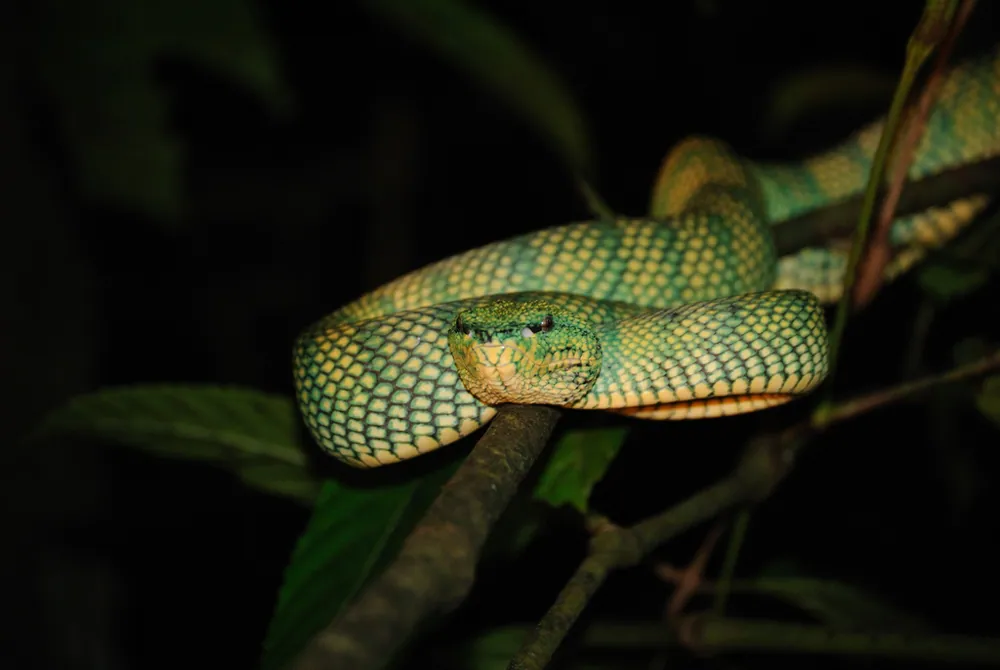
Wagler's pit viper is a venomous snake that lives in the forests of Southeast Asia. It spends most of its life in trees and is sometimes called the temple viper, because it is common around the Temple of the Azure Cloud in Malaysia. Its venom has also been used in scientific research.1



 Mmene ungaizindikirire
- Females can reach about 1 m (39 in) in total length, including the tail, and are black with yellow stripes.1
- Males typically do not exceed 75 cm (29.5 in). They have large triangular heads and relatively thin green bodies.1
- The species has many colour forms. Some are black or brown with orange and yellow banding, and others are light green with yellow or orange banding.1
- It is nocturnal, so it is active at night, and it often stays still for long periods.1
Mphamvu ya ululu
Ululu umatuluka kudzera m'mano ake ikaluma.
Ululu wake umachita chiyani?
The venom contains four peptides (small protein chains) called waglerins. In studies on mice, waglerin-1 blocked signals passing from nerves to muscles. Waglerins caused fatal breathing paralysis in adult mice.1
Ndi yoopsa bwanji kwa anthu?
Ngozi kwa anthu: YoopsaKulumidwa kumafuna dokotala. Imfa ndi zosowa kwambiri.Imachita chiyani ikachita mantha?
When disturbed, it can strike quickly.1
 Ikaluma
- Munthuyo akhale chete ndi wodekha, chiwalo cholumidwacho chikhale pamlingo wa mtima, chotsa mphete ndi zinthu zothina, ndipo mufikitse kuchipatala mwachangu.
Nthawi zonse yamba wayimbira nambala yadzidzidzi (112, 000, 911). Awa ndi malangizo wamba a chithandizo choyamba, osati malangizo a dokotala. Zoyambira za chithandizo choyamba
 Khala wotetezeka
- Usakhudze, kugwira kapena kuseweretsa nyama yakuthengo, ngakhale yaing'ono, ndipo ngakhale ikuoneka ngati yagona kapena yafa.
- Ipatse malo. Ukakumana nayo, khala chete, bwerera m'mbuyo pang'onopang'ono ndipo uilole ipite njira yake.
- Ikakuluma: khala chete, usasunthe, imbira nambala yadzidzidzi (112, 000, 911) kapena pita kuchipatala mwachangu. Kumbukira m'mene inkaonekera, chithunzi chimathandiza.
Sikufuna kukuvulaza. Imagwiritsa ntchito ululu wake kugwira chakudya kapena kudziteteza, ndipo imakonda kwambiri kubisala. Zambiri za kukhala wotetezeka
Kuti padziko lapansi?
Ndi yaikulu bwanji?
Ndi yaitali bwanji?
 yaitali ngati amphaka apakhomo 2 mphuno ndi mchira motsatizana
 yaitali ngati nthochi 6 zoyalidwa motsatizana
 ingathamange mamita 100 m'masekondi 100 (munthu wothamanga kwambiri amafunika 9.6)
Wagler's pit viper ndi yaikulu bwanji poyerekeza ndi IWE?
Ndi masamu chabe mu msakatuli wako. Palibe chomwe chimasungidwa kapena kutumizidwa kwina.
Imathamanga bwanji?


Mfundo
Its pits can detect temperature differences as small as 0.003 °C (0.0054 °F).1
Waglerins, the peptides in its venom, are useful tools for studying how nerves and muscles connect.1
Females and males look very different, so the sexes were once hard to tell apart as one animal.1
Its many colour forms, called phases, were once thought by some researchers to be separate subspecies.1
Kuthetsa nthano zabodza
Nthano yabodza: Waglerin-1 smooths wrinkles, so it is safe to use in skin creams for that purpose.
Zoona: Waglerin-1 is included in some skin creams marketed as wrinkle removers, but there is no scientific evidence that it relaxes the muscles that cause wrinkles.1
Za akatswiri a ululu
Kumene mfundo zimachokera
- Tropidolaemus wagleri (Wikipedia (CC BY-SA 4.0))
- Tropidolaemus wagleri (iNaturalist): mayina ndi magulu a sayansi.
- Venom Wiki: mlingo wa ngozi, kukula wamba ndi kuyerekeza kwa liwiro ndi zathu. Ona mmene timazipezera: Mmene timayezera ngozi.
Mfundo iliyonse patsamba lino ili ndi nambala yosonyeza kochokera. Ngati talakwitsa, pepani, ndife okonda nyama, osati magazini a sayansi. Tiuze pa [email protected] ndipo tikonza.
 Chinkhanira chili ndi njala! Venom Wiki ndi ntchito ya munthu mmodzi: yaulere, yopanda zotsatsa ndi zokutsatira. Mphatso yaing'ono imathandiza kuti ikhalebe pa intaneti.Dyetsa chinkhanira
 Brown spotted pit viper
 Habu
Habu Hump-nosed viper
 Hundred-pace viper
 Malayan pit viper
 Mamushi
 Deathstalker
 Indian cobra
 Indian saw-scaled viper
 King cobra
 Puff adder
 Njoka ya Russell (Russell's viper)