
 Africa
 Asia
Asia Ulaya
Ulaya Amereka ya Kumwera
 Australia ndi Oceania
 Antarctica
 Nyanja ya Pacific
 Nyanja ya Atlantic
 Nyanja ya Indian
 Nyanja ya Arctic
 Nyanja ya Mediterranean
 Nyanja Yofiira
 Nyanja ya Caribbean
 Nyanja ya Coral
 Nyanja ya South China
 Nyanja ya Philippine
 Nyanja ya Andaman
 Nyanja ya Kumpoto (North Sea)
 Nyanja ya Timor ndi Arafura
 Nyanja ya Bengal
 Gulf ya California
Western yellowjacket
 Imalasa
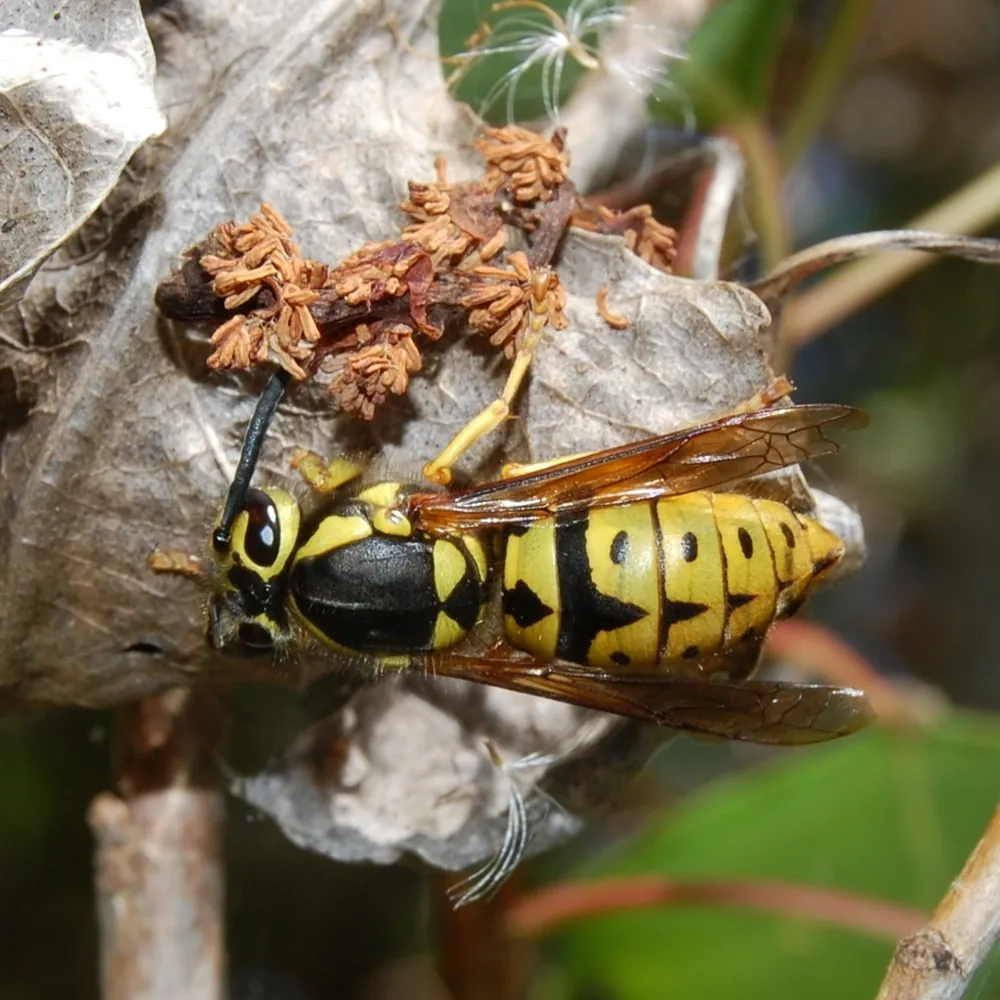
The western yellowjacket is a social wasp with a yellow and black body. It lives across the western half of North America and has spread to the Hawaiian Islands, where it is considered a major pest. Its colonies can grow very large in places without cold winters.1



 Mmene ungaizindikirire
- Yellow and black pattern, typical of social wasps in the genus Vespula1
- Most females have a continuous yellow ring around each eye, known as an eye-loop1
- A diamond-shaped black mark on the first tergum (the upper plate of the abdomen)1
- Nests are made of wood fibres and enclosed in a paper envelope, with an entrance tunnel of 10 to 30 cm at the bottom1
Nthawi zambiri imasokonezedwa ndi: It is often misidentified as V. germanica, which has a similar diamond-shaped black mark. The continuous yellow eye-loop around each eye usually tells the western yellowjacket apart, though males often lack it.1
Mphamvu ya ululu
Ululu umatuluka kudzera mu mbola.
Ndi yoopsa bwanji kwa anthu?
Ngozi kwa anthu: YopwetekaIngathe kupweteka kwambiri, koma pafupifupi nthawi zonse si vuto lalikulu. Ikalasa
- Chotsa mbola ya njuchi poikwangula ndipo ziziritsa pamalopo.
- Ngati munthuyo akuvutika kupuma, nkhope kapena khosi zikutupa, kapena akumva ngati akomoka, ndi vuto ladzidzidzi la ziwengo (allergy): imbira nambala yadzidzidzi ndipo gwiritsa ntchito jakisoni wake wa adrenaline (adrenaline pen) ngati ali nawo.
Nthawi zonse yamba wayimbira nambala yadzidzidzi (112, 000, 911). Awa ndi malangizo wamba a chithandizo choyamba, osati malangizo a dokotala. Zoyambira za chithandizo choyamba
 Khala wotetezeka
- Usakhudze, kugwira kapena kuseweretsa nyama yakuthengo, ngakhale yaing'ono, ndipo ngakhale ikuoneka ngati yagona kapena yafa.
- Ipatse malo. Ukakumana nayo, khala chete, bwerera m'mbuyo pang'onopang'ono ndipo uilole ipite njira yake.
- Ikakulasa: khala chete, usasunthe, imbira nambala yadzidzidzi (112, 000, 911) kapena pita kuchipatala mwachangu. Kumbukira m'mene inkaonekera, chithunzi chimathandiza.
Sikufuna kukuvulaza. Imagwiritsa ntchito ululu wake kugwira chakudya kapena kudziteteza, ndipo imakonda kwambiri kubisala. Zambiri za kukhala wotetezeka
Kuti padziko lapansi?
Ndi yaikulu bwanji?
Ndi yaitali bwanji?
 yaifupi kuposa chala chako chaching'ono
 ingauluke kudutsa bwalo lonse la mpira m'masekondi 16
Western yellowjacket ndi yaikulu bwanji poyerekeza ndi IWE?
Ndi masamu chabe mu msakatuli wako. Palibe chomwe chimasungidwa kapena kutumizidwa kwina.
Imathamanga bwanji?


Mfundo
Workers settle dominance within the nest by mauling, where one wasp chews on another that stays still.1
In Hawaii, the western yellowjacket has become so invasive that it is labelled a major pest.1
The nest is kept cleaner than those of many other social wasps, with waste, prey remains and dead larvae removed.1
Only the inseminated queen survives the winter, entering diapause (a resting state) until spring.1
Most foraging happens close to the nest, usually within about 335 metres, though some trips reach about 550 metres.1
Cold weather limits the number of western yellowjackets, but in places without cold winters their population can grow very quickly.1
Za akatswiri a ululu
Kumene mfundo zimachokera
- Vespula pensylvanica (Wikipedia (CC BY-SA 4.0))
- Vespula pensylvanica (iNaturalist): mayina ndi magulu a sayansi.
- Venom Wiki: mlingo wa ngozi, kukula wamba ndi kuyerekeza kwa liwiro ndi zathu. Ona mmene timazipezera: Mmene timayezera ngozi.
Mfundo iliyonse patsamba lino ili ndi nambala yosonyeza kochokera. Ngati talakwitsa, pepani, ndife okonda nyama, osati magazini a sayansi. Tiuze pa [email protected] ndipo tikonza.
 Chinkhanira chili ndi njala! Venom Wiki ndi ntchito ya munthu mmodzi: yaulere, yopanda zotsatsa ndi zokutsatira. Mphatso yaing'ono imathandiza kuti ikhalebe pa intaneti.Dyetsa chinkhanira
Zina za gulu lomwelo: Njuchi, mavu ndi mavu akuluakulu (hornets)
 Tarantula hawkNjuchi, mavu ndi mavu akuluakulu (hornets)Imangopweteka
 Executioner waspNjuchi, mavu ndi mavu akuluakulu (hornets)Ikufuna dokotala
 Warrior waspNjuchi, mavu ndi mavu akuluakulu (hornets)Ikufuna dokotala
 Bald-faced hornetNjuchi, mavu ndi mavu akuluakulu (hornets)Imangopweteka
 Cow killer velvet antNjuchi, mavu ndi mavu akuluakulu (hornets)Imangopweteka
 Eastern cicada killerNjuchi, mavu ndi mavu akuluakulu (hornets)Yosavulaza
Imakhalanso ku: Amereka ya Kumpoto
 TerciopeloNjoka za pit viperYakupha
 Eastern coral snakeNjoka za coralIngathe kupha
 Eastern diamondback rattlesnakeNjoka za rattlesnakeIngathe kupha
 Eyelash viperNjoka za pit viperIngathe kupha
 Timber rattlesnakeNjoka za rattlesnakeIngathe kupha
 Western diamondback rattlesnakeNjoka za rattlesnakeIngathe kupha