
 Afurika
 Aziya
Aziya Uburayi
 Amerika y'Amajyepfo
 Ositaraliya na Oseyaniya
 Antaragitika
 Inyanja ya Pasifika
 Inyanja ya Atalantika
 Inyanja y'Abahinde
 Inyanja ya Arigitika
 Inyanja ya Mediterane
 Inyanja Itukura
 Inyanja ya Karayibe
 Inyanja ya Korali
 Inyanja y'Amajyepfo y'u Bushinwa
 Inyanja ya Filipine
 Inyanja ya Andamani
 Inyanja y'Amajyaruguru
 Inyanja ya Timor na Arafura
 Ikigobe cya Bengali
 Ikigobe cya Kaliforuniya
Bengal slow loris
 Iraruma
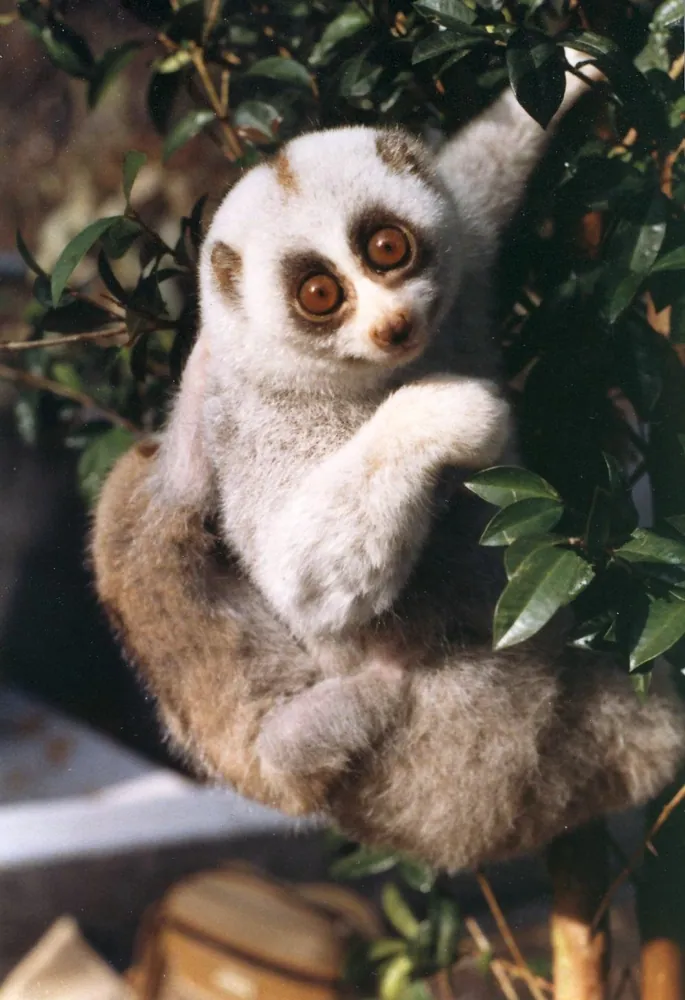
The Bengal slow loris is a small, nocturnal primate with big eyes and dense, woolly fur. It lives in forests across South and Southeast Asia, and it is the largest of the slow loris species. It is endangered, mainly because it is sold in animal markets and used in traditional medicine.1



 Uko wayimenya
- Dense, woolly brown-grey fur on its back, with white fur on its underside1
- A dark stripe running up to the top of its head, which does not reach the ears1
- Pale forearms and feet, with limbs that vary from brown to nearly white1
- A round head, flat face, large eyes that show a bright orange eye shine, and short ears1
- Body and head length of 26 to 38 cm1
Ikunze kwitiranywa na: The Sunda slow loris is similar in size but is smaller and tawny- or golden-brown, without the pale head, nape and shoulders. The pygmy slow loris is much smaller, with dark brown fur, longer ears and no dark dorsal stripe.1
Imbaraga z'ubumara
Ubumara busohokera mu menyo yayo y'ubumara cyangwa mu yandi menyo iyo iriye.
Ubumara bwayo bukora iki?
A small gland on the inside of the elbow produces a pungent, clear, oily toxin. The animal wipes this fluid onto its toothcomb as a defence. The main chemical in it is m-cresol, a phenolic compound, and the mixture contains several dozen volatile chemicals.1
Iteje akaga kangana iki ku bantu?
Akaga ku bantu: IrababazaIshobora kubabaza cyane, ariko hafi ya buri gihe nta kibazo gikomeye biteza. Niba iruma
- Oza igikomere neza kandi ushake ubufasha bwa muganga.
Buri gihe banza uhamagare nimero y'ubutabazi (112, 000, 911). Izi ni inama rusange z'ubutabazi bw'ibanze, si inama za muganga. Ibanze by'ubutabazi bw'ibanze
 Irinde akaga
- Ntuzigere ukora, ufata cyangwa ushotora inyamaswa yo mu gasozi, nubwo yaba ntoya, kandi nubwo yasa n'isinziriye cyangwa yapfuye.
- Yihe umwanya. Niba uhuye n'imwe, tuza, usubire inyuma buhoro buhoro kandi uyireke yigendere.
- Niba imwe ikurumye: tuza, ntunyeganyege, hamagara nimero y'ubutabazi (112, 000, 911) cyangwa ujye ku bitaro vuba. Ibuka uko yasaga, ifoto irafasha.
Ntigushakisha ngo ikugirire nabi. Ikoresha ubumara bwayo kugira ngo ifate ibyo kurya cyangwa yirinde, kandi ikunda cyane kwihisha. Ibindi ku kwirinda
Ingana gute?
Ireshya ite?
Iremera ibingana iki?

 ireshya n'ibice 12 by'ibikinisho byo kubaka biri ku murongo
 iremera hafi nk'injangwe yo mu rugo
 yakwiruka metero 100 mu masegonda 180 (umuntu wihuta kurusha abandi akenera 9,6)
Bengal slow loris ingana ite ugereranyije NAWE?
Ni imibare gusa ikorerwa muri mudasobwa yawe. Nta kintu kibikwa cyangwa cyoherezwa ahandi.
Yihuta gute?


Ibintu by'ukuri
Its toxin may carry information about a loris's sex, age, health and social status, so it may act as a form of scent communication.1
It is the largest species of slow loris.1
Its second hind toe has a curved toilet-claw that it uses for scratching and grooming, while its other nails are straight.1
It has an excellent night vision, helped by a tapetum lucidum, a reflective layer in the eye.1
Females can have a new offspring every 12 to 18 months, and could even become pregnant again when the previous young is about six months old.1
It is an important seed disperser and pollinator, and it is also prey for several carnivores.1
Ku bahanga mu by'ubumara
- Izina rya siyansi
- Nycticebus bengalensis
- Itsinda
- Inyamabere zifite ubumara
- Umuryango
- Lorisidae2
- Itsinda rinini (order)
- Primates
- Imigabane
- Aziya
- Abana bato
- It usually gives birth to a single offspring after a six-month pregnancy, and twins are rare. The mother carries the young for about three months, and it becomes independent at around three months of age.1
- Igihe ibaho
- hafi imyaka 201
- Uko imeze mu gasozi
- Endangered1
- Akaga ku bantu
- 2 / 5: Irababaza3
Aho ibintu bivugwa bituruka
- Bengal slow loris (Wikipedia (CC BY-SA 4.0))
- Nycticebus bengalensis (iNaturalist): amazina n'ibyiciro.
- Venom Wiki: urwego rw'akaga, ingano isanzwe n'ikigereranyo cy'umuvuduko ni ibyacu bwite. Reba uko tubibara: Uko tugena akaga.
Buri kintu kivugwa kuri iyi paji gifite nimero yerekana aho cyavuye. Niba twibeshye, tubabarire, turi abakunzi b'inyamaswa, ntituri ikinyamakuru cya siyansi. Tubwire kuri [email protected] tuzabikosora.
 Sikorupiyo irashonje! Venom Wiki ni umushinga w'umuntu umwe: ni ubuntu, nta matangazo kandi nta bikurikirana abantu. Impano ntoya ifasha kugira ngo ikomeze kuboneka kuri interineti.Gaburira sikorupiyo
Izindi zo mu itsinda rimwe: Inyamabere zifite ubumara
 Javan slow lorisInyamabere zifite ubumaraIrababaza gusa
 Pygmy slow lorisInyamabere zifite ubumaraIrababaza gusa
 Sunda slow lorisInyamabere zifite ubumaraIrababaza gusa
 Kayan River slow lorisInyamabere zifite ubumaraIrababaza gusa
 Philippine slow lorisInyamabere zifite ubumaraIrababaza gusa
 Eurasian water shrewInyamabere zifite ubumaraNtacyo itwaye
 Deathstalker
 Indian cobra
 Indian saw-scaled viper
 King cobra
 Puff adder
 Impiri ya Russell