
 Afurika
 Aziya
Aziya Uburayi
 Amerika y'Amajyepfo
 Ositaraliya na Oseyaniya
 Antaragitika
 Inyanja ya Pasifika
 Inyanja ya Atalantika
 Inyanja y'Abahinde
 Inyanja ya Arigitika
 Inyanja ya Mediterane
 Inyanja Itukura
 Inyanja ya Karayibe
 Inyanja ya Korali
 Inyanja y'Amajyepfo y'u Bushinwa
 Inyanja ya Filipine
 Inyanja ya Andamani
 Inyanja y'Amajyaruguru
 Inyanja ya Timor na Arafura
 Ikigobe cya Bengali
 Ikigobe cya Kaliforuniya
East Pacific red octopus
 Iraruma
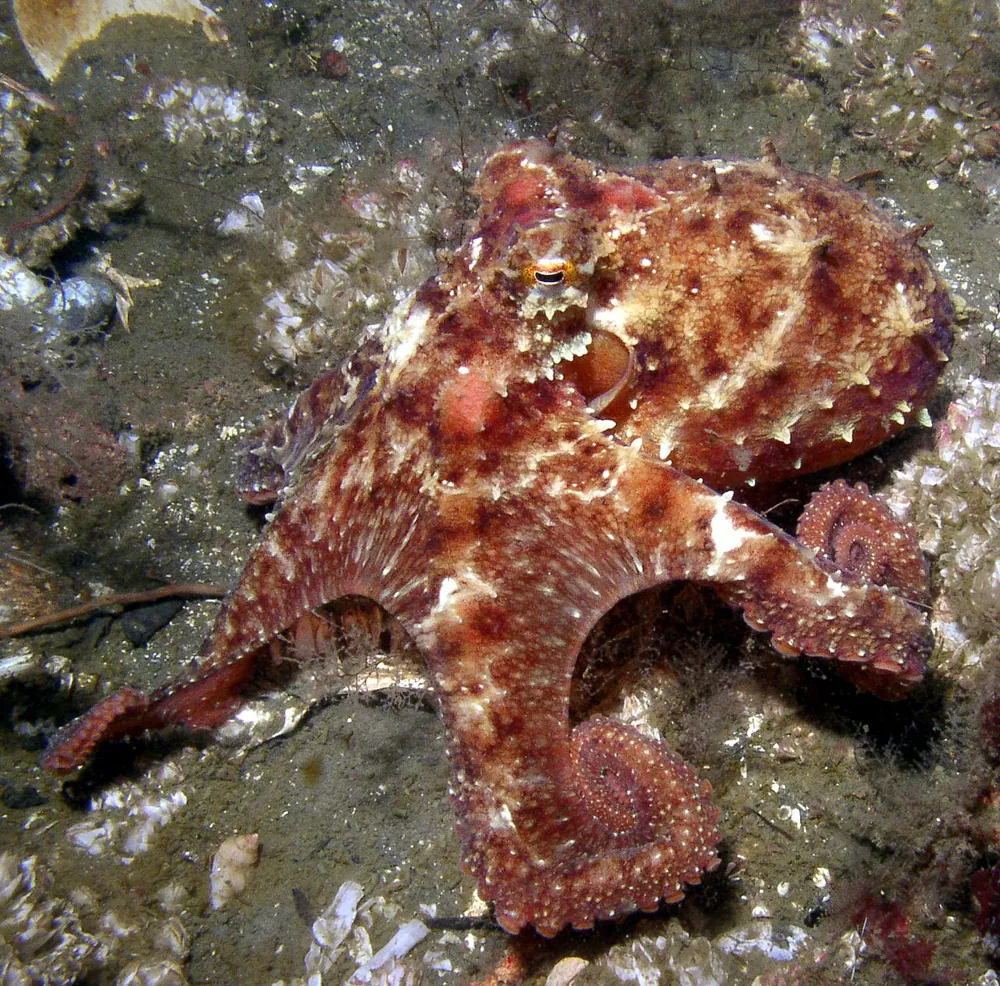
The East Pacific red octopus is a small octopus that lives along the North American West Coast. It is the most common shallow-water octopus in much of this region and hunts on the seabed. It is special because scientists have shown it has individual personalities, the first invertebrate found to have them.1


 Uko wayimenya
- Its colour can vary from deep brick red to brown, to white, or a mottled mixture of these.1
- It can change both its colour and skin texture.1
- It has three eyelash-like papillae (small bumps) below each eye.1
- Adults usually have a mantle (body) length of 8–10 cm, with arms of 30–40 cm.1
Ikunze kwitiranywa na: Small individuals of the giant Pacific octopus (Enteroctopus dofleini) can be mistaken for it in the north of its range. The East Pacific red octopus has three eyelash-like papillae below each eye, which the giant Pacific octopus lacks.1
Imbaraga z'ubumara
Ubumara busohokera mu menyo yayo y'ubumara cyangwa mu yandi menyo iyo iriye.
Ubumara bwayo bukora iki?
It uses venom to subdue its prey. After catching a bivalve such as a clam, it drills a hole through the shell near the adductor muscles and injects venom through that hole.1
Iteje akaga kangana iki ku bantu?
Akaga ku bantu: IrababazaIshobora kubabaza cyane, ariko hafi ya buri gihe nta kibazo gikomeye biteza. Niba iruma
- Gupfuka ukanda no kudanyeganyeza (pressure immobilisation): zingira bande ikweduka kandi ifashe neza hejuru y'aho yarumye, hanyuma uzamuke ku rugingo rwose, urushyireho agati ko kurukomeza (attelle), kandi umuntu agume atanyeganyega na gato kugeza ubutabazi buhageze.
- Octopus ifite impeta z'ubururu cyangwa cone snail bishobora gutuma umuntu ahagarika guhumeka nyamara akiri maso: hamagara ubutabazi kandi witegure kumuhumekera mu kanwa kugeza igihe abo mu mbangukiragutabara bagusimbuye.
Buri gihe banza uhamagare nimero y'ubutabazi (112, 000, 911). Izi ni inama rusange z'ubutabazi bw'ibanze, si inama za muganga. Ibanze by'ubutabazi bw'ibanze
 Irinde akaga
- Ntuzigere ukora, ufata cyangwa ushotora inyamaswa yo mu gasozi, nubwo yaba ntoya, kandi nubwo yasa n'isinziriye cyangwa yapfuye.
- Yihe umwanya. Niba uhuye n'imwe, tuza, usubire inyuma buhoro buhoro kandi uyireke yigendere.
- Niba imwe ikurumye: tuza, ntunyeganyege, hamagara nimero y'ubutabazi (112, 000, 911) cyangwa ujye ku bitaro vuba. Ibuka uko yasaga, ifoto irafasha.
Ntigushakisha ngo ikugirire nabi. Ikoresha ubumara bwayo kugira ngo ifate ibyo kurya cyangwa yirinde, kandi ikunda cyane kwihisha. Ibindi ku kwirinda
Ni hehe ku isi?
Ingana gute?
Ireshya ite?
Iremera ibingana iki?

 ireshya n'ibice 3 by'ibikinisho byo kubaka biri ku murongo
 yakoga uburebure bw'ikidendezi kinini (metero 50) mu masegonda 7,2
East Pacific red octopus ingana ite ugereranyije NAWE?
Ni imibare gusa ikorerwa muri mudasobwa yawe. Nta kintu kibikwa cyangwa cyoherezwa ahandi.
Yihuta gute?

Ibintu by'ukuri
It was the first invertebrate in which individual personalities were demonstrated.1
In the 2016 Pixar film Finding Dory, a character named Hank is an East Pacific red octopus. The animators gave him seven arms because they could not fit all eight on his model.1
It drills holes in bivalve shells, often near the adductor muscles, to reach the prey inside.1
A 2011 study suggested it may choose prey based on how easily the fat can be digested rather than on calories.1
It was widely thought to be a young giant Pacific octopus before it was described as a species in 1953.1
Usenya ibinyoma
Ikinyoma: Because captive animals were active at night, many people believed it hunts only at night.
Ukuri: A study in Puget Sound, Washington, found that a local population was likely active during the day (diurnal).1
Aho ibintu bivugwa bituruka
- East Pacific red octopus (Wikipedia (CC BY-SA 4.0))
- Octopus rubescens (iNaturalist): amazina n'ibyiciro.
- Venom Wiki: urwego rw'akaga, ingano isanzwe n'ikigereranyo cy'umuvuduko ni ibyacu bwite. Reba uko tubibara: Uko tugena akaga.
Buri kintu kivugwa kuri iyi paji gifite nimero yerekana aho cyavuye. Niba twibeshye, tubabarire, turi abakunzi b'inyamaswa, ntituri ikinyamakuru cya siyansi. Tubwire kuri [email protected] tuzabikosora.
 Sikorupiyo irashonje! Venom Wiki ni umushinga w'umuntu umwe: ni ubuntu, nta matangazo kandi nta bikurikirana abantu. Impano ntoya ifasha kugira ngo ikomeze kuboneka kuri interineti.Gaburira sikorupiyo
Izindi zo mu itsinda rimwe: Cone snail na octopus
 Geography cone
 Greater blue-ringed octopus
 Southern blue-ringed octopus
 Blue sea dragon
 Common octopus
 Giant Pacific octopus
Iba kandi muri: Inyanja ya Pasifika
 Australian box jellyfishJellyfish n'izindi nyamaswa zo mu nyanja zitera uruboriYicaNtukayikoreho
 Japanese pufferfishIzindi nyamaswa zifite uburoziYica
 Hawksbill sea turtleIzindi nyamaswa zifite uburoziIshobora kwica
 Irukandji jellyfishJellyfish n'izindi nyamaswa zo mu nyanja zitera uruboriIshobora kwicaNtukayikoreho
 Reef stonefishAmafi afite ubumaraIshobora kwicaNtukayikoreho
 Crown-of-thorns starfishOursins, inyenyeri zo mu nyanja n'inyoBisaba mugangaNtukayikoreho