
 Afurika
 Aziya
Aziya Uburayi
 Amerika y'Amajyepfo
 Ositaraliya na Oseyaniya
 Antaragitika
 Inyanja ya Pasifika
 Inyanja ya Atalantika
 Inyanja y'Abahinde
 Inyanja ya Arigitika
 Inyanja ya Mediterane
 Inyanja Itukura
 Inyanja ya Karayibe
 Inyanja ya Korali
 Inyanja y'Amajyepfo y'u Bushinwa
 Inyanja ya Filipine
 Inyanja ya Andamani
 Inyanja y'Amajyaruguru
 Inyanja ya Timor na Arafura
 Ikigobe cya Bengali
 Ikigobe cya Kaliforuniya
Field's horned viper
 Iraruma
Field's horned viper is a venomous snake from the viper family. It lives in the deserts of the Middle East. Its venom is unusual because it attacks the nerves, while most vipers' venom damages tissue and blood vessels.1
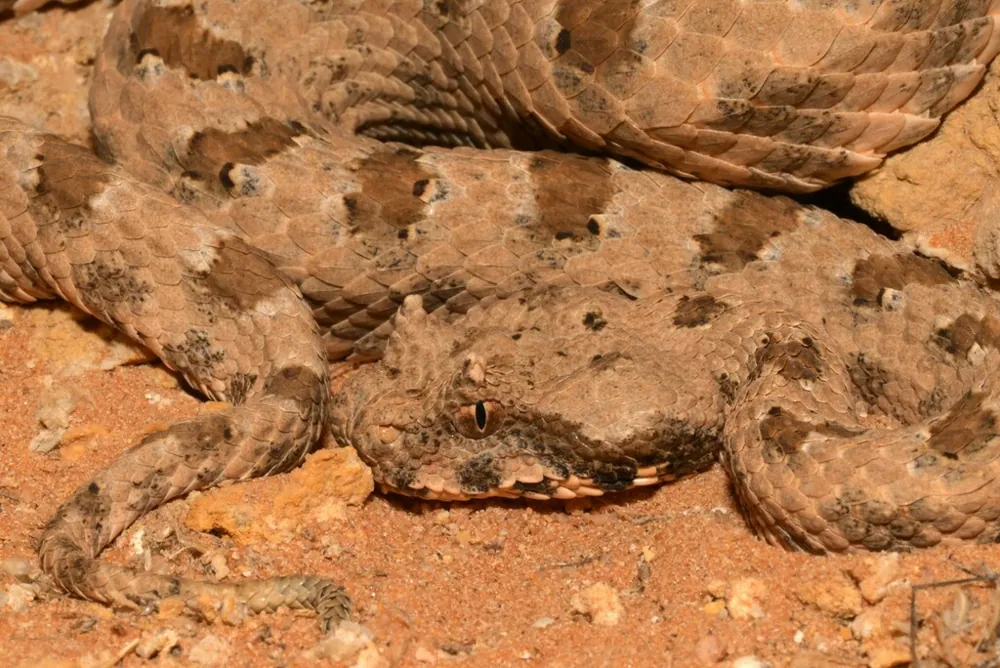
 Uko wayimenya
- It has fewer scales in certain counts than the Persian horned viper.1
- Its tail is much shorter compared with its overall body length.1
- Several rows of its side scales are almost smooth.1
Ikunze kwitiranywa na: It is most often confused with the Persian horned viper. The Persian horned viper has strongly keeled (ridged) scales on its back and sides, while Field's horned viper has smooth side scales. Its tail is also much shorter.1
Imbaraga z'ubumara
Ubumara busohokera mu menyo yayo y'ubumara cyangwa mu yandi menyo iyo iriye.
Ubumara bwayo bukora iki?
Its venom contains several fractions with marked neurotoxic activity, which means it attacks the nerves. This differs from the Persian horned viper, whose venom causes strong bleeding and tissue damage typical of most vipers. Its venom is venomous, so bites are a medical emergency.1
Iteje akaga kangana iki ku bantu?
Akaga ku bantu: IkomeyeKurumwa na yo bisaba kujya kwa muganga. Abapfa ni bake cyane. Niba iruma
- No antivenom is available for bites from this snake. A polyvalent antiserum may offer some protection against its blood-damaging toxins, but none against the nerve-attacking effects of its venom.1
- Umuntu agume atanyeganyega kandi atuje, urugingo rwarumwe rugume ku rwego rumwe n'umutima, mukuremo impeta n'ibindi bintu bifashe cyane, kandi mujye ku bitaro vuba.
Buri gihe banza uhamagare nimero y'ubutabazi (112, 000, 911). Izi ni inama rusange z'ubutabazi bw'ibanze, si inama za muganga. Ibanze by'ubutabazi bw'ibanze
 Irinde akaga
- Ntuzigere ukora, ufata cyangwa ushotora inyamaswa yo mu gasozi, nubwo yaba ntoya, kandi nubwo yasa n'isinziriye cyangwa yapfuye.
- Yihe umwanya. Niba uhuye n'imwe, tuza, usubire inyuma buhoro buhoro kandi uyireke yigendere.
- Niba imwe ikurumye: tuza, ntunyeganyege, hamagara nimero y'ubutabazi (112, 000, 911) cyangwa ujye ku bitaro vuba. Ibuka uko yasaga, ifoto irafasha.
Ntigushakisha ngo ikugirire nabi. Ikoresha ubumara bwayo kugira ngo ifate ibyo kurya cyangwa yirinde, kandi ikunda cyane kwihisha. Ibindi ku kwirinda
Ingana gute?
Ireshya ite?
 ireshya n'imineke 3 ikurikiranye
 yakwiruka metero 100 mu masegonda 110 (umuntu wihuta kurusha abandi akenera 9,6)
Field's horned viper ingana ite ugereranyije NAWE?
Ni imibare gusa ikorerwa muri mudasobwa yawe. Nta kintu kibikwa cyangwa cyoherezwa ahandi.
Yihuta gute?


Ibintu by'ukuri
Usenya ibinyoma
Ikinyoma: It is just a subspecies of the Persian horned viper.
Ukuri: Most sources now classify it as a separate species, Pseudocerastes fieldi.1
Aho ibintu bivugwa bituruka
- Field's horned viper (Wikipedia (CC BY-SA 4.0))
- Pseudocerastes fieldi (iNaturalist): amazina n'ibyiciro.
- Venom Wiki: urwego rw'akaga, ingano isanzwe n'ikigereranyo cy'umuvuduko ni ibyacu bwite. Reba uko tubibara: Uko tugena akaga.
Buri kintu kivugwa kuri iyi paji gifite nimero yerekana aho cyavuye. Niba twibeshye, tubabarire, turi abakunzi b'inyamaswa, ntituri ikinyamakuru cya siyansi. Tubwire kuri [email protected] tuzabikosora.
 Sikorupiyo irashonje! Venom Wiki ni umushinga w'umuntu umwe: ni ubuntu, nta matangazo kandi nta bikurikirana abantu. Impano ntoya ifasha kugira ngo ikomeze kuboneka kuri interineti.Gaburira sikorupiyo
 Indian saw-scaled viper
 Puff adder
 Impiri ya Russell
 Common European adder
 Eastern Russell's viper
 Northeast African carpet viper
 Deathstalker
 Indian cobra
 King cobra
 Asian giant hornet
 Komodo dragon
 Spanish fly