
 Afurika
 Aziya
Aziya Uburayi
 Amerika y'Amajyepfo
 Ositaraliya na Oseyaniya
 Antaragitika
 Inyanja ya Pasifika
 Inyanja ya Atalantika
 Inyanja y'Abahinde
 Inyanja ya Arigitika
 Inyanja ya Mediterane
 Inyanja Itukura
 Inyanja ya Karayibe
 Inyanja ya Korali
 Inyanja y'Amajyepfo y'u Bushinwa
 Inyanja ya Filipine
 Inyanja ya Andamani
 Inyanja y'Amajyaruguru
 Inyanja ya Timor na Arafura
 Ikigobe cya Bengali
 Ikigobe cya Kaliforuniya
Goldenrod crab spider
 Iraruma
The goldenrod crab spider is a small, flat spider that hides on flowers and waits for insects to land nearby. It lives in Europe and North America. It is named for the way it walks, and it can change its colour to match the flower it sits on.1



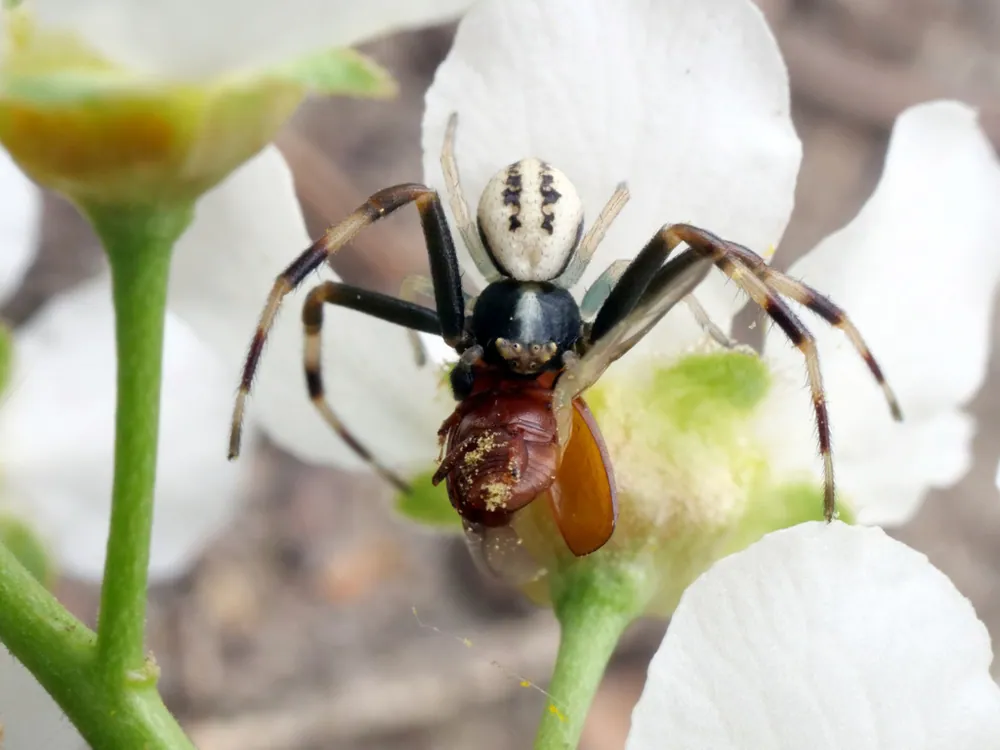
 Uko wayimenya
- Wide, flat, short body that is shaped like a crab.1
- Usually yellow or white, or a pattern of these two colours. It can also be pale green or pink, with white.1
- Females have white or yellow legs. Males are darker, with red or brown outer shells and red and white bands.1
- Holds its first two pairs of legs open, which are the longest, ready to grab prey.1
- Can walk sideways, forwards and backwards.1
Ikunze kwitiranywa na: Mecaphesa asperata is similar in size and shape, but it is light grey to brown with pink stripes on its abdomen and cephalothorax. Diaea crab spiders can be lime green, and some Xysticus and Coriarchne species are brown.1
Imbaraga z'ubumara
Ubumara busohokera mu menyo yayo y'ubumara cyangwa mu yandi menyo iyo iriye.
Ubumara bwayo bukora iki?
Its venom is paralysing, which means it stops prey from moving. The spider injects digestive enzymes with its fangs to break down the insides of its prey. The venom is too weak to harm larger animals.1
Iteje akaga kangana iki ku bantu?
Akaga ku bantu: YorohejeNko guterwa urubori n'uruyuki cyangwa munsi yaho. Mu by'ukuri ntacyo itwaye abantu.This spider is harmless to humans. Its fangs are not strong enough to pierce human skin, and its venom is too weak to harm larger animals.1
 Niba iruma
- Oza aho yarumye kandi uhashyire agapaki k'urubura kubera ububabare. Shaka ubufasha bwa muganga niba ububabare bukabije, bukwirakwira cyangwa umuntu yumva atameze neza.
Buri gihe banza uhamagare nimero y'ubutabazi (112, 000, 911). Izi ni inama rusange z'ubutabazi bw'ibanze, si inama za muganga. Ibanze by'ubutabazi bw'ibanze
 Irinde akaga
- Ntuzigere ukora, ufata cyangwa ushotora inyamaswa yo mu gasozi, nubwo yaba ntoya, kandi nubwo yasa n'isinziriye cyangwa yapfuye.
- Yihe umwanya. Niba uhuye n'imwe, tuza, usubire inyuma buhoro buhoro kandi uyireke yigendere.
- Niba imwe ikurumye: tuza, ntunyeganyege, hamagara nimero y'ubutabazi (112, 000, 911) cyangwa ujye ku bitaro vuba. Ibuka uko yasaga, ifoto irafasha.
Ntigushakisha ngo ikugirire nabi. Ikoresha ubumara bwayo kugira ngo ifate ibyo kurya cyangwa yirinde, kandi ikunda cyane kwihisha. Ibindi ku kwirinda
Ingana gute?
Ireshya ite?
 ntoya ku buryo yakwicara ku nzara yawe
Goldenrod crab spider ingana ite ugereranyije NAWE?
Ni imibare gusa ikorerwa muri mudasobwa yawe. Nta kintu kibikwa cyangwa cyoherezwa ahandi.
Yihuta gute?


Ibintu by'ukuri
Females can change colour from yellow to white, or back again, to match the flower they sit on. This process can take up to 25 days.1
The spider can catch prey much larger than itself, because its paralysing venom works so well.1
Unlike many spiders, it does not wrap its prey in silk. It relies entirely on venom to hold its meals still.1
Females leave silk trails called draglines behind them as they move, and males follow these trails rather than pheromones.1
Females wait on flowers and do not travel far, while males roam over great distances to look for mates.1
Females live longer than males, on average.1
Usenya ibinyoma
Ikinyoma: Because it is a venomous spider with a name like Whitedeath, it is dangerous to people.
Ukuri: The goldenrod crab spider is harmless to humans. Its fangs cannot pierce human skin, and its venom is too weak to harm larger animals.1
Aho ibintu bivugwa bituruka
- Misumena vatia (Wikipedia (CC BY-SA 4.0))
- Misumena vatia (iNaturalist): amazina n'ibyiciro.
- Venom Wiki: urwego rw'akaga, ingano isanzwe n'ikigereranyo cy'umuvuduko ni ibyacu bwite. Reba uko tubibara: Uko tugena akaga.
Buri kintu kivugwa kuri iyi paji gifite nimero yerekana aho cyavuye. Niba twibeshye, tubabarire, turi abakunzi b'inyamaswa, ntituri ikinyamakuru cya siyansi. Tubwire kuri [email protected] tuzabikosora.
 Sikorupiyo irashonje! Venom Wiki ni umushinga w'umuntu umwe: ni ubuntu, nta matangazo kandi nta bikurikirana abantu. Impano ntoya ifasha kugira ngo ikomeze kuboneka kuri interineti.Gaburira sikorupiyo
Izindi zo mu itsinda rimwe: Ibitagangurirwa
 Brown recluse
 Southern black widow
 Mediterranean black widow
 Northern black widow
 Western black widow
 Diving bell spider
Iba kandi muri: Uburayi
 Common European adderVipera na adderBisaba muganga
 Spanish flyIzindi nyamaswa zifite uburoziBisaba mugangaNtukayikoreho
 Common waspInzuki, amavubi n'amavubi maniniIrababaza gusa
 European hornetInzuki, amavubi n'amavubi maniniIrababaza gusa
 Fire salamanderIbikeri by'uburozi, ibikeri binini na newtIrababaza gusaNtukayikoreho
 Western honey beeInzuki, amavubi n'amavubi maniniIrababaza gusa