
 Afrika
 Asia
Asia Yuropu
 Amerika yeKumaodzanyemba
 Australia neOceania
 Antarctica
 Gungwa rePacific
 Gungwa reAtlantic
 Gungwa reIndia
 Gungwa reArctic
 Gungwa reMediterranean
 Gungwa Dzvuku
 Gungwa reCaribbean
 Gungwa reCoral
 Gungwa reChina yeKumaodzanyemba
 Gungwa rePhilippines
 Gungwa reAndaman
 Gungwa reKuchamhembe
 Gungwa reTimor neArafura
 Gungwa reBengal
 Gulf yeCalifornia
Guinea paper wasp
 Inobaya
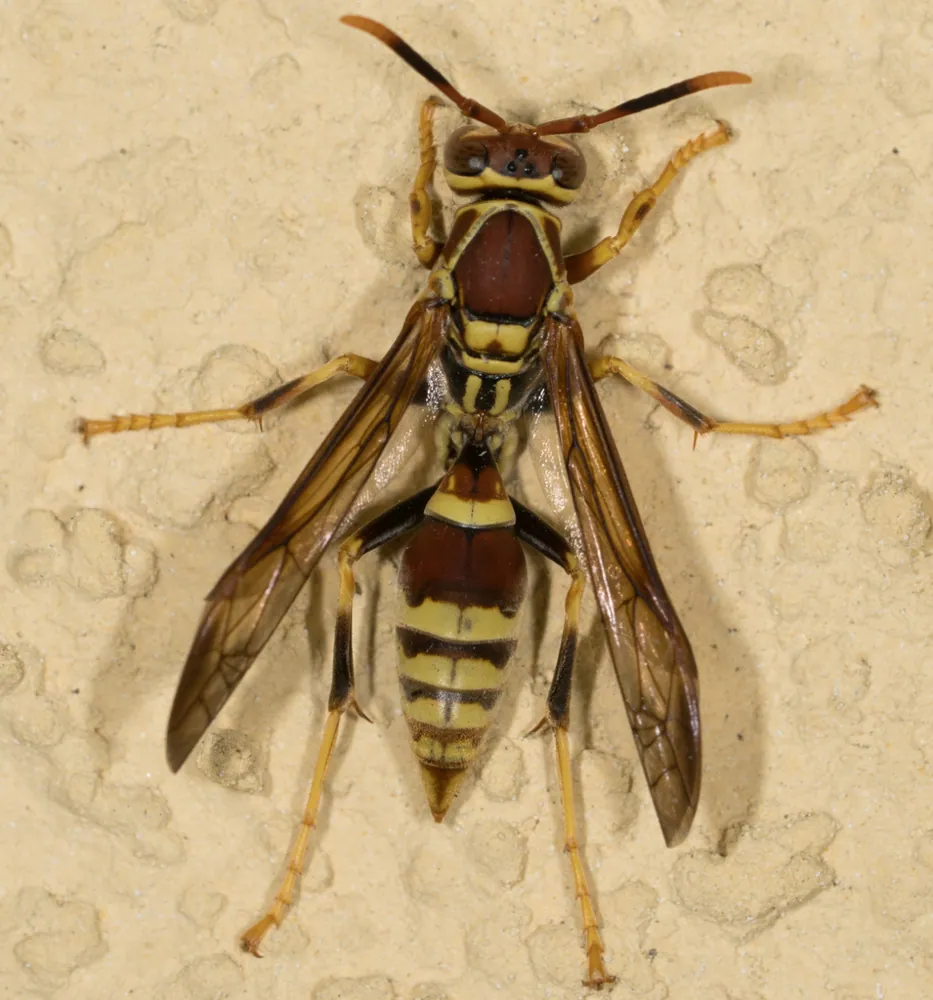
The Guinea paper wasp is a social wasp that builds small, open nests in colonies of up to about one hundred individuals. It lives in parts of North America, including the eastern United States, Ontario in Canada, and Mexico. Its colonies are often found near buildings and other man-made structures.1
 Maziviro ayo
- Typical form: mostly yellow markings on the back of the thorax and the propodeum (the rear part of the thorax), and wings that are purple-tinged rather than yellow.1
- Variable form: red-brown body with dark, almost black, markings on the middle of the antennae, the bases of the abdominal segments and the wings, and pale ivory-white markings spread across the body.1
- Antennae banded with red, black and yellow, unlike most paper wasps, which have only one antenna colour.1
- Females have forewings of 13.0 to 16.5 mm; males have forewings of 12.0 to 15.0 mm.1
- Males have bulging eyes and slender antennae.1
Inowanzovhiringidzwa ne: The typical form is often confused with Polistes fuscatus, Polistes crinitus and Polistes minor.1
Simba reuturu
Uturu hunobuda nerumbori.
Ine ngozi yakadii kuvanhu?
Ngozi kuvanhu: InorwadzaInogona kurwadza chaizvo, asi kazhinji haisi njodzi huru. Kana ikabaya
- Bvisa rumbori rwenyuchi nekurikwenya, wotonhodza panzvimbo iyoyo.
- Kana munhu achinetseka kufema, chiso kana huro zvichizvimba, kana achinzwa kunge ofenda, ndiyo njodzi yeallergy: fonera nhamba yechimbichimbi uye shandisa pen yake yeadrenaline kana anayo.
Gara uchitanga wafonera nhamba yechimbichimbi (112, 000, 911). Iri izano rakajairika rerubatsiro rwekutanga, kwete zano rechiremba. Zvakakosha zverubatsiro rwekutanga
 Gara wakachengeteka
- Usambobata mhuka yesango, kuedza kuitora kana kuinetsa, kunyange iri diki, uye kunyange ichiita seyakarara kana yakafa.
- Ipa nzvimbo. Kana ukasangana nayo, dzikama, dzokera shure zvishoma nezvishoma uirege iende nenzira yayo.
- Kana imwe ikakubaya: dzikama, gara wakanyarara, fonera nhamba yechimbichimbi (112, 000, 911) kana kuti enda kuchipatara nokukurumidza. Rangarira kuti yaitaridzika sei, mufananidzo unobatsira.
Haisi kukutsvaga. Inoshandisa uturu hwayo kubata chikafu kana kuzvidzivirira, uye inotonyanya kuda kuhwanda. Zvimwe pamusoro pekugara wakachengeteka
Yakakura sei?
Yakareba zvakadii?
 ipfupi kupfuura munwe wako mudiki
 inogona kubhururuka ichiyambuka nhandare yose yebhora mumasekondi 15
Guinea paper wasp yakakura sei kana yaenzaniswa NEWE?
Masvomhu chete mubrowser yako. Hapana chinochengetwa kana kutumirwa kupi zvako.
Inomhanya zvakadii?


Chokwadi
Queens survive cold better than workers. In one test at 5 °C over 15 days, 76% of queens survived compared with 17% of workers, partly because they build up sugars that act as antifreeze and a layer of body fat.1
When a queen dies, the oldest female worker becomes the new queen, because the colony ranks its members by age.1
Whether a wasp becomes a worker or a queen is set by the temperature it experiences as an immature wasp.1
Nests are small, usually with fewer than one hundred individuals, so the queen is often the most active wasp in the nest and directly controls the nest's activity.1
Out of six wasp species studied, this was the only one that nested in artificial sites.1
Kwakabva chokwadi
- Polistes exclamans (Wikipedia (CC BY-SA 4.0))
- Polistes exclamans (iNaturalist): mazita nekurongwa kwemhuka.
- Venom Wiki: danho rengozi, saizi yakajairika nekufungidzira kwekumhanya ndezvedu. Ona kuti tinozviwana sei: Matinoyera ngozi.
Chokwadi chimwe nechimwe pane peji rino chine nhamba inoratidza kwachakabva. Kana takakanganisa, ruregerero, tiri vanoda mhuka, kwete magazini yesainzi. Tiudze pa[email protected] tichazvigadzirisa.
 Chinyavada chine nzara! Venom Wiki iprojekiti yemunhu mumwe: yemahara, isina kushambadza uye isina zvinokuteedzera. Chipo chidiki chinobatsira kuti irambe iri paindaneti.Fudza chinyavada
Zvimwe kubva muboka rimwe chete: Nyuchi, mago nemahornet
 Tarantula hawkNyuchi, mago nemahornetInongorwadza
 Executioner waspNyuchi, mago nemahornetInoda chiremba
 Warrior waspNyuchi, mago nemahornetInoda chiremba
 Bald-faced hornetNyuchi, mago nemahornetInongorwadza
 Cow killer velvet antNyuchi, mago nemahornetInongorwadza
 Eastern cicada killerNyuchi, mago nemahornetIsina ngozi
 Terciopelo
 Eastern coral snake
 Eastern diamondback rattlesnake
 Eyelash viper
 Timber rattlesnake
 Western diamondback rattlesnake