
 Afrika
 Asia
Asia Yuropa
 Amerika Borwa
 Australia le Oceania
 Antarctica
 Lewatle la Pacific
 Lewatle la Atlantic
 Lewatle la India
 Lewatle la Arctic
 Lewatle la Mediterranean
 Lewatle le Lefubedu
 Lewatle la Caribbean
 Lewatle la Coral
 Lewatle la China Borwa
 Lewatle la Philippine
 Lewatle la Andaman
 Lewatle la Leboya
 Lewatle la Timor le Arafura
 Kgwohlo ya Bengal
 Kgwohlo ya California
Common rain spider
 Ho loma
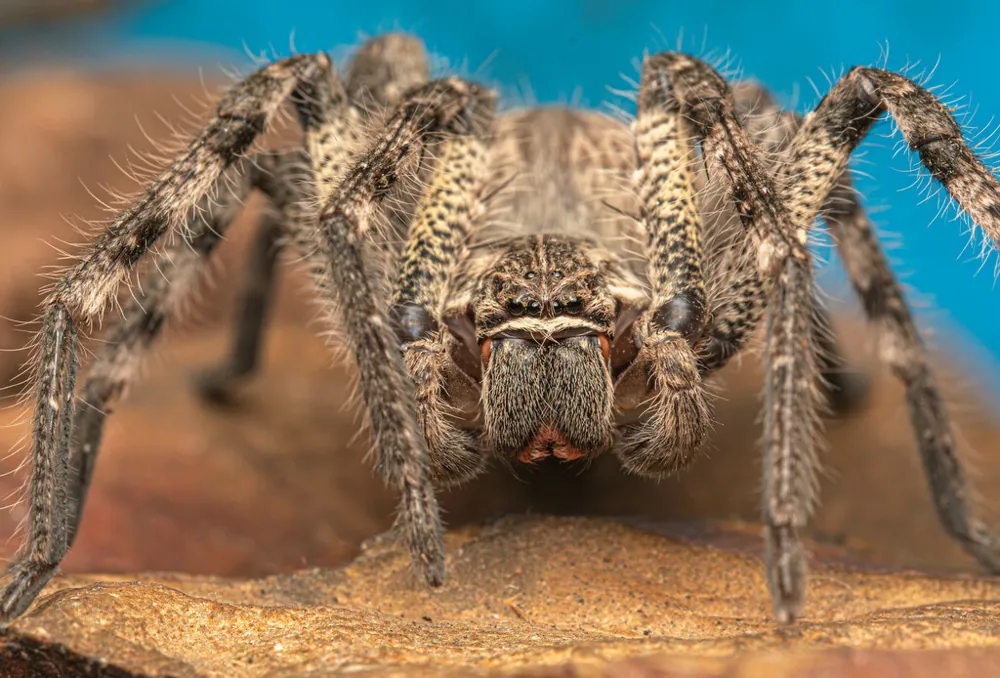
The common rain spider is a large huntsman spider that lives across southern Africa. It often comes indoors, especially before rain, and it hunts geckos. Its size and striking leg markings make it look frightening, but its bite is not dangerous to people.1

 Ho e tseba jwang
- A large huntsman spider. Its body can reach about 4 cm and its legs about 11 cm.1
- Both males and females are roughly the same size.1
- When threatened, it lifts into a threat pose that shows yellow and black bands on the underside of its legs.1
- Females build large round silk egg sacs with twigs and leaves woven in.1
Matla a chefo
Chefo e tswa ka meno a yona a chefo (fangs) kapa ka meno a mang ha e loma.
Chefo ya yona (eo e e kenyang ka ho loma kapa ho hlaba) e etsang?
Its bite causes a burning sensation and swelling. The swelling lasts for a few days. Recovery is spontaneous and complete.1
E kotsi hakae ho batho?
Kotsi ho batho: E bobebeJwaloka ho hlajwa ke notshi kapa ho fetang moo. Ha e na kotsi ho batho.In humans, the bite is no more dangerous than a bee sting. Many gardeners are bitten by protective females guarding their egg sacs.1
E etsang ha e tshohile?
It lifts into a threat pose that shows yellow and black banding on the underside of its legs, and females guard their egg sacs aggressively.1
 Haeba e loma
- Hlatswa moo e lomileng teng mme o bee pakete ya leqhwa hodima teng bakeng sa bohloko. Fumana thuso ya bongaka haeba bohloko bo le matla, bo phatlalla kapa motho a ikutlwa a kula.
Kamehla letsetsa nomoro ya tshohanyetso pele (112, 000, 911). Ena ke tataiso e akaretsang ya thuso ya pele, hase keletso ya bongaka. Metheo ya thuso ya pele
 Dula o bolokehile
- O se ke wa ama, wa tshwara kapa wa tena phoofolo ya naheng, leha e le e nyenyane, le leha e shebahala e robetse kapa e shwele.
- E fe sebaka. Ha o kopana le yona, dula o kgutsitse, kgutlela morao butle mme o e tlohele e tsamaye ka tsela ya yona.
- Haeba e nngwe e o loma: dula o kgutsitse, o se ke wa sisinyeha, letsetsa nomoro ya tshohanyetso (112, 000, 911) kapa o ye sepetlele kapele. Hopola hore e ne e shebahala jwang, foto e a thusa.
Ha e o batle. E sebedisa chefo ya yona ho tshwara dijo kapa ho itshireletsa, mme e kgetha ho ipata. Ho eketsehileng ka ho dula o bolokehile
Hokae lefatsheng?
E kgolo hakae?
E telele hakae?
 e telele jwaloka klipi ya pampiri
 e ka matha metara e 100 ka metsotswana e 210 (motho ya potlakang ka ho fetisisa o hloka 9,6)
Common rain spider e kgolo hakae ha e bapiswa le WENA?
Ke dipalo feela ka hara sebatli sa hao. Ha ho letho le bolokwang kapa le romelwang kae kapa kae.
E potlaka hakae?


Dintlha
Ho senya ditshomo
Tshomo: A guinea pig died within 7 minutes after a rain spider bit it in a 1959 experiment, so the spider's venom must be deadly.
Nnete: Further research on anaesthetised guinea pigs showed the original animal died of shock, not from the venom. In humans, the bite is no more dangerous than a bee sting.1
Bakeng sa ditsebi tsa chefo
- Lebitso la saense
- Palystes superciliosus
- Sehlopha
- Dikgo
- Lelapa
- Sparassidae2
- Tatelano
- Araneae
- Dikontinente
- Afrika
- Masea
- Females lay eggs in a large silk egg sac, about three sacs over their two-year lives. The spiderlings hatch inside the sac and chew their way out about three weeks later.1
- Nako ya bophelo
- e ka bang dilemo tse 21
- Kotsi ho batho
- 1 / 5: E bobebe3
Moo dintlha di tswang teng
- Palystes superciliosus (Wikipedia (CC BY-SA 4.0))
- Palystes superciliosus (iNaturalist): mabitso le tlhophiso.
- Venom Wiki: boemo ba kotsi, boholo bo tlwaelehileng le kakanyo ya lebelo ke tsa rona. Bona kamoo re di balang ka teng: Kamoo re lekanyang kotsi ka teng.
Taba e nngwe le e nngwe leqepheng lena e na le nomoro e bontshang mohlodi wa yona. Haeba re entse phoso, re kopa tshwarelo, re barati ba diphoofolo, hase makasine wa saense. Re bolelle ho [email protected] mme re tla e lokisa.
 Phepheng e lapile! Venom Wiki ke projeke ya motho a le mong: ke mahala, ha e na dipapatso ebile ha e na di-tracker. Thuso e nyenyane ya tjhelete e e boloka e ntse e le inthaneteng.Fepa phepheng
 Mediterranean black widow
 Six-eyed sand spider
 Brown widow
 Noble false widow
 Darwin's bark spider
 Wasp spider
 Black mamba
 Deathstalker
 Egyptian cobra
 Puff adder
 Boomslang
 Fat-tailed scorpion