
 Afrika
 Asia
Asia Yuropa
 Amerika Borwa
 Australia le Oceania
 Antarctica
 Lewatle la Pacific
 Lewatle la Atlantic
 Lewatle la India
 Lewatle la Arctic
 Lewatle la Mediterranean
 Lewatle le Lefubedu
 Lewatle la Caribbean
 Lewatle la Coral
 Lewatle la China Borwa
 Lewatle la Philippine
 Lewatle la Andaman
 Lewatle la Leboya
 Lewatle la Timor le Arafura
 Kgwohlo ya Bengal
 Kgwohlo ya California
Ethiopian mountain adder
 Ho loma
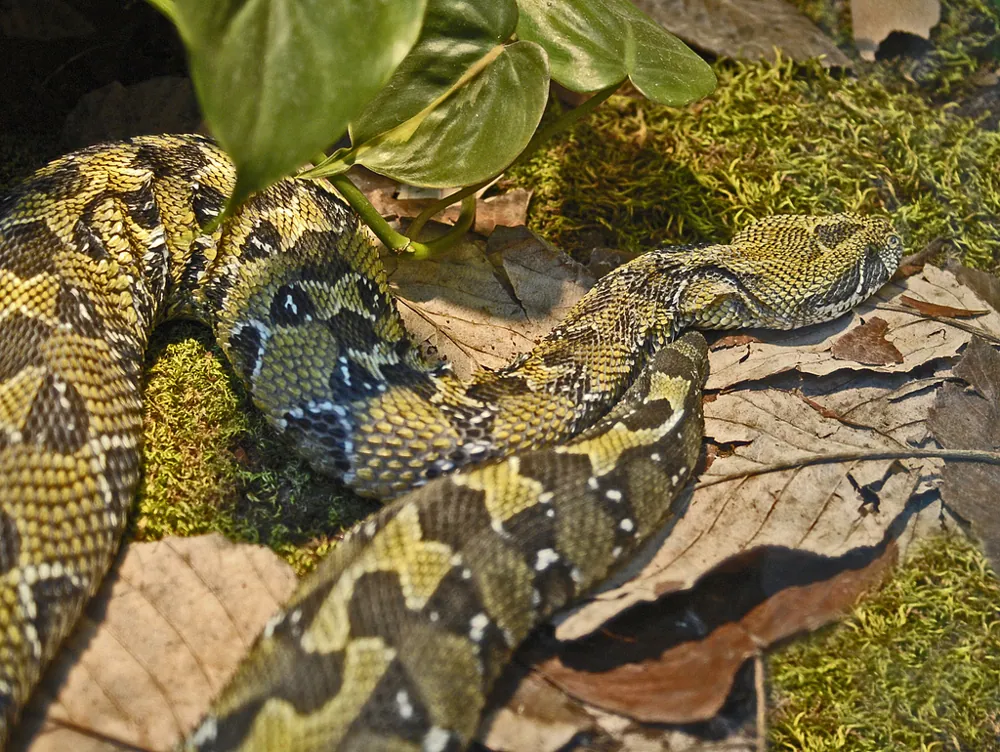
The Ethiopian mountain adder is a large venomous viper that lives only in Ethiopia. It has a broad head and striking geometric patterns along its back. Scientists knew very little about it for many years, and it is still being studied.1
 Ho e tseba jwang
- It is large, with a broad, flat, triangular head that is distinct from its thin neck.1
- A pattern of black hexagons or diamonds runs down the centre of the back, linked by yellow butterfly-shaped markings.1
- Black triangular spots with white centres run down the upper flanks, and greenish-grey triangles with yellow edges sit on the lower flanks.1
- The head is brown with a dark triangle between the eyes and a dark hammer shape behind it.1
- The upper lip scales are white, and the chin and throat are white with black speckling.1
Matla a chefo
Chefo e tswa ka meno a yona a chefo (fangs) kapa ka meno a mang ha e loma.
Chefo ya yona (eo e e kenyang ka ho loma kapa ho hlaba) e etsang?
Its venom was essentially unknown until recently, so its toxicity and make-up are still poorly understood. It is assumed to cause at least some of the bites reported in the densely populated areas where it lives. The venom can be neutralised by SAIMR antivenom.1
E kotsi hakae ho batho?
Kotsi ho batho: E kotsi haholoE ka bolaya motho ya sa fumaneng kalafo.Local people regard it as very dangerous. The only well-documented bite involved a herpetologist from Texas in 2009, who was bitten on the finger by a young captive snake and survived.1
 Ditaba tse monate: dingaka di na le moriana (antivenom) kapa kalafo bakeng sa sena.1
E etsang ha e tshohile?
In the one living specimen studied, it was less irritable than the puff adder and was not inclined to strike, but it hissed when teased and struggled furiously when restrained.1
 Haeba e loma
- Boloka motho a sa sisinyehe ebile a kgutsitse, boloka setho se lomilweng se lekana le bophahamo ba pelo, tlosa mesale le dintho tse tiileng, mme o mo ise sepetlele kapele.
Kamehla letsetsa nomoro ya tshohanyetso pele (112, 000, 911). Ena ke tataiso e akaretsang ya thuso ya pele, hase keletso ya bongaka. Metheo ya thuso ya pele
 Dula o bolokehile
- O se ke wa ama, wa tshwara kapa wa tena phoofolo ya naheng, leha e le e nyenyane, le leha e shebahala e robetse kapa e shwele.
- E fe sebaka. Ha o kopana le yona, dula o kgutsitse, kgutlela morao butle mme o e tlohele e tsamaye ka tsela ya yona.
- Haeba e nngwe e o loma: dula o kgutsitse, o se ke wa sisinyeha, letsetsa nomoro ya tshohanyetso (112, 000, 911) kapa o ye sepetlele kapele. Hopola hore e ne e shebahala jwang, foto e a thusa.
Ha e o batle. E sebedisa chefo ya yona ho tshwara dijo kapa ho itshireletsa, mme e kgetha ho ipata. Ho eketsehileng ka ho dula o bolokehile
Hokae lefatsheng?
E kgolo hakae?
E telele hakae?
 e telele jwaloka dikatse tsa lapeng tse 2,5 ho tloha nkong ho isa mohatleng
 e telele jwaloka dibanana tse 7 tse latellanang
 e ka matha metara e 100 ka metsotswana e 100 (motho ya potlakang ka ho fetisisa o hloka 9,6)
Ethiopian mountain adder e kgolo hakae ha e bapiswa le WENA?
Ke dipalo feela ka hara sebatli sa hao. Ha ho letho le bolokwang kapa le romelwang kae kapa kae.
E potlaka hakae?


Dintlha
The first specimen known to science was a road kill on the east side of the Rift Valley in Ethiopia.1
In 1995, the species was known from only three specimens.1
In 2007, an exporter transported 20 of these snakes to the United States.1
In 2014, the San Diego Zoo became the first U.S. zoo to successfully breed the species in captivity.1
Moo dintlha di tswang teng
- Bitis parviocula (Wikipedia (CC BY-SA 4.0))
- Bitis parviocula (iNaturalist): mabitso le tlhophiso.
- Venom Wiki: boemo ba kotsi, boholo bo tlwaelehileng le kakanyo ya lebelo ke tsa rona. Bona kamoo re di balang ka teng: Kamoo re lekanyang kotsi ka teng.
Taba e nngwe le e nngwe leqepheng lena e na le nomoro e bontshang mohlodi wa yona. Haeba re entse phoso, re kopa tshwarelo, re barati ba diphoofolo, hase makasine wa saense. Re bolelle ho [email protected] mme re tla e lokisa.
 Phepheng e lapile! Venom Wiki ke projeke ya motho a le mong: ke mahala, ha e na dipapatso ebile ha e na di-tracker. Thuso e nyenyane ya tjhelete e e boloka e ntse e le inthaneteng.Fepa phepheng
Tse ding tsa sehlopha se le seng: Di-viper le di-adder
 Puff adderDi-viper le di-adderE a bolaya
 Gaboon viperDi-viper le di-adderE ka bolaya
 Northeast African carpet viperDi-viper le di-adderE a bolaya
 West African carpet viperDi-viper le di-adderE a bolaya
 Rhinoceros viperDi-viper le di-adderE ka bolaya
 West African Gaboon viperDi-viper le di-adderE ka bolaya
 Black mamba
 Deathstalker
 Egyptian cobra
 Boomslang
 Fat-tailed scorpion
 Western honey bee