
 Afrika
 Asia
Asia Yuropa
 Amerika Borwa
 Australia le Oceania
 Antarctica
 Lewatle la Pacific
 Lewatle la Atlantic
 Lewatle la India
 Lewatle la Arctic
 Lewatle la Mediterranean
 Lewatle le Lefubedu
 Lewatle la Caribbean
 Lewatle la Coral
 Lewatle la China Borwa
 Lewatle la Philippine
 Lewatle la Andaman
 Lewatle la Leboya
 Lewatle la Timor le Arafura
 Kgwohlo ya Bengal
 Kgwohlo ya California
Flamboyant cuttlefish
 E a chefa ha e jewa
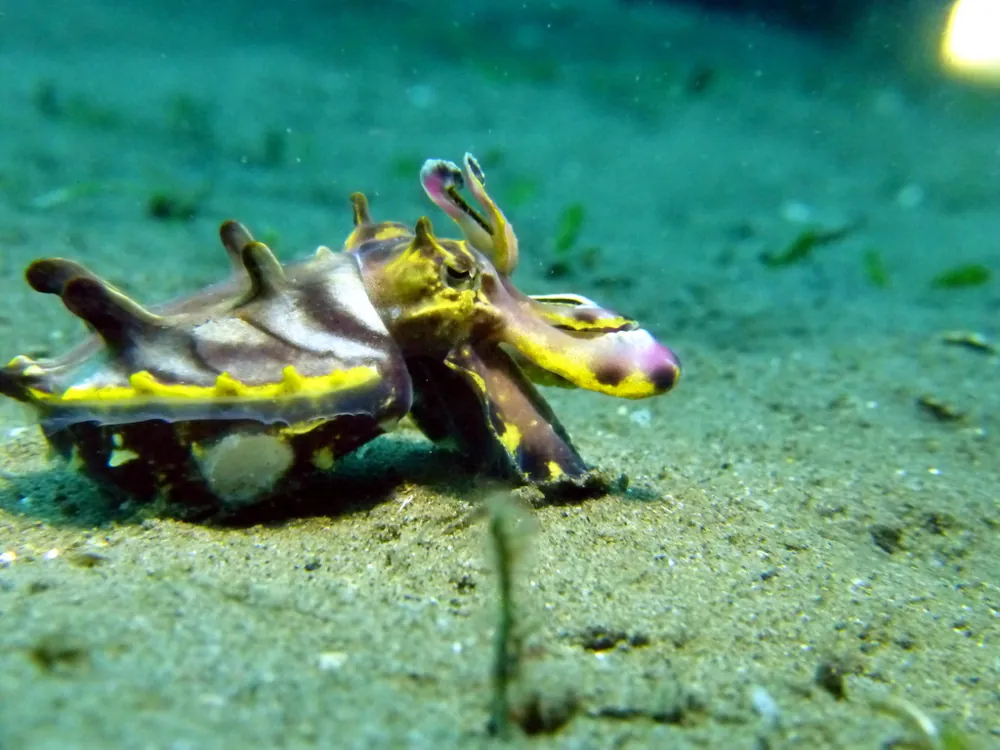
The flamboyant cuttlefish is a small sea creature that can change its colours and patterns in a flash. It lives in shallow tropical waters around northern Australia, New Guinea, the Philippines, Indonesia and Malaysia. It is special because its flesh is poisonous to eat, and it walks along the sea floor instead of swimming.1


 Ho e tseba jwang
- Has a very broad, oval body (mantle) and small, flat, fin-like flaps on the back1
- Broad, blade-like arms with four rows of suckers1
- Normal base colour is dark brown1
- When disturbed, it quickly turns black, dark brown and white, with yellow patches around the body, arms and eyes1
- Arm tips often flash bright red as a warning1
Matla a chefo
E kotsi feela haeba ho na le se e jang.
E kotsi hakae ho batho?
Kotsi ho batho: E bohlokoE ka utlwisa bohloko haholo, empa hoo e batlang e le kamehla ha e kotsi haholo.Its muscle tissue is highly toxic, so eating it can be dangerous.1
E etsang ha e tshohile?
When disturbed or attacked, it changes colour to a dark, high-contrast pattern and shows bright red arm tips to warn off predators. It also walks along the sea floor while waving the wide membranes on its arms.1
 Haeba motho a e amme kapa a e jele
- Pressure immobilisation: phuthela bandeje e tiileng e huduhang (elastiki) hodima moo e lomileng teng ebe o nyolla setho sohle, o se tlame ka splint (lepolanka la ho se tshehetsa), mme o boloke motho a sa sisinyehe ho hang ho fihlela thuso e fihla.
- Octopus e nang le mehele e putswa kapa kgofu ya cone e ka etsa hore motho a emise ho hema a ntse a tsohile: bitsa thuso mme o itokisetse ho mo hemela ka molomo (rescue breaths) ho fihlela ambulense e nka boikarabelo.
Kamehla letsetsa nomoro ya tshohanyetso pele (112, 000, 911). Ena ke tataiso e akaretsang ya thuso ya pele, hase keletso ya bongaka. Metheo ya thuso ya pele
 Dula o bolokehile
- O se ke wa ama, wa tshwara kapa wa tena phoofolo ya naheng, leha e le e nyenyane, le leha e shebahala e robetse kapa e shwele.
- E fe sebaka. Ha o kopana le yona, dula o kgutsitse, kgutlela morao butle mme o e tlohele e tsamaye ka tsela ya yona.
- Haeba o e amme kapa o e jele: o se ke wa hohla mahlo kapa molomo, hlatswa matsoho mme o fumane thuso ya bongaka.
Ha e o batle. Chefo ya yona e teng feela hore ho se be le letho le e jang. Ho eketsehileng ka ho dula o bolokehile
Hokae lefatsheng?
E kgolo hakae?
E telele hakae?
 e telele jwaloka diboloko tsa ho bapala tse 2,5 moleng
 e ka sesa bolelele ba letangwane le leholo la ho sesa (50 m) ka metsotswana e 12
Flamboyant cuttlefish e kgolo hakae ha e bapiswa le WENA?
Ke dipalo feela ka hara sebatli sa hao. Ha ho letho le bolokwang kapa le romelwang kae kapa kae.
E potlaka hakae?

Dintlha
A toxicology report found its muscle tissue highly toxic, making it only the third cephalopod known to be poisonous.1
It is one of the only cuttlefish known to walk on the sea floor. This is because its cuttlebone lacks an outer cone, the part most other cuttlefish use to float.1
A female once laid about a dozen eggs inside an overturned half coconut husk, which kept them safe from fish.1
Its toxin has been compared with that of the blue-ringed octopus, but the strength of that link is disputed.1
Ho senya ditshomo
Tshomo: Its bright arm display means it is a dangerous, deadly poisonous animal.
Nnete: The display is thought to warn predators that its flesh is poisonous. However, significant amounts of toxin have not yet been isolated from this species, and preliminary tests found only trace amounts of tetrodotoxin.1
Bakeng sa ditsebi tsa chefo
- Lebitso la saense
- Metasepia pfefferi
- Sehlopha
- Dikgofu tsa cone le di-octopus
- Lelapa
- Sepiidae2
- Tatelano
- Sepiida
- Dikontinente
- Lewatle la India, Lewatle la Pacific, Lewatle la Coral, Lewatle la Philippine, Lewatle la Timor le Arafura, Mawatle
- Masea
- Eggs are laid one at a time in crevices or on ledges in coral, rock or wood. Hatchlings look like adults and can copy the same camouflage patterns. They receive no care from their parents.1
- Kotsi ho batho
- 2 / 5: E bohloko3
Moo dintlha di tswang teng
- Ascarosepion pfefferi (Wikipedia (CC BY-SA 4.0))
- Metasepia pfefferi (iNaturalist): mabitso le tlhophiso.
- Venom Wiki: boemo ba kotsi, boholo bo tlwaelehileng le kakanyo ya lebelo ke tsa rona. Bona kamoo re di balang ka teng: Kamoo re lekanyang kotsi ka teng.
Taba e nngwe le e nngwe leqepheng lena e na le nomoro e bontshang mohlodi wa yona. Haeba re entse phoso, re kopa tshwarelo, re barati ba diphoofolo, hase makasine wa saense. Re bolelle ho [email protected] mme re tla e lokisa.
 Phepheng e lapile! Venom Wiki ke projeke ya motho a le mong: ke mahala, ha e na dipapatso ebile ha e na di-tracker. Thuso e nyenyane ya tjhelete e e boloka e ntse e le inthaneteng.Fepa phepheng
Tse ding tsa sehlopha se le seng: Dikgofu tsa cone le di-octopus
 Geography coneDikgofu tsa cone le di-octopusE a bolaya
 Greater blue-ringed octopusDikgofu tsa cone le di-octopusE a bolaya
 Southern blue-ringed octopusDikgofu tsa cone le di-octopusE a bolaya
 Blue sea dragonDikgofu tsa cone le di-octopusE utlwisa bohloko feela
 Common octopusDikgofu tsa cone le di-octopusHa e na kotsi
 Giant Pacific octopusDikgofu tsa cone le di-octopusHa e na kotsi
E boetse e phela: Lewatle la India
 Australian box jellyfishDi-jellyfish le diphoofolo tsa lewatle tse hlabangE a bolayaO se ke wa ama
 Hawksbill sea turtleDiphoofolo tse ding tse chefangE ka bolaya
 Irukandji jellyfishDi-jellyfish le diphoofolo tsa lewatle tse hlabangE ka bolayaO se ke wa ama
 Reef stonefishDitlhapi tse nang le chefoE ka bolayaO se ke wa ama
 Crown-of-thorns starfishDi-sea urchin, dinaledi tsa lewatle le dibokoE hloka ngakaO se ke wa ama
 Portuguese man o' warDi-jellyfish le diphoofolo tsa lewatle tse hlabangE hloka ngakaO se ke wa ama