
 Afrika
 Asia
Asia Yuropa
 Amerika Borwa
 Australia le Oceania
 Antarctica
 Lewatle la Pacific
 Lewatle la Atlantic
 Lewatle la India
 Lewatle la Arctic
 Lewatle la Mediterranean
 Lewatle le Lefubedu
 Lewatle la Caribbean
 Lewatle la Coral
 Lewatle la China Borwa
 Lewatle la Philippine
 Lewatle la Andaman
 Lewatle la Leboya
 Lewatle la Timor le Arafura
 Kgwohlo ya Bengal
 Kgwohlo ya California
Gafftopsail catfish
 Meutlwa e nang le chefo
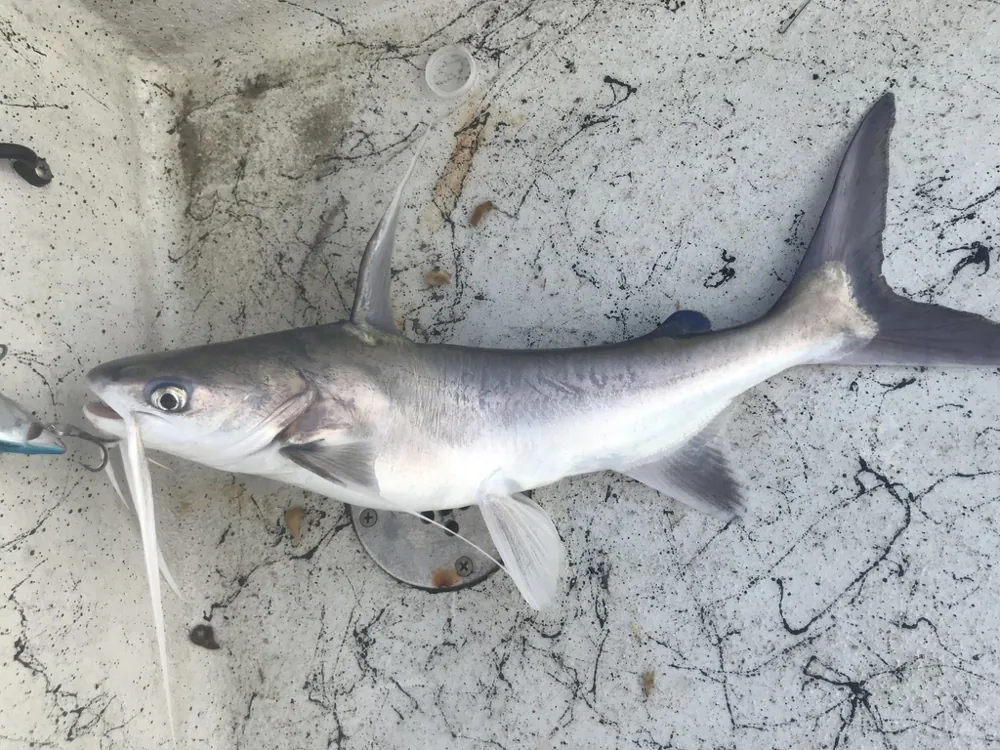
The gafftopsail catfish is a sea catfish with long, venomous spines that can cause painful wounds. It lives in warm coastal waters of the western Atlantic, the Gulf of Mexico and the Caribbean Sea. The male carries the eggs in his mouth until they hatch.1



 Ho e tseba jwang
- Blue-grey to dark brown on the back, with a light grey belly.1
- Deeply forked tail.1
- Long, serrated venomous spines on the pectoral and dorsal fins.1
- A small hump on the back that looks somewhat like a wave.1
- A white or pale blue anal fin, and a fleshy extension on the dorsal spine.1
Hangata e ferekanngwa le: It resembles the hardhead catfish. The gafftopsail can be told apart by the distinctive fleshy extension on its dorsal spine.1
Matla a chefo
Meutlwa e bohale e nka chefo. Ho e hata kapa ho e tshwara ho bohloko.
Chefo ya yona (eo e e kenyang ka ho loma kapa ho hlaba) e etsang?
Its long, serrated spines are venomous and can cause painful wounds.1
E kotsi hakae ho batho?
Kotsi ho batho: E bohlokoE ka utlwisa bohloko haholo, empa hoo e batlang e le kamehla ha e kotsi haholo.The spines can cause painful wounds, so care should be taken when handling this fish.1
 Haeba meutlwa ya yona e o hlaba
- Kenya leqeba metsing a tjhesang, a tjhesang hoo motho a ka a mamellang ntle le ho tjha (a leke ka letsoho la hao pele), metsotso e 30 ho isa ho e 90. Fumana thuso ya bongaka, haholoholo bakeng sa di-stonefish le di-stingray.
Kamehla letsetsa nomoro ya tshohanyetso pele (112, 000, 911). Ena ke tataiso e akaretsang ya thuso ya pele, hase keletso ya bongaka. Metheo ya thuso ya pele
 Dula o bolokehile
- O se ke wa ama, wa tshwara kapa wa tena phoofolo ya naheng, leha e le e nyenyane, le leha e shebahala e robetse kapa e shwele.
- E fe sebaka. Ha o kopana le yona, dula o kgutsitse, kgutlela morao butle mme o e tlohele e tsamaye ka tsela ya yona.
- Haeba meutlwa ya yona e o hlaba: dula o kgutsitse, o se ke wa sisinyeha, letsetsa nomoro ya tshohanyetso (112, 000, 911) kapa o ye sepetlele kapele. Hopola hore e ne e shebahala jwang, foto e a thusa.
Ha e o batle. E sebedisa chefo ya yona ho tshwara dijo kapa ho itshireletsa, mme e kgetha ho ipata. Ho eketsehileng ka ho dula o bolokehile
Hokae lefatsheng?
E kgolo hakae?
E telele hakae?
E boima hakae?
 e telele jwaloka dibanana tse 4 tse latellanang
 e boima jwaloka katse ya lapeng
 e ka sesa bolelele ba letangwane le leholo la ho sesa (50 m) ka metsotswana e 24
Gafftopsail catfish e kgolo hakae ha e bapiswa le WENA?
Ke dipalo feela ka hara sebatli sa hao. Ha ho letho le bolokwang kapa le romelwang kae kapa kae.
E potlaka hakae?
Dintlha
Males carry the eggs in their mouths, and do not feed while they are brooding eggs or young.1
Anglers consider it a strong fighter, and it is attracted to the sound of struggling fish.1
Unlike most catfish, which mainly feed on the bottom, this fish feeds throughout the water column.1
Young fish are about 5 cm long when they hatch from the eggs.1
Bakeng sa ditsebi tsa chefo
- Lebitso la saense
- Bagre marinus
- Sehlopha
- Ditlhapi tse nang le chefo
- Lelapa
- Ariidae2
- Tatelano
- Siluriformes
- Dikontinente
- Lewatle la Atlantic, Kgwohlo ya Mexico, Lewatle la Caribbean, Mawatle
- Masea
- The male keeps up to 55 eggs in his mouth until they hatch, and may keep brooding the young until they are about 10 cm long. Spawning takes place over inshore mudflats from May to August.1
- Kotsi ho batho
- 2 / 5: E bohloko3
Moo dintlha di tswang teng
- Gafftopsail catfish (Wikipedia (CC BY-SA 4.0))
- Bagre marinus (iNaturalist): mabitso le tlhophiso.
- Venom Wiki: boemo ba kotsi, boholo bo tlwaelehileng le kakanyo ya lebelo ke tsa rona. Bona kamoo re di balang ka teng: Kamoo re lekanyang kotsi ka teng.
Taba e nngwe le e nngwe leqepheng lena e na le nomoro e bontshang mohlodi wa yona. Haeba re entse phoso, re kopa tshwarelo, re barati ba diphoofolo, hase makasine wa saense. Re bolelle ho [email protected] mme re tla e lokisa.
 Phepheng e lapile! Venom Wiki ke projeke ya motho a le mong: ke mahala, ha e na dipapatso ebile ha e na di-tracker. Thuso e nyenyane ya tjhelete e e boloka e ntse e le inthaneteng.Fepa phepheng
Tse ding tsa sehlopha se le seng: Ditlhapi tse nang le chefo
 Reef stonefishDitlhapi tse nang le chefoE ka bolayaO se ke wa ama
 Red lionfishDitlhapi tse nang le chefoE hloka ngakaO se ke wa ama
 Estuarine stonefishDitlhapi tse nang le chefoE ka bolayaO se ke wa ama
 Short-tail stingrayDitlhapi tse nang le chefoE ka bolaya
 Striped eel catfishDitlhapi tse nang le chefoE ka bolayaO se ke wa ama
 Bluespotted ribbontail rayDitlhapi tse nang le chefoE hloka ngaka
E boetse e phela: Lewatle la Atlantic
 Hawksbill sea turtleDiphoofolo tse ding tse chefangE ka bolaya
 Portuguese man o' warDi-jellyfish le diphoofolo tsa lewatle tse hlabangE hloka ngakaO se ke wa ama
 Blue sea dragonDikgofu tsa cone le di-octopusE utlwisa bohloko feela
 Greenland sharkDiphoofolo tse ding tse chefangE utlwisa bohloko feela
 Lion's mane jellyfishDi-jellyfish le diphoofolo tsa lewatle tse hlabangE utlwisa bohloko feelaO se ke wa ama
 Common octopusDikgofu tsa cone le di-octopusHa e na kotsi