
 Afrika
 Asia
Asia Yuropa
 Amerika Borwa
 Australia le Oceania
 Antarctica
 Lewatle la Pacific
 Lewatle la Atlantic
 Lewatle la India
 Lewatle la Arctic
 Lewatle la Mediterranean
 Lewatle le Lefubedu
 Lewatle la Caribbean
 Lewatle la Coral
 Lewatle la China Borwa
 Lewatle la Philippine
 Lewatle la Andaman
 Lewatle la Leboya
 Lewatle la Timor le Arafura
 Kgwohlo ya Bengal
 Kgwohlo ya California
Goldenrod crab spider
 Ho loma
The goldenrod crab spider is a small, flat spider that hides on flowers and waits for insects to land nearby. It lives in Europe and North America. It is named for the way it walks, and it can change its colour to match the flower it sits on.1



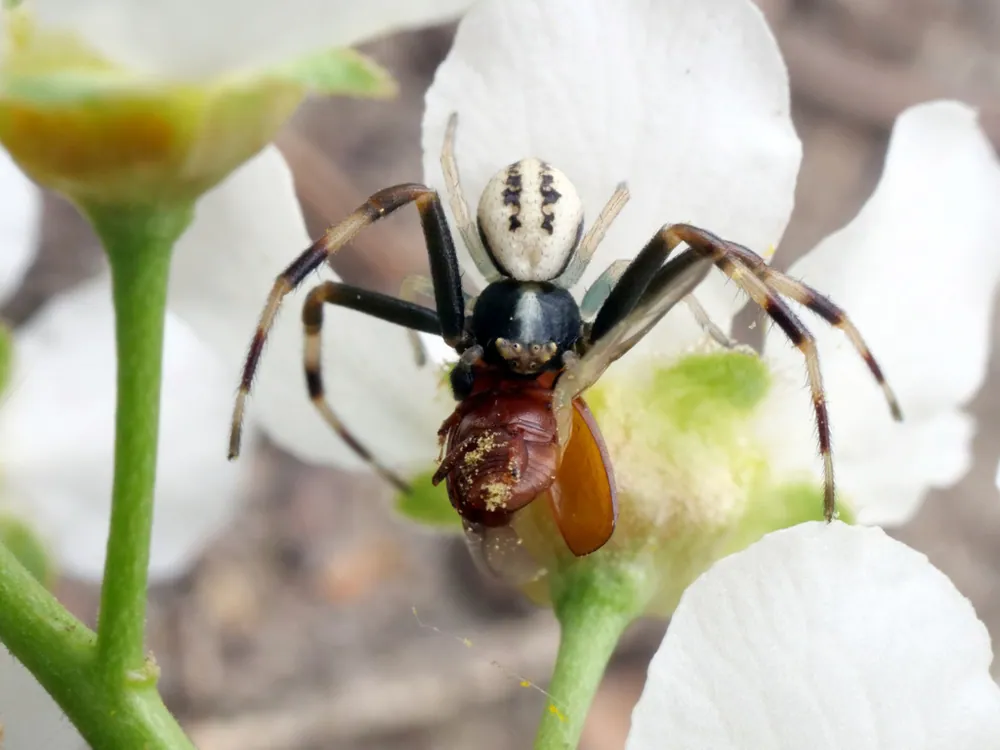
 Ho e tseba jwang
- Wide, flat, short body that is shaped like a crab.1
- Usually yellow or white, or a pattern of these two colours. It can also be pale green or pink, with white.1
- Females have white or yellow legs. Males are darker, with red or brown outer shells and red and white bands.1
- Holds its first two pairs of legs open, which are the longest, ready to grab prey.1
- Can walk sideways, forwards and backwards.1
Hangata e ferekanngwa le: Mecaphesa asperata is similar in size and shape, but it is light grey to brown with pink stripes on its abdomen and cephalothorax. Diaea crab spiders can be lime green, and some Xysticus and Coriarchne species are brown.1
Matla a chefo
Chefo e tswa ka meno a yona a chefo (fangs) kapa ka meno a mang ha e loma.
Chefo ya yona (eo e e kenyang ka ho loma kapa ho hlaba) e etsang?
Its venom is paralysing, which means it stops prey from moving. The spider injects digestive enzymes with its fangs to break down the insides of its prey. The venom is too weak to harm larger animals.1
E kotsi hakae ho batho?
Kotsi ho batho: E bobebeJwaloka ho hlajwa ke notshi kapa ho fetang moo. Ha e na kotsi ho batho.This spider is harmless to humans. Its fangs are not strong enough to pierce human skin, and its venom is too weak to harm larger animals.1
 Haeba e loma
- Hlatswa moo e lomileng teng mme o bee pakete ya leqhwa hodima teng bakeng sa bohloko. Fumana thuso ya bongaka haeba bohloko bo le matla, bo phatlalla kapa motho a ikutlwa a kula.
Kamehla letsetsa nomoro ya tshohanyetso pele (112, 000, 911). Ena ke tataiso e akaretsang ya thuso ya pele, hase keletso ya bongaka. Metheo ya thuso ya pele
 Dula o bolokehile
- O se ke wa ama, wa tshwara kapa wa tena phoofolo ya naheng, leha e le e nyenyane, le leha e shebahala e robetse kapa e shwele.
- E fe sebaka. Ha o kopana le yona, dula o kgutsitse, kgutlela morao butle mme o e tlohele e tsamaye ka tsela ya yona.
- Haeba e nngwe e o loma: dula o kgutsitse, o se ke wa sisinyeha, letsetsa nomoro ya tshohanyetso (112, 000, 911) kapa o ye sepetlele kapele. Hopola hore e ne e shebahala jwang, foto e a thusa.
Ha e o batle. E sebedisa chefo ya yona ho tshwara dijo kapa ho itshireletsa, mme e kgetha ho ipata. Ho eketsehileng ka ho dula o bolokehile
Hokae lefatsheng?
E kgolo hakae?
E telele hakae?
 e nyenyane hoo e ka dulang lenalong la hao
Goldenrod crab spider e kgolo hakae ha e bapiswa le WENA?
Ke dipalo feela ka hara sebatli sa hao. Ha ho letho le bolokwang kapa le romelwang kae kapa kae.
E potlaka hakae?


Dintlha
Females can change colour from yellow to white, or back again, to match the flower they sit on. This process can take up to 25 days.1
The spider can catch prey much larger than itself, because its paralysing venom works so well.1
Unlike many spiders, it does not wrap its prey in silk. It relies entirely on venom to hold its meals still.1
Females leave silk trails called draglines behind them as they move, and males follow these trails rather than pheromones.1
Females wait on flowers and do not travel far, while males roam over great distances to look for mates.1
Females live longer than males, on average.1
Ho senya ditshomo
Tshomo: Because it is a venomous spider with a name like Whitedeath, it is dangerous to people.
Nnete: The goldenrod crab spider is harmless to humans. Its fangs cannot pierce human skin, and its venom is too weak to harm larger animals.1
Moo dintlha di tswang teng
- Misumena vatia (Wikipedia (CC BY-SA 4.0))
- Misumena vatia (iNaturalist): mabitso le tlhophiso.
- Venom Wiki: boemo ba kotsi, boholo bo tlwaelehileng le kakanyo ya lebelo ke tsa rona. Bona kamoo re di balang ka teng: Kamoo re lekanyang kotsi ka teng.
Taba e nngwe le e nngwe leqepheng lena e na le nomoro e bontshang mohlodi wa yona. Haeba re entse phoso, re kopa tshwarelo, re barati ba diphoofolo, hase makasine wa saense. Re bolelle ho [email protected] mme re tla e lokisa.
 Phepheng e lapile! Venom Wiki ke projeke ya motho a le mong: ke mahala, ha e na dipapatso ebile ha e na di-tracker. Thuso e nyenyane ya tjhelete e e boloka e ntse e le inthaneteng.Fepa phepheng
Tse ding tsa sehlopha se le seng: Dikgo
 Brown recluse
 Southern black widow
 Mediterranean black widow
 Northern black widow
 Western black widow
 Diving bell spider
E boetse e phela: Yuropa
 Common European adderDi-viper le di-adderE hloka ngaka
 Spanish flyDiphoofolo tse ding tse chefangE hloka ngakaO se ke wa ama
 Common waspDinotshi, di-wasp le di-hornetE utlwisa bohloko feela
 European hornetDinotshi, di-wasp le di-hornetE utlwisa bohloko feela
 Fire salamanderDihoho tse chefang, mampotsana le di-newtE utlwisa bohloko feelaO se ke wa ama
 Western honey beeDinotshi, di-wasp le di-hornetE utlwisa bohloko feela