
 Afrika
 Asia
Asia Yuropa
 Amerika Borwa
 Australia le Oceania
 Antarctica
 Lewatle la Pacific
 Lewatle la Atlantic
 Lewatle la India
 Lewatle la Arctic
 Lewatle la Mediterranean
 Lewatle le Lefubedu
 Lewatle la Caribbean
 Lewatle la Coral
 Lewatle la China Borwa
 Lewatle la Philippine
 Lewatle la Andaman
 Lewatle la Leboya
 Lewatle la Timor le Arafura
 Kgwohlo ya Bengal
 Kgwohlo ya California
Green lynx spider
 Ho loma
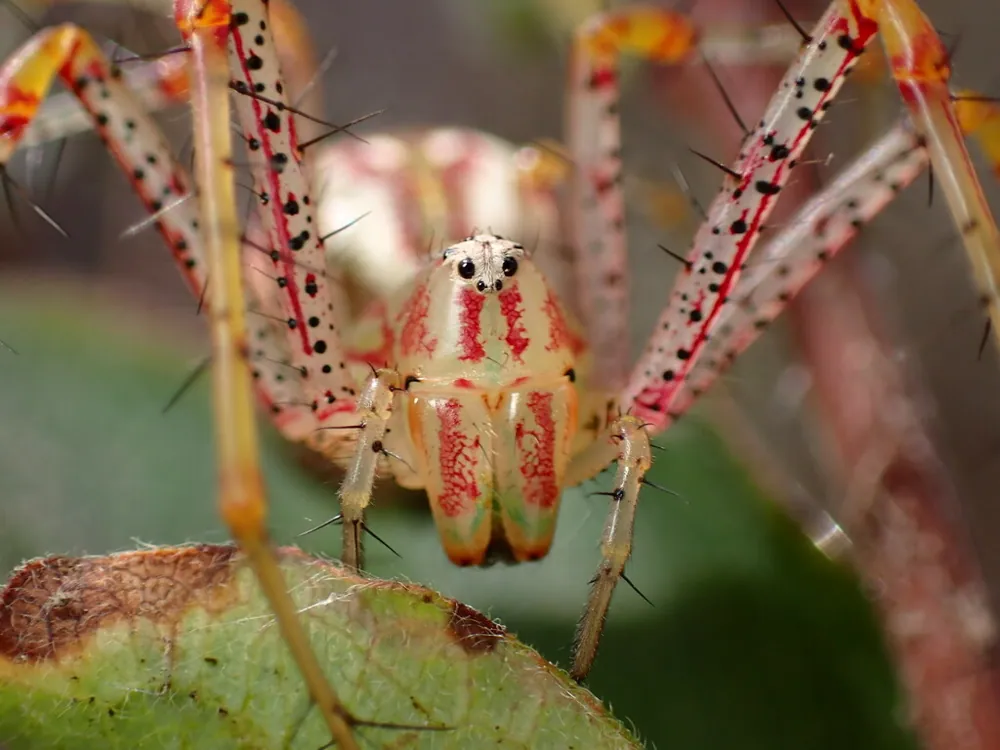
The green lynx spider is a bright green spider that hunts on plants instead of catching prey in a web. It is common in the southern United States, Mexico, Central America and parts of the West Indies. Its bite is painful but not deadly to people.1



 Ho e tseba jwang
- Bright green body, which may turn paler yellow late in the season, sometimes with reddish streaks1
- Often a red patch between the eyes, with a few red spots on the body1
- About six chevron-like marks on the upper surface of the abdomen, with the points facing forward1
- Legs green to yellow, with long black spines and a scattering of black spots1
- Females are larger than males; the male is more slender1
Hangata e ferekanngwa le: Peucetia longipalpis, the other Peucetia species found in the United States, is very similar. It has a shorter, fatter, more domed abdomen, and its markings on the upper surface are less pronounced.1
Matla a chefo
Chefo e tswa ka meno a yona a chefo (fangs) kapa ka meno a mang ha e loma.
Chefo ya yona (eo e e kenyang ka ho loma kapa ho hlaba) e etsang?
Its bite is venomous and painful, but not deadly. In one case the swelling around the bite was 25 mm across and lasted two days. In another case, the swelling was 10 to 20 cm across.1
E kotsi hakae ho batho?
Kotsi ho batho: E bobebeJwaloka ho hlajwa ke notshi kapa ho fetang moo. Ha e na kotsi ho batho.The green lynx spider very seldom bites humans. Its bite is painful but is not deadly.1
E etsang ha e tshohile?
A female guarding her eggs hangs upside down from the egg sac and attacks anything that comes near, and she can squirt venom from her fangs up to about 30 cm.1
 Haeba e loma
- Hlatswa moo e lomileng teng mme o bee pakete ya leqhwa hodima teng bakeng sa bohloko. Fumana thuso ya bongaka haeba bohloko bo le matla, bo phatlalla kapa motho a ikutlwa a kula.
Kamehla letsetsa nomoro ya tshohanyetso pele (112, 000, 911). Ena ke tataiso e akaretsang ya thuso ya pele, hase keletso ya bongaka. Metheo ya thuso ya pele
 Dula o bolokehile
- O se ke wa ama, wa tshwara kapa wa tena phoofolo ya naheng, leha e le e nyenyane, le leha e shebahala e robetse kapa e shwele.
- E fe sebaka. Ha o kopana le yona, dula o kgutsitse, kgutlela morao butle mme o e tlohele e tsamaye ka tsela ya yona.
- Haeba e nngwe e o loma: dula o kgutsitse, o se ke wa sisinyeha, letsetsa nomoro ya tshohanyetso (112, 000, 911) kapa o ye sepetlele kapele. Hopola hore e ne e shebahala jwang, foto e a thusa.
Ha e o batle. E sebedisa chefo ya yona ho tshwara dijo kapa ho itshireletsa, mme e kgetha ho ipata. Ho eketsehileng ka ho dula o bolokehile
Hokae lefatsheng?
E kgolo hakae?
E telele hakae?
 e telele jwaloka klipi ya pampiri
 e ka matha metara e 100 ka metsotswana e 300 (motho ya potlakang ka ho fetisisa o hloka 9,6)
Green lynx spider e kgolo hakae ha e bapiswa le WENA?
Ke dipalo feela ka hara sebatli sa hao. Ha ho letho le bolokwang kapa le romelwang kae kapa kae.
E potlaka hakae?


Dintlha
A female can squirt venom from her fangs for a distance of about 30 cm to defend her eggs.1
A pregnant female can change her colour to match her background, a process that takes about 16 days.1
The green lynx spider is studied for its use in farming, especially pest control in cotton fields.1
Late in the season, the spider can change from green to a paler yellow.1
Its young pass through eight stages of growth, called instars, before reaching adulthood.1
Ho senya ditshomo
Tshomo: The green lynx spider is a deadly spider that often bites people.
Nnete: It very seldom bites humans, and its bite, though painful, is not deadly.1
Bakeng sa ditsebi tsa chefo
Moo dintlha di tswang teng
- Peucetia viridans (Wikipedia (CC BY-SA 4.0))
- Peucetia viridans (iNaturalist): mabitso le tlhophiso.
- Venom Wiki: boemo ba kotsi, boholo bo tlwaelehileng le kakanyo ya lebelo ke tsa rona. Bona kamoo re di balang ka teng: Kamoo re lekanyang kotsi ka teng.
Taba e nngwe le e nngwe leqepheng lena e na le nomoro e bontshang mohlodi wa yona. Haeba re entse phoso, re kopa tshwarelo, re barati ba diphoofolo, hase makasine wa saense. Re bolelle ho [email protected] mme re tla e lokisa.
 Phepheng e lapile! Venom Wiki ke projeke ya motho a le mong: ke mahala, ha e na dipapatso ebile ha e na di-tracker. Thuso e nyenyane ya tjhelete e e boloka e ntse e le inthaneteng.Fepa phepheng
 Brown recluse
 Southern black widow
 Northern black widow
 Western black widow
 Bold jumping spider
 Golden silk orb-weaver
 Terciopelo
 Eastern coral snake
 Eastern diamondback rattlesnake
 Eyelash viper
 Timber rattlesnake
 Western diamondback rattlesnake