
 Afrika
 Asia
Asia Yuropa
 Amerika Borwa
 Australia le Oceania
 Antarctica
 Lewatle la Pacific
 Lewatle la Atlantic
 Lewatle la India
 Lewatle la Arctic
 Lewatle la Mediterranean
 Lewatle le Lefubedu
 Lewatle la Caribbean
 Lewatle la Coral
 Lewatle la China Borwa
 Lewatle la Philippine
 Lewatle la Andaman
 Lewatle la Leboya
 Lewatle la Timor le Arafura
 Kgwohlo ya Bengal
 Kgwohlo ya California
Gwardar
 Ho loma
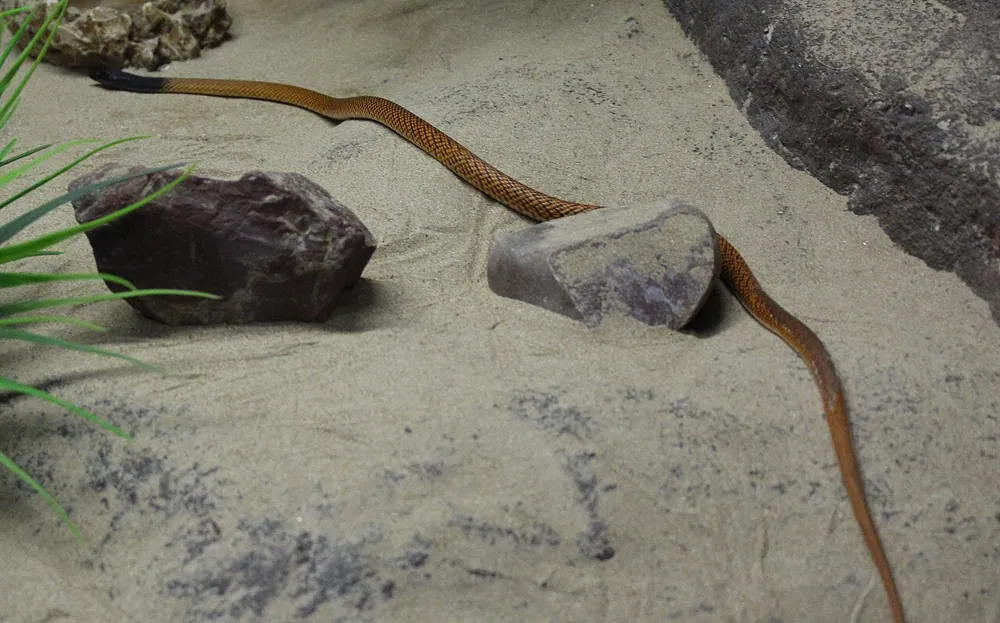
The gwardar, also called Mengden's brown snake or the western brown snake, is a venomous snake found in dry parts of Australia. It is considered dangerously venomous, and its bite can cause severe symptoms that may lead to death.1
 Ho e tseba jwang
- Highly variable in colour, from light brown to almost black1
- Two distinct forms: 'orange with black head' and 'pale head, grey nape'1
- Scales on the head often form a black V or W pattern1
- Cream, yellow, orange or grey belly, often with dark orange or grey blotches1
- Slender body and narrow head, with a large strap-like scale around the front of the snout1
Hangata e ferekanngwa le: It is often confused with the eastern brown snake, which has a pink mouth lining, and the northern brown snake, which has a purplish or blue-black mouth lining. It is also confused with other brown snakes and the black-headed python. Telling species apart reliably requires scale counts, which should only be done by an experienced herpetologist.1
Matla a chefo
Chefo e tswa ka meno a yona a chefo (fangs) kapa ka meno a mang ha e loma.
Chefo ya yona (eo e e kenyang ka ho loma kapa ho hlaba) e etsang?
Its venom is neurotoxic, which attacks the nerves, and haemotoxic, which affects the blood. Its symptoms are severe and potentially fatal.1
E kotsi hakae ho batho?
Kotsi ho batho: E kotsi haholoE ka bolaya motho ya sa fumaneng kalafo.It is considered dangerously venomous. Its bite can cause severe symptoms resulting in death. A scratch from its fangs can still be fatal.1
 Ditaba tse monate: dingaka di na le moriana (antivenom) kapa kalafo bakeng sa sena.1
E etsang ha e tshohile?
When threatened, it raises the front part of its body into an S-shape, lifts its head off the ground and opens its mouth.1
 Haeba e loma
- First aid must be applied and medical attention sought straight away. Brown snake antivenom is the treatment used in case of envenoming.1
- Pressure immobilisation: phuthela bandeje e tiileng e huduhang (elastiki) hodima moo e lomileng teng ebe o nyolla setho sohle, o se tlame ka splint (lepolanka la ho se tshehetsa), mme o boloke motho a sa sisinyehe ho hang ho fihlela thuso e fihla.
- O se ke wa hlatswa moo e lomileng teng: dipetlele di ka hlahloba chefo e setseng letlalong ho kgetha antivenom e nepahetseng.
Kamehla letsetsa nomoro ya tshohanyetso pele (112, 000, 911). Ena ke tataiso e akaretsang ya thuso ya pele, hase keletso ya bongaka. Metheo ya thuso ya pele
 Dula o bolokehile
- O se ke wa ama, wa tshwara kapa wa tena phoofolo ya naheng, leha e le e nyenyane, le leha e shebahala e robetse kapa e shwele.
- E fe sebaka. Ha o kopana le yona, dula o kgutsitse, kgutlela morao butle mme o e tlohele e tsamaye ka tsela ya yona.
- Haeba e nngwe e o loma: dula o kgutsitse, o se ke wa sisinyeha, letsetsa nomoro ya tshohanyetso (112, 000, 911) kapa o ye sepetlele kapele. Hopola hore e ne e shebahala jwang, foto e a thusa.
Ha e o batle. E sebedisa chefo ya yona ho tshwara dijo kapa ho itshireletsa, mme e kgetha ho ipata. Ho eketsehileng ka ho dula o bolokehile
Hokae lefatsheng?
E kgolo hakae?
E telele hakae?
 e telele jwaloka dikatse tsa lapeng tse 4 ho tloha nkong ho isa mohatleng
 e telele jwaloka dibanana tse 11 tse latellanang
 e ka matha metara e 100 ka metsotswana e 48 (motho ya potlakang ka ho fetisisa o hloka 9,6)
Gwardar e kgolo hakae ha e bapiswa le WENA?
Ke dipalo feela ka hara sebatli sa hao. Ha ho letho le bolokwang kapa le romelwang kae kapa kae.
E potlaka hakae?


Dintlha
Moo dintlha di tswang teng
- Pseudonaja mengdeni (Wikipedia (CC BY-SA 4.0))
- Pseudonaja mengdeni (iNaturalist): mabitso le tlhophiso.
- Venom Wiki: boemo ba kotsi, boholo bo tlwaelehileng le kakanyo ya lebelo ke tsa rona. Bona kamoo re di balang ka teng: Kamoo re lekanyang kotsi ka teng.
Taba e nngwe le e nngwe leqepheng lena e na le nomoro e bontshang mohlodi wa yona. Haeba re entse phoso, re kopa tshwarelo, re barati ba diphoofolo, hase makasine wa saense. Re bolelle ho [email protected] mme re tla e lokisa.
 Phepheng e lapile! Venom Wiki ke projeke ya motho a le mong: ke mahala, ha e na dipapatso ebile ha e na di-tracker. Thuso e nyenyane ya tjhelete e e boloka e ntse e le inthaneteng.Fepa phepheng
Tse ding tsa sehlopha se le seng: Dinoha tsa Australia
 Coastal taipan
 Common death adder
 Eastern brown snake
 Taipan ya naheng e kahare
 Noha ya tiger
 Collett's snake
E boetse e phela: Australia le Oceania
 Sydney funnel-web spiderDi-tarantula le di-funnel-webE a bolaya
 Redback spiderDikgoE hloka ngaka
 Brown tree snakeDinoha tse meno a ka moraoE utlwisa bohloko feela
 Hooded pitohuiDiphoofolo tse ding tse chefangE utlwisa bohloko feelaO se ke wa ama
 PlatypusDiphoofolo tse anyesang tse nang le chefoE utlwisa bohloko feela
 Northern tree-dwelling funnel-web spiderDi-tarantula le di-funnel-webE a bolaya