
 Afrika
 Asia
Asia Yuropa
 Amerika Borwa
 Australia le Oceania
 Antarctica
 Lewatle la Pacific
 Lewatle la Atlantic
 Lewatle la India
 Lewatle la Arctic
 Lewatle la Mediterranean
 Lewatle le Lefubedu
 Lewatle la Caribbean
 Lewatle la Coral
 Lewatle la China Borwa
 Lewatle la Philippine
 Lewatle la Andaman
 Lewatle la Leboya
 Lewatle la Timor le Arafura
 Kgwohlo ya Bengal
 Kgwohlo ya California
Moroccan flic-flac spider
 Ho loma
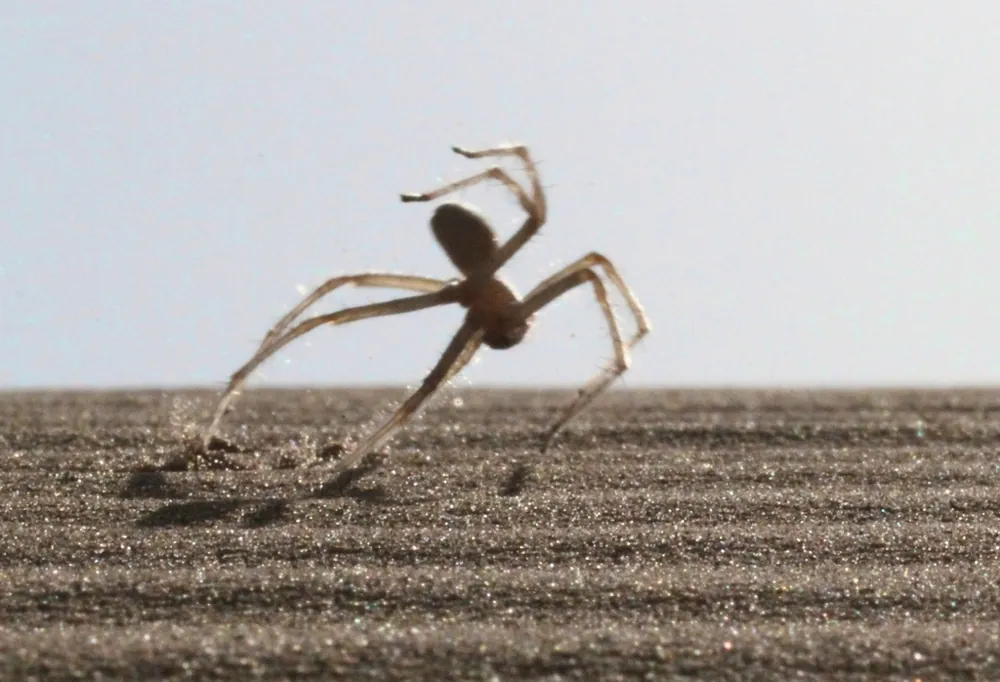
The Moroccan flic-flac spider is a medium-sized huntsman spider that lives in the sand dunes of the Erg Chebbi desert in Morocco. When threatened, it escapes by doing forward or backward flips, like a gymnast's cartwheel. It is the only spider known to move this way.1

 Ho e tseba jwang
- Medium-sized huntsman spider, with males 13.8 to 19.0 mm long and females 19 to 19.5 mm long1
- White body with black scopulae (hair pads) on the underside of its legs1
- Yellow colouring on the upper part of the abdomen and on the femora (the thigh segments of the legs)1
- Active at night, and escapes by flipping forward or backward1
Hangata e ferekanngwa le: It was first confused with the Tunisian spider Cebrennus villosus. Scientists later found small differences in the genitalia of the two species, and the flic-flac movement is distinctive to the Moroccan spider.1
Matla a chefo
Chefo e tswa ka meno a yona a chefo (fangs) kapa ka meno a mang ha e loma.
E kotsi hakae ho batho?
Kotsi ho batho: E bobebeJwaloka ho hlajwa ke notshi kapa ho fetang moo. Ha e na kotsi ho batho.E etsang ha e tshohile?
When provoked or threatened, it flips forward or backward and can double its normal walking speed to escape.1
 Haeba e loma
- Hlatswa moo e lomileng teng mme o bee pakete ya leqhwa hodima teng bakeng sa bohloko. Fumana thuso ya bongaka haeba bohloko bo le matla, bo phatlalla kapa motho a ikutlwa a kula.
Kamehla letsetsa nomoro ya tshohanyetso pele (112, 000, 911). Ena ke tataiso e akaretsang ya thuso ya pele, hase keletso ya bongaka. Metheo ya thuso ya pele
 Dula o bolokehile
- O se ke wa ama, wa tshwara kapa wa tena phoofolo ya naheng, leha e le e nyenyane, le leha e shebahala e robetse kapa e shwele.
- E fe sebaka. Ha o kopana le yona, dula o kgutsitse, kgutlela morao butle mme o e tlohele e tsamaye ka tsela ya yona.
- Haeba e nngwe e o loma: dula o kgutsitse, o se ke wa sisinyeha, letsetsa nomoro ya tshohanyetso (112, 000, 911) kapa o ye sepetlele kapele. Hopola hore e ne e shebahala jwang, foto e a thusa.
Ha e o batle. E sebedisa chefo ya yona ho tshwara dijo kapa ho itshireletsa, mme e kgetha ho ipata. Ho eketsehileng ka ho dula o bolokehile
Hokae lefatsheng?
E kgolo hakae?
E telele hakae?
 e kgutshwane ho feta monwana wa hao o monyenyane
 e ka matha metara e 100 ka metsotswana e 50 (motho ya potlakang ka ho fetisisa o hloka 9,6)
Moroccan flic-flac spider e kgolo hakae ha e bapiswa le WENA?
Ke dipalo feela ka hara sebatli sa hao. Ha ho letho le bolokwang kapa le romelwang kae kapa kae.
E potlaka hakae?


Dintlha
It is the only spider known to use this unusual rolling, flic-flac style of movement.1
It actively flips itself off the ground, so it can move both uphill and downhill, even on a 40 percent incline. Another huntsman spider from the Namib Desert moves by passive cartwheeling instead.1
Its movement inspired a biomimetic robot called Tabbot, about 25 cm long. The name comes from the Berber word 'tabacha', meaning spider.1
It builds long vertical tubes of sand and silk, using its feelers (pedipalps) and bristles.1
Moo dintlha di tswang teng
- Cebrennus rechenbergi (Wikipedia (CC BY-SA 4.0))
- Cebrennus rechenbergi (iNaturalist): mabitso le tlhophiso.
- Venom Wiki: boemo ba kotsi, boholo bo tlwaelehileng le kakanyo ya lebelo ke tsa rona. Bona kamoo re di balang ka teng: Kamoo re lekanyang kotsi ka teng.
Taba e nngwe le e nngwe leqepheng lena e na le nomoro e bontshang mohlodi wa yona. Haeba re entse phoso, re kopa tshwarelo, re barati ba diphoofolo, hase makasine wa saense. Re bolelle ho [email protected] mme re tla e lokisa.
 Phepheng e lapile! Venom Wiki ke projeke ya motho a le mong: ke mahala, ha e na dipapatso ebile ha e na di-tracker. Thuso e nyenyane ya tjhelete e e boloka e ntse e le inthaneteng.Fepa phepheng
 Mediterranean black widow
 Six-eyed sand spider
 Brown widow
 Noble false widow
 Darwin's bark spider
 Wasp spider
 Black mamba
 Deathstalker
 Egyptian cobra
 Puff adder
 Boomslang
 Fat-tailed scorpion