
 Afrika
 Asia
Asia Yuropa
 Amerika Borwa
 Australia le Oceania
 Antarctica
 Lewatle la Pacific
 Lewatle la Atlantic
 Lewatle la India
 Lewatle la Arctic
 Lewatle la Mediterranean
 Lewatle le Lefubedu
 Lewatle la Caribbean
 Lewatle la Coral
 Lewatle la China Borwa
 Lewatle la Philippine
 Lewatle la Andaman
 Lewatle la Leboya
 Lewatle la Timor le Arafura
 Kgwohlo ya Bengal
 Kgwohlo ya California
Peacock spider
 Ho loma
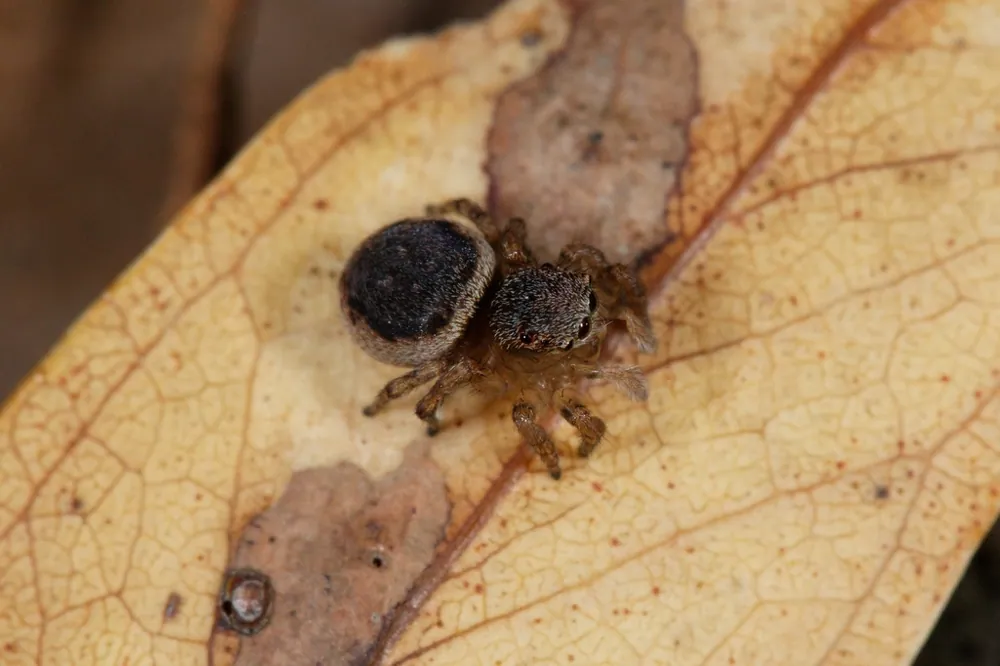
The peacock spider is a tiny jumping spider from Australia. Males are brightly coloured, and they show off with a fan of flaps on their abdomen and a dance to win a female. Its eyesight is so good that it can see ultraviolet light, which helps it hunt.1

 Ho e tseba jwang
- Males are red, blue and black, with flap-like extensions on the abdomen that have white hairs and can be folded down.1
- Females and young spiders are brown, with colour patterns that set them apart from related species.1
- Both sexes reach about 5 mm in body length.1
- The males raise their abdomen and spread the flaps into a white-fringed, circular field of colour during courtship.1
Matla a chefo
Chefo e tswa ka meno a yona a chefo (fangs) kapa ka meno a mang ha e loma.
E kotsi hakae ho batho?
Kotsi ho batho: E bobebeJwaloka ho hlajwa ke notshi kapa ho fetang moo. Ha e na kotsi ho batho. Haeba e loma
- Hlatswa moo e lomileng teng mme o bee pakete ya leqhwa hodima teng bakeng sa bohloko. Fumana thuso ya bongaka haeba bohloko bo le matla, bo phatlalla kapa motho a ikutlwa a kula.
Kamehla letsetsa nomoro ya tshohanyetso pele (112, 000, 911). Ena ke tataiso e akaretsang ya thuso ya pele, hase keletso ya bongaka. Metheo ya thuso ya pele
 Dula o bolokehile
- O se ke wa ama, wa tshwara kapa wa tena phoofolo ya naheng, leha e le e nyenyane, le leha e shebahala e robetse kapa e shwele.
- E fe sebaka. Ha o kopana le yona, dula o kgutsitse, kgutlela morao butle mme o e tlohele e tsamaye ka tsela ya yona.
- Haeba e nngwe e o loma: dula o kgutsitse, o se ke wa sisinyeha, letsetsa nomoro ya tshohanyetso (112, 000, 911) kapa o ye sepetlele kapele. Hopola hore e ne e shebahala jwang, foto e a thusa.
Ha e o batle. E sebedisa chefo ya yona ho tshwara dijo kapa ho itshireletsa, mme e kgetha ho ipata. Ho eketsehileng ka ho dula o bolokehile
Hokae lefatsheng?
E kgolo hakae?
E telele hakae?
 e nyenyane hoo e ka dulang lenalong la hao
Peacock spider e kgolo hakae ha e bapiswa le WENA?
Ke dipalo feela ka hara sebatli sa hao. Ha ho letho le bolokwang kapa le romelwang kae kapa kae.
E potlaka hakae?


Dintlha
Some males can change their scale colours from red to green to violet with slight movements, because their scales reflect light in a special way.1
Peacock spiders can jump up to 40 times their own body length.1
They have eight eyes and can see ultraviolet light as well as the full visible spectrum.1
Males dance and vibrate their abdomen for an average of about 24 minutes to win a female, and the dance can last from 6 to 50 minutes.1
Females of this species are thought to mate only once.1
Ho senya ditshomo
Tshomo: The male spider uses its colourful flaps as wings to help it glide or sustain its leaps.
Nnete: This belief has been debunked by the Australasian Arachnological Society.1
Bakeng sa ditsebi tsa chefo
- Lebitso la saense
- Maratus volans
- Sehlopha
- Dikgo
- Lelapa
- Salticidae2
- Tatelano
- Araneae
- Dikontinente
- Australia le Oceania
- Masea
- Females dig nests underground in December and lay between 6 and 15 eggs per clutch. Some females have several broods in a season.1
- Nako ya bophelo
- e ka bang dilemo tse 11
- Kotsi ho batho
- 1 / 5: E bobebe3
Moo dintlha di tswang teng
- Maratus volans (Wikipedia (CC BY-SA 4.0))
- Maratus volans (iNaturalist): mabitso le tlhophiso.
- Venom Wiki: boemo ba kotsi, boholo bo tlwaelehileng le kakanyo ya lebelo ke tsa rona. Bona kamoo re di balang ka teng: Kamoo re lekanyang kotsi ka teng.
Taba e nngwe le e nngwe leqepheng lena e na le nomoro e bontshang mohlodi wa yona. Haeba re entse phoso, re kopa tshwarelo, re barati ba diphoofolo, hase makasine wa saense. Re bolelle ho [email protected] mme re tla e lokisa.
 Phepheng e lapile! Venom Wiki ke projeke ya motho a le mong: ke mahala, ha e na dipapatso ebile ha e na di-tracker. Thuso e nyenyane ya tjhelete e e boloka e ntse e le inthaneteng.Fepa phepheng
Tse ding tsa sehlopha se le seng: Dikgo
 Redback spider
 Katipo
 White-tailed spider
 Badge huntsman spider
 Black house spider
 Eastern white-tailed spider
E boetse e phela: Australia le Oceania
 Coastal taipanDinoha tsa AustraliaE a bolaya
 Common death adderDinoha tsa AustraliaE a bolaya
 Eastern brown snakeDinoha tsa AustraliaE a bolaya
 Taipan ya naheng e kahareDinoha tsa AustraliaE a bolaya
 Sydney funnel-web spiderDi-tarantula le di-funnel-webE a bolaya
 Noha ya tigerDinoha tsa AustraliaE a bolaya