
 Afrika
 Asia
Asia Yuropa
 Amerika Borwa
 Australia le Oceania
 Antarctica
 Lewatle la Pacific
 Lewatle la Atlantic
 Lewatle la India
 Lewatle la Arctic
 Lewatle la Mediterranean
 Lewatle le Lefubedu
 Lewatle la Caribbean
 Lewatle la Coral
 Lewatle la China Borwa
 Lewatle la Philippine
 Lewatle la Andaman
 Lewatle la Leboya
 Lewatle la Timor le Arafura
 Kgwohlo ya Bengal
 Kgwohlo ya California
White-tailed spider
 Ho loma
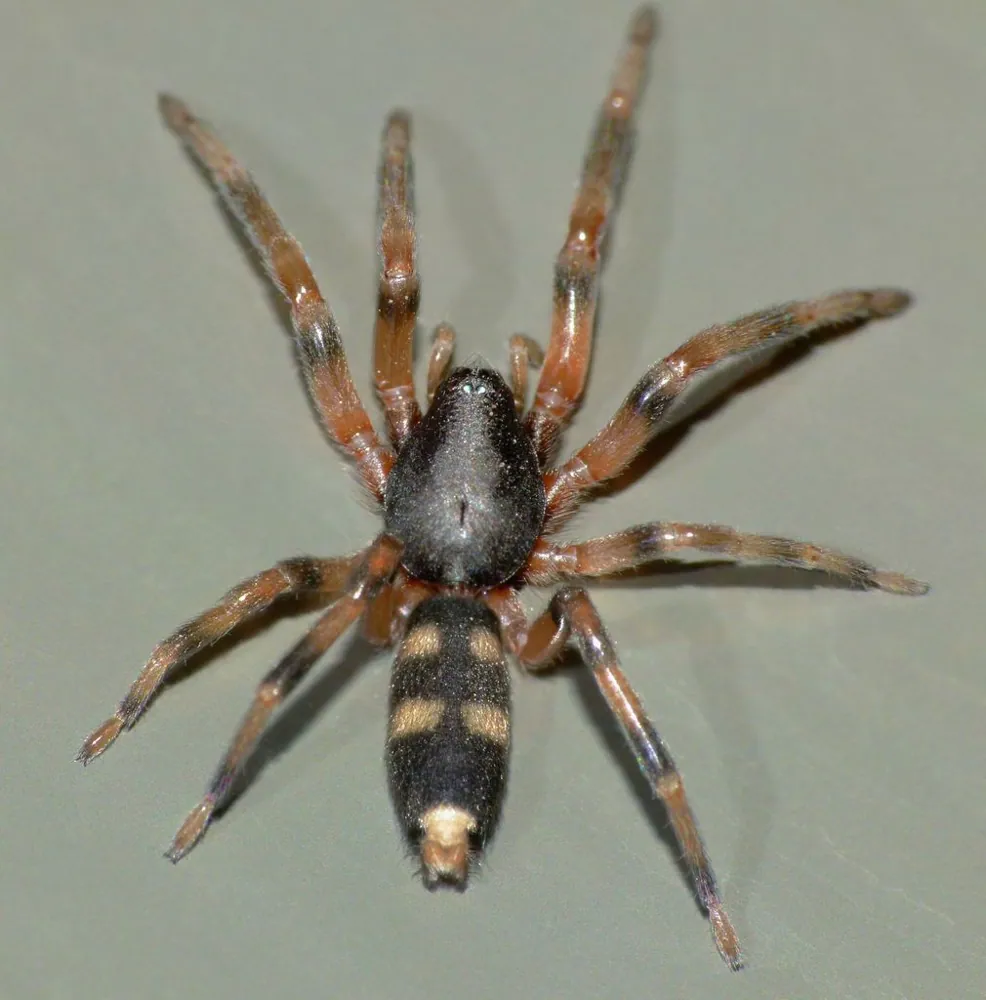
The white-tailed spider is a slim, long-legged spider that lives in southern and eastern Australia. It gets its name from the whitish tip at the end of its abdomen. It hunts other spiders at night rather than spinning a web, and it can bite people.1

 Ho e tseba jwang
- Slender spider with a dark reddish to grey, cigar-shaped body1
- Dark orange-brown legs with bands1
- Grey abdomen with two pairs of faint white spots1
- Usually a distinct white spot at the tip of the abdomen, just above the spinnerets (the silk-producing organs)1
- Does not build a web1
Hangata e ferekanngwa le: Lampona murina is very similar to Lampona cylindrata. The two are not easily told apart without microscopic examination. Several other spider species also have a white mark at the end of the abdomen and are called white-tails.1
Matla a chefo
Chefo e tswa ka meno a yona a chefo (fangs) kapa ka meno a mang ha e loma.
Chefo ya yona (eo e e kenyang ka ho loma kapa ho hlaba) e etsang?
The bite injects venom. Typical effects are a small red or discoloured bump that burns or itches, along with local pain and swelling. Rarely, the bite causes nausea, vomiting, malaise (a general feeling of being unwell) or headache. These symptoms are generally mild and go away over time.1
E kotsi hakae ho batho?
Kotsi ho batho: E bohlokoE ka utlwisa bohloko haholo, empa hoo e batlang e le kamehla ha e kotsi haholo.Bites are generally mild. In a study of 130 confirmed white-tailed spider bites, there were no necrotic ulcers (areas of dead tissue) and no confirmed infections. The effects were mainly local, such as pain, a red mark, swelling and itching.1
 Haeba e loma
- Hlatswa moo e lomileng teng mme o bee pakete ya leqhwa hodima teng bakeng sa bohloko. Fumana thuso ya bongaka haeba bohloko bo le matla, bo phatlalla kapa motho a ikutlwa a kula.
Kamehla letsetsa nomoro ya tshohanyetso pele (112, 000, 911). Ena ke tataiso e akaretsang ya thuso ya pele, hase keletso ya bongaka. Metheo ya thuso ya pele
 Dula o bolokehile
- O se ke wa ama, wa tshwara kapa wa tena phoofolo ya naheng, leha e le e nyenyane, le leha e shebahala e robetse kapa e shwele.
- E fe sebaka. Ha o kopana le yona, dula o kgutsitse, kgutlela morao butle mme o e tlohele e tsamaye ka tsela ya yona.
- Haeba e nngwe e o loma: dula o kgutsitse, o se ke wa sisinyeha, letsetsa nomoro ya tshohanyetso (112, 000, 911) kapa o ye sepetlele kapele. Hopola hore e ne e shebahala jwang, foto e a thusa.
Ha e o batle. E sebedisa chefo ya yona ho tshwara dijo kapa ho itshireletsa, mme e kgetha ho ipata. Ho eketsehileng ka ho dula o bolokehile
Hokae lefatsheng?
E kgolo hakae?
E telele hakae?
 e kgutshwane ho feta monwana wa hao o monyenyane
White-tailed spider e kgolo hakae ha e bapiswa le WENA?
Ke dipalo feela ka hara sebatli sa hao. Ha ho letho le bolokwang kapa le romelwang kae kapa kae.
E potlaka hakae?


Dintlha
Ulcers and tissue death were once blamed on white-tailed spider bites, but studies found other causes, mostly infections.1
In reported bite cases, more than 60% of people said the spider had got into their clothing, towels or bed.1
The two common species look so alike that people once thought there was only one kind of white-tailed spider.1
The white tail marking stays into adulthood, while other markings fade with each moult.1
Lampona murina has lived on New Zealand's North Island for over a hundred years.1
Ho senya ditshomo
Tshomo: White-tailed spider bites cause ulcers and necrosis (dead tissue).
Nnete: A study of 130 bites found no necrotic ulcers or confirmed infections. Ulcers blamed on these spiders were shown to have other causes, mostly infections.1
Bakeng sa ditsebi tsa chefo
Moo dintlha di tswang teng
- White-tailed spider (Wikipedia (CC BY-SA 4.0))
- Lampona cylindrata (iNaturalist): mabitso le tlhophiso.
- Venom Wiki: boemo ba kotsi, boholo bo tlwaelehileng le kakanyo ya lebelo ke tsa rona. Bona kamoo re di balang ka teng: Kamoo re lekanyang kotsi ka teng.
Taba e nngwe le e nngwe leqepheng lena e na le nomoro e bontshang mohlodi wa yona. Haeba re entse phoso, re kopa tshwarelo, re barati ba diphoofolo, hase makasine wa saense. Re bolelle ho [email protected] mme re tla e lokisa.
 Phepheng e lapile! Venom Wiki ke projeke ya motho a le mong: ke mahala, ha e na dipapatso ebile ha e na di-tracker. Thuso e nyenyane ya tjhelete e e boloka e ntse e le inthaneteng.Fepa phepheng
Tse ding tsa sehlopha se le seng: Dikgo
 Redback spider
 Katipo
 Peacock spider
 Badge huntsman spider
 Black house spider
 Eastern white-tailed spider
E boetse e phela: Australia le Oceania
 Coastal taipanDinoha tsa AustraliaE a bolaya
 Common death adderDinoha tsa AustraliaE a bolaya
 Eastern brown snakeDinoha tsa AustraliaE a bolaya
 Taipan ya naheng e kahareDinoha tsa AustraliaE a bolaya
 Sydney funnel-web spiderDi-tarantula le di-funnel-webE a bolaya
 Noha ya tigerDinoha tsa AustraliaE a bolaya