
 Afrika
 Asia
Asia Yuropa
 Amerika Borwa
 Australia le Oceania
 Antarctica
 Lewatle la Pacific
 Lewatle la Atlantic
 Lewatle la India
 Lewatle la Arctic
 Lewatle la Mediterranean
 Lewatle le Lefubedu
 Lewatle la Caribbean
 Lewatle la Coral
 Lewatle la China Borwa
 Lewatle la Philippine
 Lewatle la Andaman
 Lewatle la Leboya
 Lewatle la Timor le Arafura
 Kgwohlo ya Bengal
 Kgwohlo ya California
Phinda button spider
 Ho loma
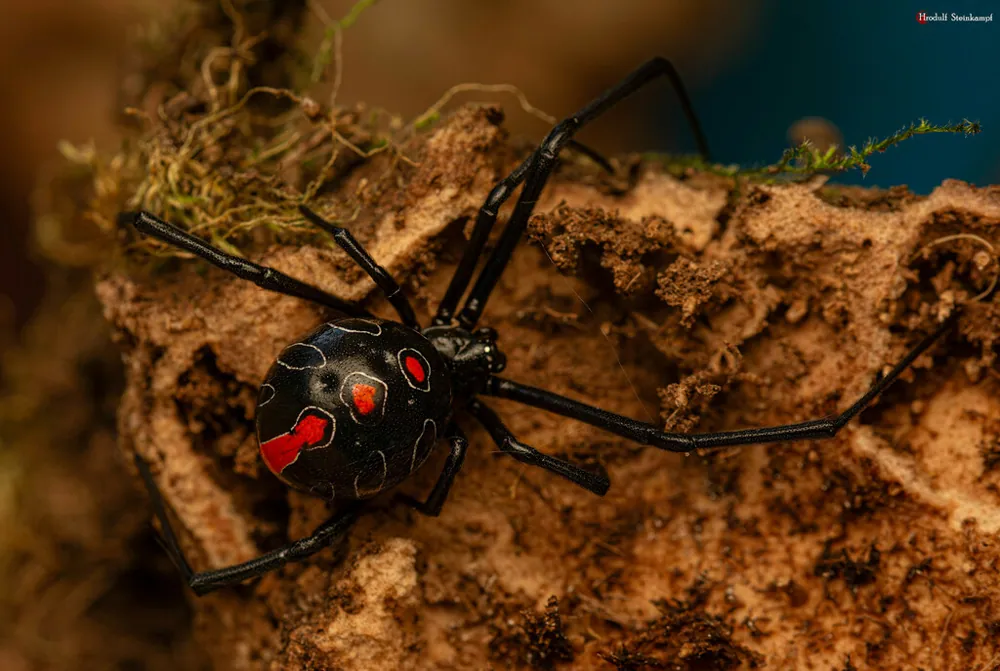
The Phinda button spider is a type of button, or widow, spider. It was formally described as a new species in 2019. It lives only in sand forests in northern Zululand, in South Africa's KwaZulu-Natal province, and is believed to be the largest member of its genus.1
 Ho e tseba jwang
- Females have red markings on both the top and underside of the abdomen, which no other African Latrodectus species has.1
- Males have white markings on the underside of the abdomen, which darken with age.1
- Egg sacs are large and smooth, bright purple when freshly laid, fading to shiny grey as they dry.1
- Webs are not usually found outside the tree hollow. When present, they are typical hackle webs spreading out from the hollow.1
Hangata e ferekanngwa le: Other African button spiders do not have the red markings on both the top and underside of the female abdomen, which is the main feature that sets this species apart.1
Matla a chefo
Chefo e tswa ka meno a yona a chefo (fangs) kapa ka meno a mang ha e loma.
E kotsi hakae ho batho?
Kotsi ho batho: E bohlokoE ka utlwisa bohloko haholo, empa hoo e batlang e le kamehla ha e kotsi haholo. Haeba e loma
- Hlatswa moo e lomileng teng mme o bee pakete ya leqhwa hodima teng bakeng sa bohloko. Fumana thuso ya bongaka haeba bohloko bo le matla, bo phatlalla kapa motho a ikutlwa a kula.
Kamehla letsetsa nomoro ya tshohanyetso pele (112, 000, 911). Ena ke tataiso e akaretsang ya thuso ya pele, hase keletso ya bongaka. Metheo ya thuso ya pele
 Dula o bolokehile
- O se ke wa ama, wa tshwara kapa wa tena phoofolo ya naheng, leha e le e nyenyane, le leha e shebahala e robetse kapa e shwele.
- E fe sebaka. Ha o kopana le yona, dula o kgutsitse, kgutlela morao butle mme o e tlohele e tsamaye ka tsela ya yona.
- Haeba e nngwe e o loma: dula o kgutsitse, o se ke wa sisinyeha, letsetsa nomoro ya tshohanyetso (112, 000, 911) kapa o ye sepetlele kapele. Hopola hore e ne e shebahala jwang, foto e a thusa.
Ha e o batle. E sebedisa chefo ya yona ho tshwara dijo kapa ho itshireletsa, mme e kgetha ho ipata. Ho eketsehileng ka ho dula o bolokehile
Hokae lefatsheng?
E kgolo hakae?
E telele hakae?
 e telele jwaloka klipi ya pampiri
Phinda button spider e kgolo hakae ha e bapiswa le WENA?
Ke dipalo feela ka hara sebatli sa hao. Ha ho letho le bolokwang kapa le romelwang kae kapa kae.
E potlaka hakae?


Dintlha
It is believed to be the largest member of the button spider genus, Latrodectus.1
Its discovery was the first new addition to the genus in 28 years. Before this, 31 button or widow spiders were known, eight of them from Africa.1
Females nest in tree hollows and stumps higher above the ground than most other members of the genus.1
It was first found in 2014 in Tembe Elephant Park, but was only confirmed as a new species in 2019, after live specimens were collected from Phinda reserve.1
One female kept in a laboratory lived for two years until her natural death, and her offspring were also studied.1
Moo dintlha di tswang teng
- Latrodectus umbukwane (Wikipedia (CC BY-SA 4.0))
- Latrodectus umbukwane (iNaturalist): mabitso le tlhophiso.
- Venom Wiki: boemo ba kotsi, boholo bo tlwaelehileng le kakanyo ya lebelo ke tsa rona. Bona kamoo re di balang ka teng: Kamoo re lekanyang kotsi ka teng.
Taba e nngwe le e nngwe leqepheng lena e na le nomoro e bontshang mohlodi wa yona. Haeba re entse phoso, re kopa tshwarelo, re barati ba diphoofolo, hase makasine wa saense. Re bolelle ho [email protected] mme re tla e lokisa.
 Phepheng e lapile! Venom Wiki ke projeke ya motho a le mong: ke mahala, ha e na dipapatso ebile ha e na di-tracker. Thuso e nyenyane ya tjhelete e e boloka e ntse e le inthaneteng.Fepa phepheng
 Mediterranean black widow
 Six-eyed sand spider
 Brown widow
 Noble false widow
 Darwin's bark spider
 Wasp spider
 Black mamba
 Deathstalker
 Egyptian cobra
 Puff adder
 Boomslang
 Fat-tailed scorpion