
 Afrika
 Asia
Asia Yuropa
 Amerika Borwa
 Australia le Oceania
 Antarctica
 Lewatle la Pacific
 Lewatle la Atlantic
 Lewatle la India
 Lewatle la Arctic
 Lewatle la Mediterranean
 Lewatle le Lefubedu
 Lewatle la Caribbean
 Lewatle la Coral
 Lewatle la China Borwa
 Lewatle la Philippine
 Lewatle la Andaman
 Lewatle la Leboya
 Lewatle la Timor le Arafura
 Kgwohlo ya Bengal
 Kgwohlo ya California
Red-bellied black snake
 Ho loma
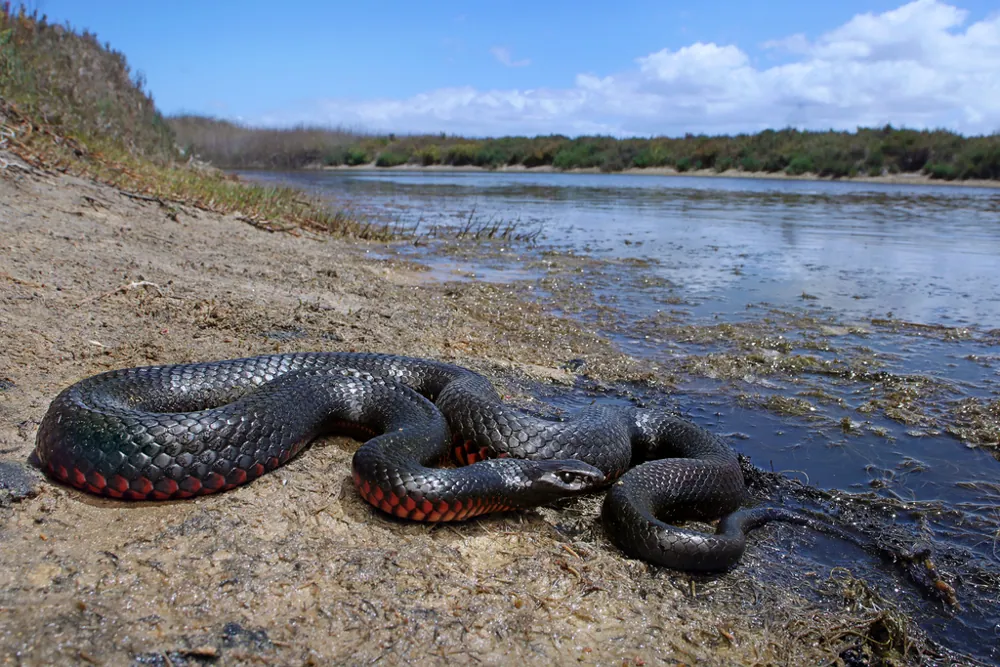
The red-bellied black snake is a venomous snake found along the east coast of Australia, where it is one of the most commonly met snakes. It is glossy black on top, with bright red or orange sides. It often lives near water, and it sometimes turns up in backyards in towns and cities.1



 Ho e tseba jwang
- Glossy black upperparts with a light-grey snout and a completely black tail1
- Bright red or orange flanks that fade to a pink or dull red belly1
- No well-defined neck, so the head merges into the body1
- Adults average about 1.25 m in total length, including the tail1
Hangata e ferekanngwa le: Juveniles look similar to the eastern small-eyed snake, but that species lacks red flanks. Other similar snakes include the blue-bellied black snake and copperheads of the genus Austrelaps.1
Matla a chefo
Chefo e tswa ka meno a yona a chefo (fangs) kapa ka meno a mang ha e loma.
Chefo ya yona (eo e e kenyang ka ho loma kapa ho hlaba) e etsang?
Its venom contains neurotoxins, which attack the nerves, myotoxins, which damage muscle, and coagulants, which affect blood clotting. It also has haemolytic properties, meaning it can break down red blood cells. Bites can cause severe pain, local swelling, prolonged bleeding and local tissue death, especially on a finger. Victims can also lose their sense of smell, and nausea, vomiting, headache, abdominal pain, diarrhoea or heavy sweating can follow.1
E kotsi hakae ho batho?
Kotsi ho batho: E tebilengHo longwa ho hloka ngaka. Lefu le etsahala ka seoelo haholo.No deaths have been recorded from its bite. It is less venomous than many other Australian elapid snakes, but it can still cause significant illness. It accounted for 16% of identified snakebite victims in Australia between 2005 and 2015. Severe local reactions may need surgery or, rarely, amputation.1
E etsang ha e tshohile?
It is not aggressive and usually withdraws. If provoked, it raises its head and front body into a striking stance, widens and flattens its neck, and may bite as a last resort.1
 Haeba e loma
- Pressure immobilisation: phuthela bandeje e tiileng e huduhang (elastiki) hodima moo e lomileng teng ebe o nyolla setho sohle, o se tlame ka splint (lepolanka la ho se tshehetsa), mme o boloke motho a sa sisinyehe ho hang ho fihlela thuso e fihla.
- O se ke wa hlatswa moo e lomileng teng: dipetlele di ka hlahloba chefo e setseng letlalong ho kgetha antivenom e nepahetseng.
Kamehla letsetsa nomoro ya tshohanyetso pele (112, 000, 911). Ena ke tataiso e akaretsang ya thuso ya pele, hase keletso ya bongaka. Metheo ya thuso ya pele
 Dula o bolokehile
- O se ke wa ama, wa tshwara kapa wa tena phoofolo ya naheng, leha e le e nyenyane, le leha e shebahala e robetse kapa e shwele.
- E fe sebaka. Ha o kopana le yona, dula o kgutsitse, kgutlela morao butle mme o e tlohele e tsamaye ka tsela ya yona.
- Haeba e nngwe e o loma: dula o kgutsitse, o se ke wa sisinyeha, letsetsa nomoro ya tshohanyetso (112, 000, 911) kapa o ye sepetlele kapele. Hopola hore e ne e shebahala jwang, foto e a thusa.
Ha e o batle. E sebedisa chefo ya yona ho tshwara dijo kapa ho itshireletsa, mme e kgetha ho ipata. Ho eketsehileng ka ho dula o bolokehile
Hokae lefatsheng?
E kgolo hakae?
E telele hakae?
E boima hakae?

 e telele jwaloka dintja tse 2,5 ho tloha nkong ho isa mohatleng
 e telele jwaloka dibanana tse 14 tse latellanang
 e ka matha metara e 100 ka metsotswana e 46 (motho ya potlakang ka ho fetisisa o hloka 9,6)
Red-bellied black snake e kgolo hakae ha e bapiswa le WENA?
Ke dipalo feela ka hara sebatli sa hao. Ha ho letho le bolokwang kapa le romelwang kae kapa kae.
E potlaka hakae?


Dintlha
It can stay underwater for as long as 23 minutes after fleeing into water.1
Some populations have evolved increased resistance to cane toad toxin in less than 75 years.1
Males of the species may wrestle in ritualised combat in spring, and rarely bite while doing so.1
A male was reported to travel 1,220 m in a single day while roaming for mates in spring.1
In winter it becomes relatively inactive rather than truly hibernating, and groups of up to six have been found under concrete slabs.1
Ho senya ditshomo
Tshomo: The red-bellied black snake is harmless and not venomous, because it has no visible fangs.
Nnete: It is venomous and front-fanged, like all elapid snakes. It is less dangerous than many other Australian species, and no deaths have been recorded from its bite.1
Bakeng sa ditsebi tsa chefo
- Lebitso la saense
- Pseudechis porphyriacus
- Sehlopha
- Dinoha tsa Australia
- Lelapa
- Elapidae2
- Tatelano
- Squamata
- Dikontinente
- Australia le Oceania
- Masea
- It gives birth to live young, usually in February or March, with between eight and 40 young per litter.1
- Nako ya bophelo
- e ka bang dilemo tse 251
- Boemo ba yona naheng
- Least concern (IUCN), although its numbers are thought to be declining1
- Kotsi ho batho
- 3 / 5: E tebileng3
Moo dintlha di tswang teng
- Red-bellied black snake (Wikipedia (CC BY-SA 4.0))
- Pseudechis porphyriacus (iNaturalist): mabitso le tlhophiso.
- Venom Wiki: boemo ba kotsi, boholo bo tlwaelehileng le kakanyo ya lebelo ke tsa rona. Bona kamoo re di balang ka teng: Kamoo re lekanyang kotsi ka teng.
Taba e nngwe le e nngwe leqepheng lena e na le nomoro e bontshang mohlodi wa yona. Haeba re entse phoso, re kopa tshwarelo, re barati ba diphoofolo, hase makasine wa saense. Re bolelle ho [email protected] mme re tla e lokisa.
 Phepheng e lapile! Venom Wiki ke projeke ya motho a le mong: ke mahala, ha e na dipapatso ebile ha e na di-tracker. Thuso e nyenyane ya tjhelete e e boloka e ntse e le inthaneteng.Fepa phepheng
Tse ding tsa sehlopha se le seng: Dinoha tsa Australia
 Coastal taipan
 Common death adder
 Eastern brown snake
 Taipan ya naheng e kahare
 Noha ya tiger
 Collett's snake
E boetse e phela: Australia le Oceania
 Sydney funnel-web spiderDi-tarantula le di-funnel-webE a bolaya
 Redback spiderDikgoE hloka ngaka
 Brown tree snakeDinoha tse meno a ka moraoE utlwisa bohloko feela
 Hooded pitohuiDiphoofolo tse ding tse chefangE utlwisa bohloko feelaO se ke wa ama
 PlatypusDiphoofolo tse anyesang tse nang le chefoE utlwisa bohloko feela
 Northern tree-dwelling funnel-web spiderDi-tarantula le di-funnel-webE a bolaya